



Working With AI at Synthesia

Créez des vidéos IA avec plus de 240 avatars dans plus de 160 langues
I didn't come up through HR. My background is in finance, strategy, and corporate development, and I bring those skills to the people function. Right now, they matter more than ever. As AI compresses the half-life of nearly every role, it challenges not only how teams execute, but how companies hire, develop, and lead. We have to adapt at the pace the company adapts.
At Synthesia, we're focused on utility over novelty: how do we help people use AI in a way that measurably improves speed and quality, without creating tool sprawl, risk, or low-value output? This is a snapshot of how we approach that today.
What we mean by “working with AI”
“Working with AI” doesn’t mean delegating responsibility to a model. It means using AI as a collaborator that can turn rough inputs into structured drafts, compress complexity, generate options to evaluate, help us iterate faster and reduce repetitive work that slows teams down. The person still owns the outcome. We want to raise the ceiling on what one employee (or a small team) can do in a day, and make high-quality work easier to produce.
We’ve experimented with different ways to drive adoption. What works best for us isn’t rewarding “usage.” We’ve used token leadership boards at key moments in time like our company hackathons, but it’s not at the core of how we evaluate our employees or drive adoption, since we also wouldn’t evaluate our salespeople just on how many calls they made or emails they sent.
The principles that make AI adoption actually work
What is working for us is reducing friction and making AI usage feel normal and supported, with clear expectations around quality and safety.
1) Standardize on a small set of tools
When everyone uses different tech, it’s harder to build shared workflows, reuse templates, or and work off a shared knowledge base. Standardization makes AI skills transferable and simplifies governance. We maintain an internal AI tooling hub that clearly lists officially supported tools, provides best practices, and encourages employees to use AI not just for coding but also for planning, documentation, analysis, and communication. We also run knowledge-sharing via Slack and lightning talks to spread practical workflows and highlight wins. Today, we’re mostly using Claude, Notion and Slack as our company-wide AI tools for everyday work.
2) Optimize for outcomes, not activity
It’s easy to accidentally incentivize the wrong thing. We care about impact: faster cycle times, clearer communication, higher quality analysis, fewer bottlenecks, better handoffs and documentation.
We use a simple decision framework internally: Type 1 decisions are important and non-reversible so we deliberate carefully. Type 2 decisions are reversible and day-to-day, so we can move fast and correct as we go. Most AI-assisted work lives in Type 2 territory and the mistake is treating it like Type 1.
A few examples: our engineering team uses Claude Code and CodeGen to compress build cycles. In go-to-market, pre-call customer research is now largely AI-driven. In IT, finance and our people team, more than 70% of support tickets are handled by AI. In content moderation, more than 90% of approvals are automated.
3) Focus on quality over quantity
AI makes it cheaper to produce words, slides, and plans. As our CEO and co-founder Victor Riparbelli recently wrote, we are now in the era of “AI-sloppification” in workplace comms. To counter this, we need to be intentional about how we use LLMs so that they sharpen our thinking and make us more concise, not more verbose. We want concise and sharp content that focuses on what really matters.
4) As agents take routine work, the bar for human ownership rises
Synthesia’s culture demands ownership: fix problems no one asked you to fix, and don’t wait to be unblocked. If routine work gets cheaper, the value of human judgment, initiative, and accountability becomes even more important. We focus a lot more on how someone operates than what they've done. We want to understand how they handle ambiguity, how they make decisions without perfect information and how they react when something breaks.
Learning by doing
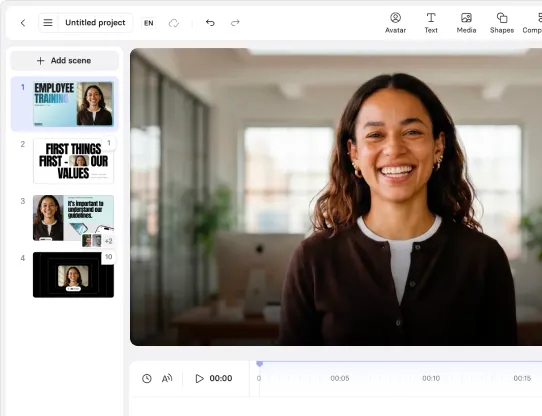
When we talk about “working with AI” internally we also mean drinking our own champagne and using Synthesia to change how we actually learn at work. Most onboarding still relies on static docs, long decks, and live sessions that don't scale. They’re time-consuming to maintain, and they don’t reflect the way people build real confidence, which is by practicing, not just reading.
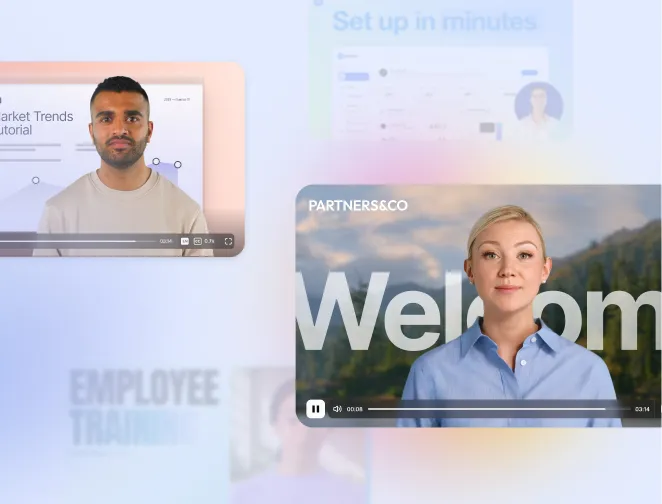
We’ve turned learning from “content” into something closer to simulation: short videos that set context and expectations, paired with interactive, scenario-based modules where someone can rehearse a real moment they’ll face on the job, like a first customer conversation, a manager feedback discussion, or presentation at a conference, and get coached through it. If AI tools make it easier to create training materials, the real win is using that time saved to help people learn by doing, in a format we can update quickly as the organization and the job itself keeps changing.
How we hire for an AI-native culture
AI is changing what "good" looks like in many roles, which means hiring can't rely on a static process. Our talent teams iterate on interview loops frequently, mirroring the teams we support.
On the technical side, we now actively encourage engineers to use AI during interviews. We care less about execution and much more about the reasoning behind it. What trade-offs did you consider? Are you defining the right problem before jumping to a solution? Will customers actually care about this feature, and why?
People sometimes assume AI companies are split between researchers who publish and engineers who ship. That isn't how we operate. Our R&D team is motivated by applying research to real product impact, which means less of a divide between research and engineering than you might expect.
The clearest hiring signal we look for: does someone propose a solution when they ask for feedback, or just surface the problem and wait? Do they step up when they see something broken, or flag it and move on? Those instincts are hard to train. If multiple signals suggest someone waits for approval before moving, they won't thrive here. We're high ownership, high impact, low ego.
At Synthesia, we believe the team you build really is the company you build. If what you just read resonates with you, we’re hiring.