



eLearning Video Production for Training Teams

.webp)
Create engaging training videos in 160+ languages.
eLearning videos can be produced in-house, outsourced to a production partner, or a mix of the two. The best path for you depends primarily on one factor: how often you will need to update the video.
Imagine this. It's Friday afternoon, and the Product team releases an update, changing the interface for Sales reps. By Monday morning, your inbox is full of messages. Your training video, which is live in Salesforce, shows the old steps, and managers have been fielding "where did that button go?" questions.
By the time you're able to produce a new training video with the updated workflow, it's too late. People have already figured it out for themselves, and you've lost their trust in your content.
That's the real challenge with eLearning videos: being able to keep them up to date when things inevitably change.
Types of eLearning videos
If you've been reading up on this subject, you've likely seen a reference to “types” of eLearning videos. Those lists often conflate three things:
- Production methods (how the video is made)
- Instructional approaches (how the video teaches)
- Use cases (what the video is for)
If this is your first time working with eLearning videos, you'll want to separate these out because eLearning videos often mix and match production methods and instructional approaches.
Microlearning often shows up as an instructional approach, but it is really more of a design constraint. It references the length and scope of the learning experience, and importantly, isn't limited to video.
How to scope your eLearning video production
Scoping your eLearning video means answering a series of questions so the project starts with realistic expectations.
Define what the video needs to do
Like all effective training, a well-defined eLearning video begins with a needs assessment.
- Who is your audience (e.g., their roles and levels)?
- What knowledge or skill gap do they need to close?
- How will you evaluate whether you closed that knowledge or skill gap?
Document your answers to these questions in a format like this:
This video is for [specific role] who currently [context or gap]. After watching, [specific role] should be able to [observable action] so that [business outcome].
Anticipate versions and revisions
Most eLearning video projects go off the rails when they don’t anticipate the need for a series, multiple versions, or revisions.
- How many videos will you need to reach your goal (a good rule of thumb is one video per learning objective)?
- How often is the content likely to change (e.g., a perennial onboarding video versus a product feature video)?
- Will you need multiple versions of any video (e.g., videos localized into specific languages and/or adapted for different roles and regions)?
If you need more than one video, document the audience, learning objective, and performance outcome for each.
Set the quality bar
Some eLearning videos just need to get the job done. Others carry higher stakes and need more polish. Consider how polished the video(s) need to be. If you need to ship an internal reference video, that’s likely a different level of polish than a customer-facing training video.
Decide your production path
Now that you’ve scoped your eLearning video, you can decide on your production path. The decision to produce the video in-house or outsource it (or maybe a mix of both) comes down to whether your team has the capacity, capability, and resources to produce and maintain the video.
Let’s say you’re looking to build a series of onboarding videos. You want a structured series that covers the company’s history, mission, vision, and values; employee benefits and perks; and how to get started with your tech. The first two videos will likely stay relevant for a year or more, but the how-to video will change whenever your tech does.
Here’s why you might produce those in-house, outsource them, or do a blend of the two.
Scenario 1: In-house production
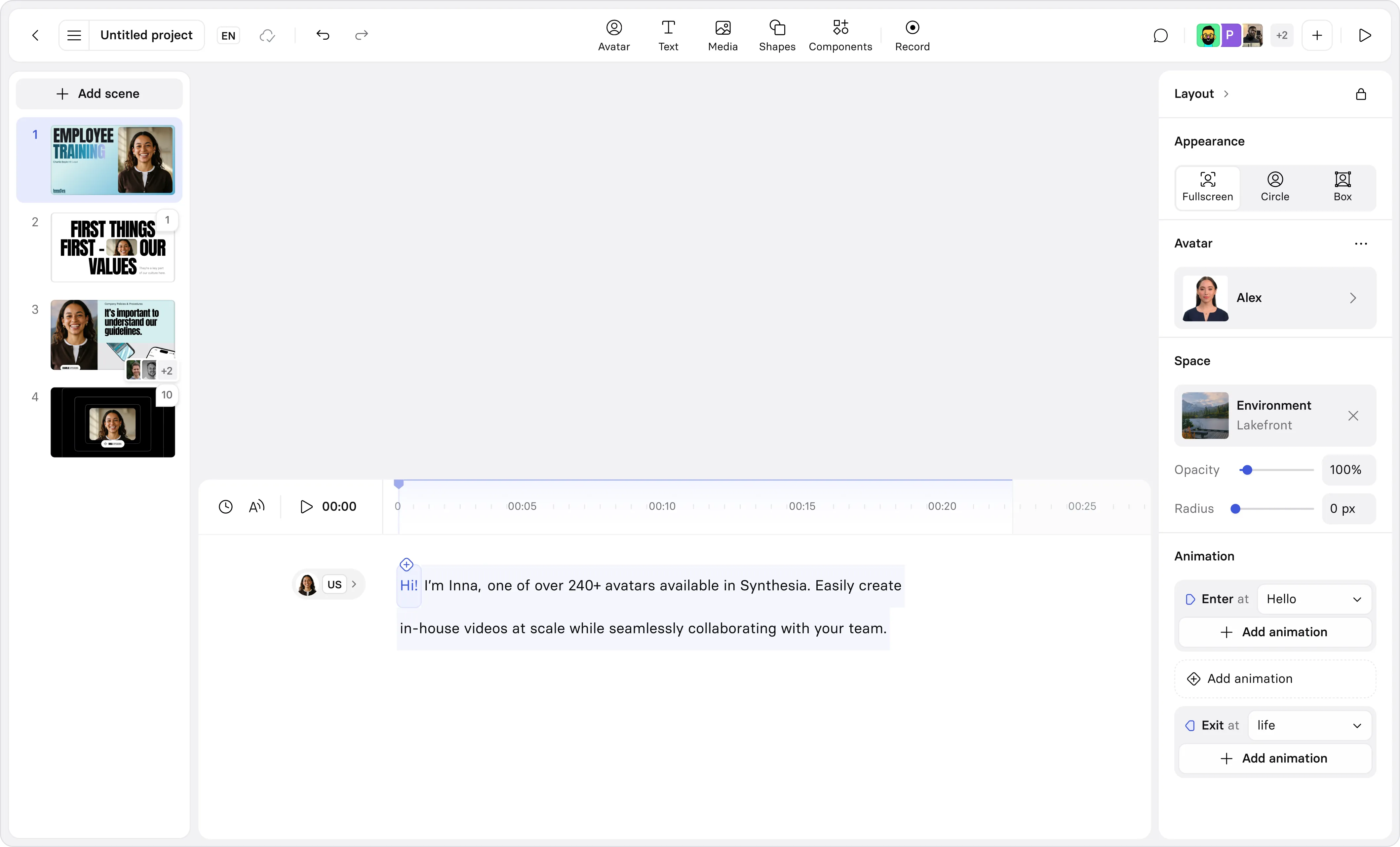
Your L&D budget for tools has room to procure licenses for an AI video platform like Synthesia, but not to work with a production partner. You also have an instructional designer who is skilled in effective video design and has capacity this quarter to build the series and maintain it as things change. It is most cost-effective to acquire a tool and keep production in-house.
Scenario 2: Outsourced production
Your team is swamped, and you need to stand up this onboarding series as soon as possible. Plus, no one on your team has experience designing training videos. You have a budget for a production partner, so you decide to outsource, planning additional funds to maintain the how-to video.
Scenario 3: A mix of the two
You want the first two onboarding videos to feature footage filmed in the office and highlight different executives. You need a traditional video crew to achieve this. You can manage the how-to video in-house because your team has the capacity, capability, and resources to make it work.
How to compare production costs
The cost of video production can vary widely depending on the scope of your project and your production path. Below, I provide a range of estimates from my personal experience, our video production team, and our customers’ results. This is to give you a range to anticipate, not a set of figures to take to your Finance team.
Production partner figures are Synthesia’s estimates of US going rates from our cost of video production guide. The customer example below is a self-reported, published case study. For example, Paragon Skills spent £850 per video working with an external production partner.
Before deciding on a production path, request tailored estimates from production partners and vendors. That’s the only way you’ll get a true understanding of costs (as frustrating as that can be). And remember, maintaining training videos is where costs can really add up, so ask about maintenance too.
How to produce an eLearning video
No matter which production path you choose, producing an eLearning video follows the same general steps. The main variables are who (or what) does the work in each step.
Step 1: Write your script
Use your learning objective and business outcome, plus any available resources, to write a script for your videos. Effective training video scripts are concise, split the cognitive load between what’s on screen and what’s narrated, and are well-structured. Remember, focused videos are effective videos.
You can write a script yourself using an LLM, a free script generator, or a template, or you can have a production partner draft it for you.
Step 2: Plan your scenes
Next, plan your scenes (this is often called storyboarding). A good rule of thumb is one idea per scene. This is when you’ll decide what type of content you want to include, whether that’s screen recordings, demos, interactivity, B-roll, scenarios, assessments, or something else.
If the video needs to be localized, you’ll want to plan for this at this stage. Identify which scenes and components will stay consistent across versions and which may need to be adapted for local contexts.
You can do this the old-fashioned way (with pen and paper, or the modern version, a doc), with an LLM, or with an AI video platform assistant like Synthesia’s. A production partner will typically manage this stage of work.
Step 3: Create your video
When you’ve completed the storyboard, you’ll begin developing your video using the resources available. My recommendation is to be ruthless about cutting anything tangential to your learning outcome. And remember, longer videos can easily be separated into a series. You don’t want to lose your learner.
If you have a production partner, be sure to review drafts before they get too far into the development process. If you plan to maintain the video afterward, you’ll also want to confirm you’ll receive the original project files and that your team has the tools to edit them. If you don’t plan to maintain it, enjoy the bliss of not knowing the nitty-gritty details.
For more detailed step-by-step guidance on creating training videos (with or without AI), see my how-to guide.
Step 4: Publish your video
Plan where your video will live and how you’ll manage revisions. That means deciding which platform hosts it (LMS, knowledge base, etc.), who has access, and who will own updates.
Step 5: Maintain and measure your video
Give the person who owns updates a clear list of what triggers an update to the training video, such as a product release or a policy change. If you outsourced the build, confirm you have the project files and the tools to edit them. An update may also be triggered by measurement, when you realize something isn’t landing the way you expected. Be sure to evaluate your video so you catch those problems early.
Without maintenance and measurement, you’re just building a video library that will quickly go stale. If you’re interested in seeing how Synthesia helps teams maintain their training videos, schedule some time with our team.
Amy Vidor, PhD, is the Learning and Development Evangelist at Synthesia, where she researches learning trends and helps organizations apply AI at scale. With 15 years of experience, she has advised companies, governments, and universities on skills.
Frequently asked questions
How much does eLearning video production cost?
The cost of eLearning video production depends on the scope of the project and your production path. Our estimates of US going rates put a production partner at about $250 to $1,000 per finished minute, or roughly $1,250 to $5,000 for a five-minute video.
Should you produce eLearning videos in-house or outsource them?
The decision comes down to whether your team has the capacity, capability, and resources to produce and maintain the video. Produce eLearning videos in-house if you’re looking for the most cost-effective approach and you have the team capacity. Outsource video production if you have the budget but not the team capability. Many teams outsource the build and maintain it with internal tools.
How do you keep eLearning videos up to date?
You can update eLearning videos without re-recording using text-based editing tools, swappable on-screen graphics, or AI video platforms. Small changes to text, captions, or overlays are easy, while changing footage or adding new narration requires either a reshoot or an AI platform.
How do you localize eLearning videos for global teams?
Localizing an eLearning video means translating the script and adapting the content for the local audience, such as using local idioms or building scenarios around the local market. Plan for localization when you’re storyboarding the video, noting which scenes will remain consistent and which need to change.
How do you measure whether an eLearning video worked?
Measure an eLearning video with a mix of snapshot metrics (completion rates, views) and signals of behavioral change (fewer errors, faster time-to-first-success, fewer support tickets). Go back to your learning objective to decide which signals matter, and collect them consistently over time.
For a one-off video, measure shortly after launch, for example after one week. The Kirkpatrick Model helps you match the depth of evaluation to the decision you need to make.


.webp)