Merck x Synthesia
For the world's oldest pharmaceutical company, the problem was never ideas. It was getting them to more than 60,000 people, across dozens of countries, in their own language. Synthesia changed that — and unlocked something nobody had planned for.
Hundreds of hours
saved annually
Months → days
Production time
60,000+ people
with centralised access
.jpg)


Merck KGaA, Darmstadt, Germany is the oldest pharmaceutical company in the world, founded in 1668. Today, it employs more than 60,000 people globally across three sectors: Healthcare, Life Science, and Electronics.
Merck KGaA, Darmstadt, Germany is the oldest pharmaceutical company in the world, founded in 1668. Today, it employs more than 60,000 people globally across three sectors: Healthcare, Life Science, and Electronics. Transforming how a company this large and this old communicates and trains was a challenge. One that Merck was up for.
The challenge
"Delivering a message to the entire organisation took sometimes even years," says Laura Eckart, Head of Leadership & Feedback Solutions. "You launched it, then you had to roll it out in different languages. There was always a phased approach."
Merck spans dozens of countries and many of its employees don't work in English, so almost every message had to be rebuilt to serve different markets. The usual route was slow and expensive: translation agencies, production studios, and rollouts staged by language, with some regions waiting months behind the English version.
Training had the same problem. For a company-wide quality transformation project touching 20,000 people, every process was documented with its own slide deck. "For highly technical roles, you'd have to click through 200 slides," says Dalia Aydin, Program Lead & Strategic Business Architect. "The way we worked before Synthesia was complex and unstructured."
Video could have helped. But at Merck's scale it was too slow and too expensive to produce, so most communication stayed in PowerPoint. Teams who tried to make their own videos recorded themselves in Teams, restarted on every stumble, and published clips that were "often not brand-compliant," as Florian Metz, Global Head of Analytics & AI Product Portfolio, puts it.
The shift
It started as a small pilot with a handful of users and grew quickly. "We started very small as a pilot and people loved it immediately," says Stefanie Babka, Global Head of Data & AI Culture. "That's how we decided to make Synthesia available for everyone, because we saw how much value it brought to Merck."
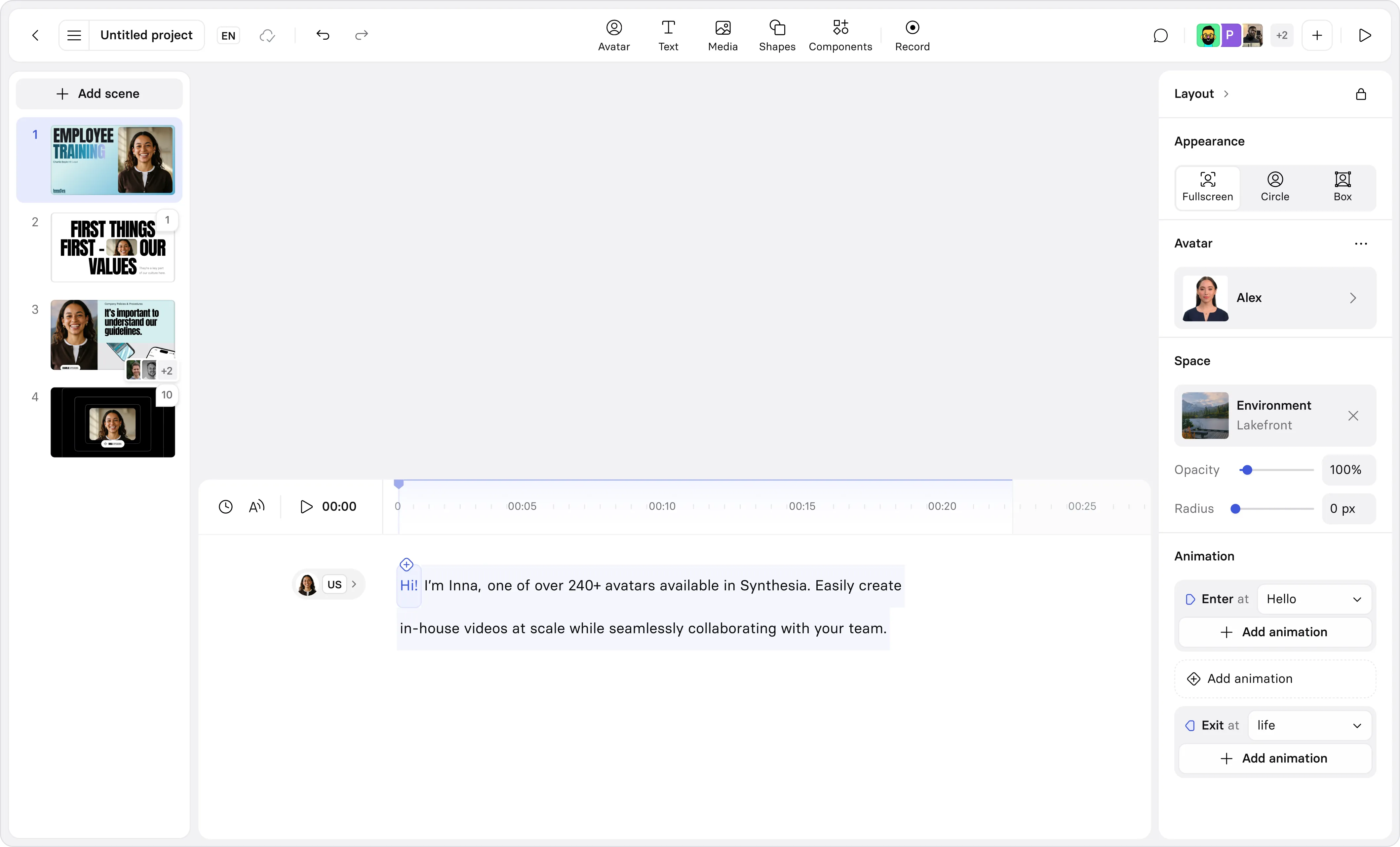
That's why in early 2025, Merck centralized Synthesia into its data and AI ecosystem as an approved tool open to all employees. For a pharmaceutical company, that rested on trust. "Synthesia is GDPR-compliant, and it has the AI governance rules we follow ourselves," says Florian. "We can now do this in-house, on our laptop, without hiring an external agency." Once it could be governed, it could be given to everyone.
The impact
"It's so much more than just creating an Avatar talking over a PowerPoint presentation," says Florian. Across Merck, different teams use the platform in entirely different ways.
At executive conferences, Anna Guenter, Head of Strategic AI Activation, uses Synthesia to close the gap between talking about AI and actually showing it. She had a senior leader's Avatar address the room in Korean and Spanish, in the leader's own voice. "What executives really don't need is another PowerPoint about AI," she says. "What they really need is to experience it. To fully grasp the art of the possible today."
For Dalia's quality program, those 200-slide processes became training videos, built around how people actually learn and scaled across all three sectors. When the team first saw it working, Dalia noticed something shift. "People started to talk about it. We saw great engagement. They were discussing, they were learning."
For Laura's team, the pace of everything changed. When Merck launched an AI coaching tool, she had enablement content ready in nine languages by the time the live sessions ran — so every employee got access on day one. "People always want to receive messages at the same time," she says. Localization that once took weeks now takes minutes, and no region gets left behind. The AI coach's adoption rate climbed as a direct result.
And then there are the things nobody planned for. Product launch videos go out in every market's language using Dubbing — no reshoot required. Field teams in India produce audio content their colleagues listen to on the commute. The accessibility community uses Voiceovers and Subtitles to make content accessible for colleagues with hearing differences.
"We see people who, out of nothing, came up with the idea to create with Synthesia," says Florian. "That's what we see more and more."
That impact wasn't just anecdotal — an internal survey found hundreds of hours saved a year. "For a tool like this," he says, "investing in it is a no-brainer."
Why it matters
Merck never lacked ideas. What it lacked was a fast, governed way to get them to all employees in their own language. One centralized, GDPR-compliant tool removed the constraint and turned video from a slow, expensive exception into something every team reaches for, from the executive stage to the field teams.
For any large, highly-regulated business watching AI tools spread from the ground up, that's the goal. Centralize the right one, govern it properly, and put it in everyone's hands.
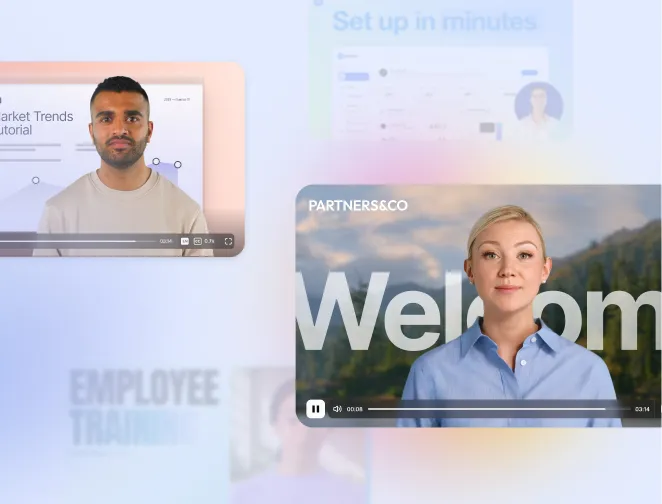
It used to take months to create videos. Now it takes days.
.png)