



5 Benefits of Employee Training and Development


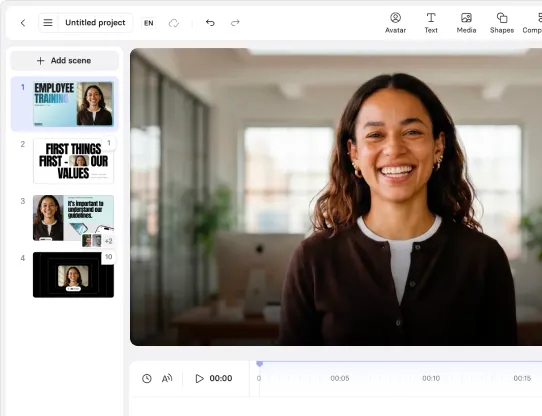
Create engaging training videos in 160+ languages.
I regularly hear from L&D leaders who have been asked to cut their budgets or their teams. They feel like they're constantly having to justify the importance of their work to leadership.
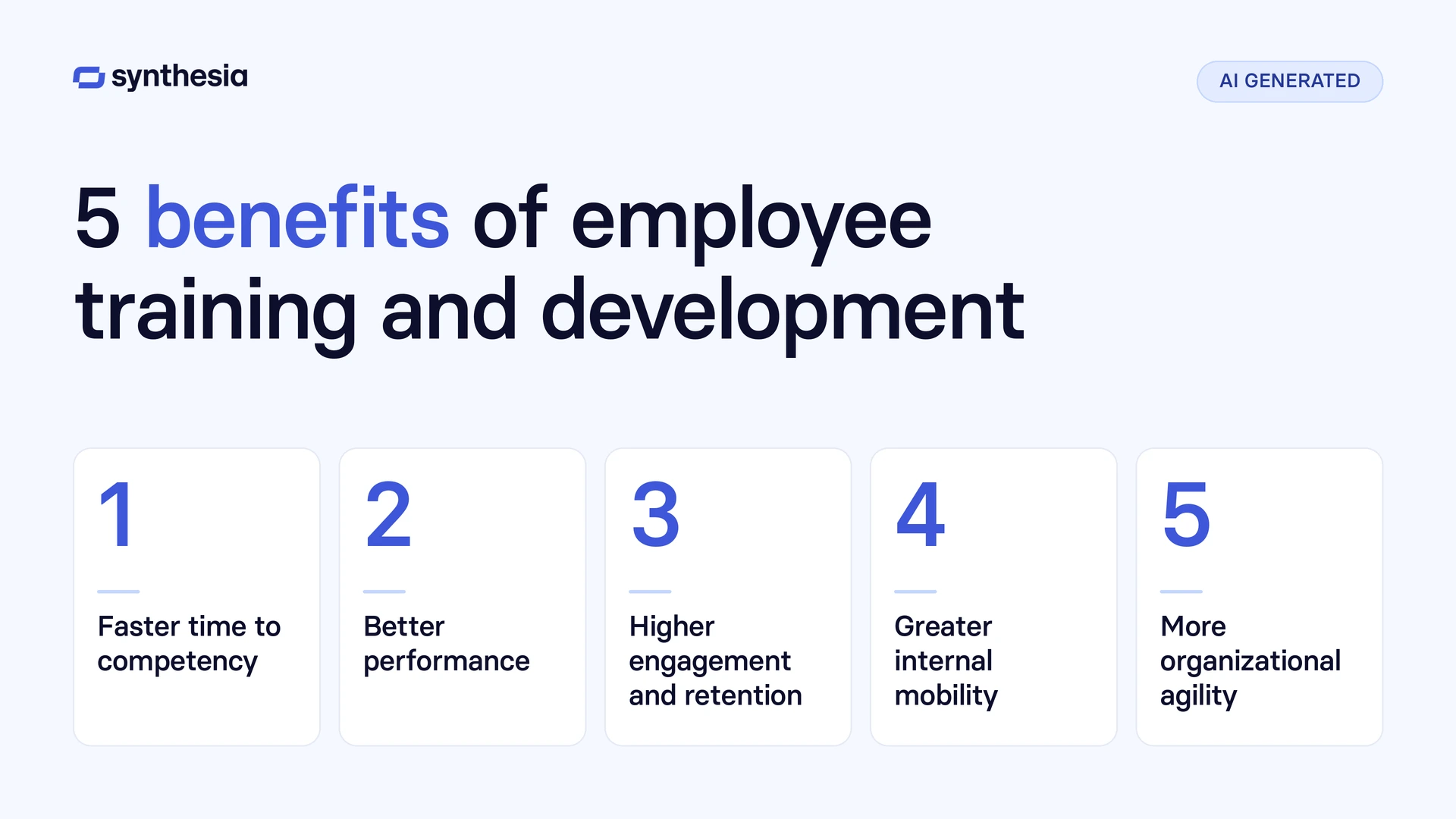
So the next time someone says to you, "Who needs L&D when there's ChatGPT?" here are five data-driven benefits that you can point to: faster time to competency, better performance, higher engagement and retention, greater internal mobility, and more organizational agility.
(And yes, I've had a leader ask me that question.)
1. Faster time to competency
Whether you're onboarding new hires, partners, or customers, you want to get them up to speed as quickly as possible. Time spent ramping is an opportunity cost that businesses are always looking to minimize. I can't tell you the number of times I've been asked by leaders if onboarding is really necessary: "Why can't you just throw them into meetings and let them figure it out?"
A meager 12% of employees strongly agree their organization does a great job of onboarding new hires, and Gallup says that failure weakens the emotional bond new hires form with the company, which can make or break retention. The better the onboarding, the faster the new hire can contribute in their role. A new hire spends less time rooting around for answers and more time learning expectations for the role.
If you're interested in seeing why BD Rowa, a pharmacy automation business within Becton Dickinson, uses training videos to train field technicians and support pharmacy partners, read more below.
2. Better performance
But training doesn't end with onboarding. Companies that invest in their employees' ongoing development see a positive impact on performance (Journal of Management, 2025).
Of course, training employees alone does not lead to better performance. (I think we can all speak to that from personal experience.)
For training to impact behavioral outcomes aligned with business KPIs, it needs to be designed with measurement in mind. Otherwise, you're just churning out content, and adding to the readiness debt, the gap between the skills your employees need and what they can confidently do because of training.
3. Higher engagement and retention
For many Gen Zs, that means an employer that supports their development, and a manager who teaches and mentors them (Deloitte, 2025).
Although the order may change year-over-year, learning and development (often framed as the opportunity for career advancement) is consistently one of the top priorities for younger employees in the workforce. They're looking for an organization that they can grow with, and if their employer doesn't provide that, they may look elsewhere. They want to work somewhere whose values align with theirs.
Gallup estimates US businesses lose $1 trillion annually in voluntary turnover. In over half of attrition cases, exiting employees say the manager or organization could have done something differently so they would've stayed. Instead, companies spend between one-half to two times the employee's annual salary replacing them. Spend your money training employees, not replacing them.
Five Below, a retailer, cut their training production costs 97% while improving learning outcomes. It is possible to be cost-effective and impactful with training.
4. Greater internal mobility
72% of L&D leaders say internal mobility is more important than ever (LinkedIn, 2026). In my opinion, that's largely attributable to AI. We're seeing job descriptions evolve rapidly, and traditional career ladders are starting to collapse.
Today's workforce will likely see their career journeys as "squiggly" (to quote Helen Tupper and Sarah Ellis) or non-linear. Someone may start in one position, develop a new skill they can execute with AI, and end up in a completely new role in the same company. We're already seeing that with the rise of high-impact individual contributors (ICs), and conversations around ICs "managing" AI agents.
By providing opportunities for your employees to develop new skills (whether through formal learning, peer learning in rotations or mentorship pairings, or professional development funds they use at their discretion), you're creating a more agile workforce.
This allows employees to take their institutional knowledge and apply it in ways you never expected. You won't have to hire externally for every critical role. Designing for this flexibility in your training and development is how you build that capacity.
5. More organizational agility
Employers surveyed for the World Economic Forum's Future of Jobs Report expect 39% of workers' core skills to change by 2030.
That means over a third of the skills your employees have today are likely to change. But which skills? That's up to you to figure out.
Only 14% of companies surveyed by LinkedIn have the infrastructure to continuously identify skill gaps and mobilize their talent (through training and enablement) in response. These companies know they can't predict the future, but they can build a capability that better anticipates skill gaps and works to close them. That's a massive advantage.
Companies with this capability are more confident in their profitability, recruitment and retention, and ability to align talent to shifting priorities. Investing in your employees' learning and development is how a business keeps performing as skills change.
If you want to see how Synthesia can help you build a more agile function, like we did for Xponential Fitness, book a demo.
Amy Vidor, PhD, is the Learning and Development Evangelist at Synthesia, where she researches learning trends and helps organizations apply AI at scale. With 15 years of experience, she has advised companies, governments, and universities on skills.
Frequently asked questions
What are the benefits of employee training and development?
The five main benefits of employee training and development are faster time to competency, better performance, higher engagement and retention, greater internal mobility, and more organizational agility.
There are innumerable benefits I could cover, including the value of learning for learning's sake.
How does employee training improve retention?
Employee training supports retention by showing employees that their organization invests in their growth. Employees, especially Gen Zs and millennials, are looking for jobs that invest in their development, according to Deloitte's 2025 Gen Z and Millennial Survey.
This doesn't necessarily mean rapid career advancement. It means a company whose leadership and management actively considers ways to support their growth. If employees are unsatisfied with their development opportunities, they may look for another opportunity.
What is the difference between employee training and development?
Training is time-bound; there's a start and an end. Training can be about building a skill or transferring knowledge, but it's done within the constraints of a course, session, or other "container."
Development is ongoing. It's about supporting people throughout their time at an organization, ensuring they have the capabilities needed to perform, as well as advance or take on new and unforeseen challenges for the business.
Why is employee training important?
Employee training is essential for organizational agility. Employers surveyed for the World Economic Forum's Future of Jobs Report expect 39% of workers' core skills to change by 2030.
For companies to keep up with those changes, they'll need to invest in developing their employees. Otherwise, they may face higher attrition, along with higher recruiting and replacement costs.