



How to Write a Video Script (+ Free Template)

Create AI videos with 240+ avatars in 160+ languages
Creating videos is no easy task, but a good video script can provide a solid foundation to make it easier. But before you start writing a video script, you should take time for some deep, creative thinking.
Yes, you are probably tempted to cut right to the chase, write the script, and film the video. But trust me, these 5 pre-writing steps are essential if you want your video to actually make sense.
Here's my step-by-step guide to writing a video script.
Step 1: Define your audience and goal
The first step in writing a video script is understanding your audience and clearly defining the goal of your video.
Let's take each of those separately.
To understand your audience, ask yourself these questions:
- What is their current level of knowledge of your video topic?
- What problems do they have and are they trying to solve?
- Where and how will they be watching your video?
To ensure that you are clear on the goal of your video, I suggest you start with a high-level goal of either educate, persuade, or instruct.
Next, define your video's success metrics, which might be completion rates, engagement (e.g. average watch time), or conversions.
If you're going for conversions, then you should also determine what your call-to-action will be.
I typically aim for a single goal in my videos, as aiming for multiple goals can get messy. If you focus on one clear outcome then the likelihood that your script will be effective is much greater.
Step 2: Choose the right video type
The video type that you want to create should align with both your goal and the expectations of your audience.
In turn, the approach to scriptwriting that you should take will be heavily influenced by the type of video you want to create.
Here are some of the most common video types made with Synthesia:
- Training videos
- Internal communications videos
- Explainer videos
- Marketing videos
- Customer support videos
Let's take a training video as an example to show you how you should be planning around your video type.
The goal with a training video is to educate your audience by breaking down a complex process or concept into digestible steps.
In my experience the most effective training video scripts focus on one concept at a time while also incorporating real-world scenarios that your learners can relate to.
A training video typically uses completion rate and quiz performance as the main success metrics, but ideally you'd tie it to improvement in on-the-job performance (although this can be harder to measure).

Avoid these common video script mistakes
- Writing for the page instead of the ear: Your script should sound natural when spoken, so try to write how you speak.
- Cramming too much into one scene: You should try to stick to one main idea per scene to avoid overwhelming your learners.
- Using jargon without context: Try to explain technical terms simply to keep your script as accessible as possible.
Step 3: Pick your visual delivery method
The next step is to pick the type of visuals you want your video to use. Your choice will have a big impact on how you will write your script.
For example, if you choose to make a talking head video, then you'll need first-person narration ("I'll show you...").
Here are some common video formats:
- Talking head videos
- Screen recording videos
- Motion graphics videos
- Animated videos
I'll go through each separately.
Talking head videos

If you're making a talking head video, I suggest writing your script in the first person in order to create a personal connection with your audience.
It's best to try to keep your sentences between 8-16 words to ensure that the script delivery sounds natural. You should also make use of pauses between complex ideas to allow time for the viewer to absorb the information and reflect.
I often combine talking heads with B-roll to keep my videos engaging and to provide a visual prop for the point or concept that the talking head is discussing.
Check out some great examples of talking head videos.
Screen recordings
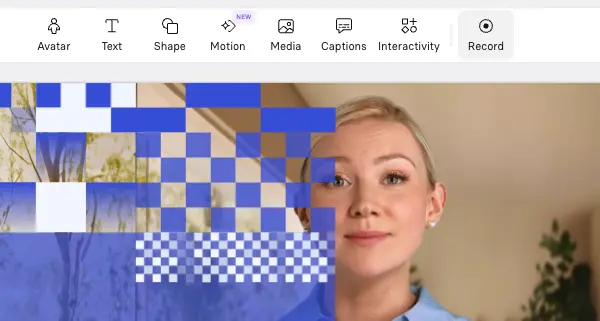
If you're writing a script for a screen recording video, you'll most likely be using second-person language to write step-by-step instructions that match the on-screen actions.
Your goal will be to guide your viewers through each click and action.
I recommend including timing cues in your script, as well as directions for any cursor movements or highlights you want to include.
I often combine screen recordings with a talking head.
Motion graphics
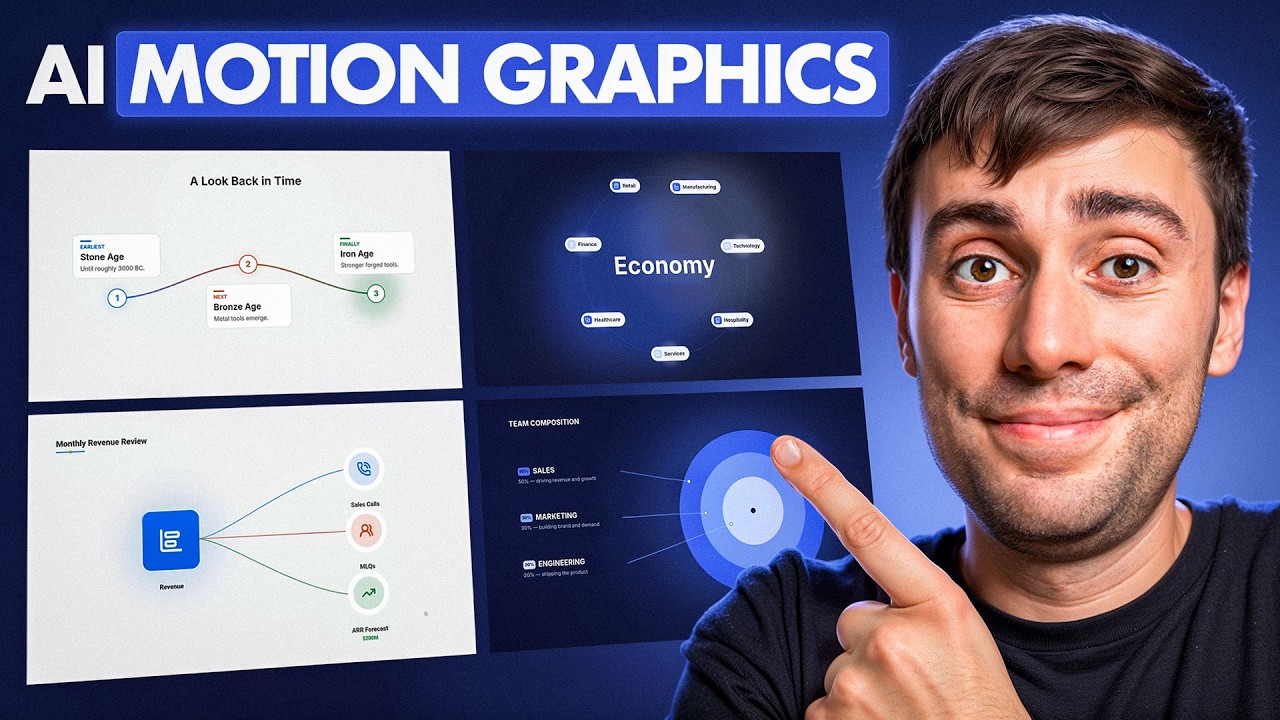
Motion graphics use animated text, shapes, and graphics to communicate ideas visually, and they are commonly combined with narration.
Your script should cover both the narration and provide a blueprint for the visuals you want, which means that you need to describe what elements will appear on the screen, when, and in what order.
It's best to stick to short sentences with each line corresponding to a specific animation or graphical element.
Animated videos
Scripts for animated videos tend to focus on narrative and storytelling elements.
You'll need to write highly descriptive visual cues and plan smooth transitions between your scenes. Your script should be a document that an animator or animation tool can use to bring your vision to life.
Step 4: Write a brief (your north star)
Before getting started writing your script, I highly recommend creating a brief. This is a quick five-sentence summary of the core message that your video will communicate.
Having this brief to hand while writing your script is useful because it acts as your north star and keeps your writing focused.
Your brief should answer the following questions:
- What problem is your video solving?
- Why should your viewers care?
- What is the main message of your video?
- What proof or examples will your video provide?
- What action do you want your viewers to take?
I always have these answers ready upfront when I get into writing my script, as I have found that it helps to prevent scope creep and keep my scriptwriting focused.
Step 5: Create a beat sheet before scriptwriting
Another preparatory step I like to take before getting started scriptwriting is to map out the structure of my video with a beat sheet.
A beat sheet outlines the key moments of your video that will guide your viewers from a problem to a solution.
Beat sheet: your script blueprint
- Hook (0-5 seconds): Your hook grabs the attention of your audience with a compelling problem or question.
- Context (5-15 seconds): You then provide some context to help your viewers understand why they should care right now about the topic.
- Solution overview (15-30 seconds): The solution overview is where you present the main message of your video clearly and concisely.
- Proof points (30-90 seconds): Sharing a few examples or demonstrations grounds your video's message and helps your viewers to relate and understand.
- Call-to-action (final 10 seconds): This is when you give your viewers a clear and actionable next step that you want them to carry out.
Step 6: Write your script using the two-column format
Now it's time to write your script.
I always use a two-column format when writing a script, with one column used for visuals and one column for audio. I like structuring it this way because it forces me to think about what my audience will see and hear simultaneously.
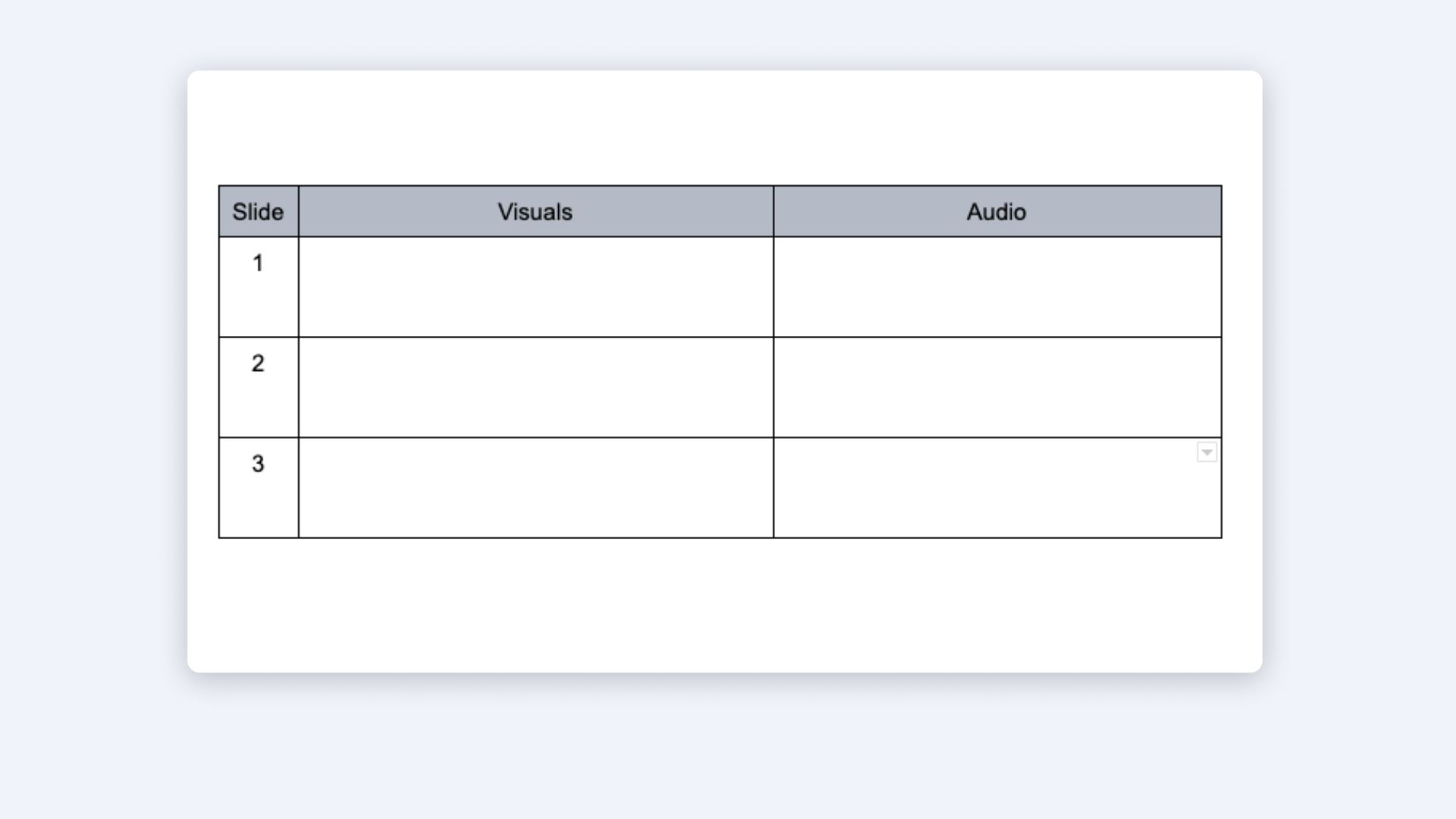
Left column: Visuals & on-screen text
The left column of your script should contain scene descriptions, any on-screen text (try to keep this to 6-9 words per line), and visual cues for screen recordings, motion graphics, or animations.
You should try to be as specific as possible with regard to what video elements appear and when. You should also specify how long they stay on the screen and when they leave the screen.
Right column: Voiceover and dialogue
The right column of your script is where you write your spoken narration and should include any pauses you want to include as well as any pronunciation notes that you might need for technical terms. I highly suggest sticking to one concept or idea per scene.
You should also include cues for any non-spoken audio, such as when you want music to start (and what music), as well as any other sound effects you might want to use in your video.
Step 7: Write, test, and refine
It's highly likely that your first draft will be very rough, but I want to stress that's totally fine.
The real work (and progress) always comes in the revision process. I suggest stepping away from scriptwriting for a few hours after finishing your first draft and coming back to it with fresh eyes.
Then I suggest reading your draft script aloud to yourself. I'm willing to bet that you'll spot a bunch of awkward phrasing, tongue-twisters, and unnatural transitions that looked fine on paper but which really leap out at you when spoken.
When you spot those bits of your script that sound off, that's typically a sign that you need to simplify or break up that sentence or paragraph.
If you can, I suggest following up your first edit by reading your script aloud again but this time to a colleague. Ideally this would be a colleague who somewhat matches your video's target audience.
Try to look out for moments where they seem confused or engaged and make a note. The feedback you can get from doing this is worth its weight in gold, and will help you to dramatically level up your script.
5 common scriptwriting challenges (and solutions)
- "My script sounds robotic when read aloud": Try using more contractions, casual phrasing, and conversational language.
- "I can't fit everything important into a short video": You should either zoom in on one important aspect or key takeaway of your topic or create a video series to give you some more room.
- "My technical content is too complex for general audiences": Try using some analogies and real-world examples to help your audience understand the technical parts of your video.
- "I struggle with timing and pacing": I find it helps to read my script aloud and use shorter sentences for emphasis.
- "My videos don't get watched to the end": Hook your audience with a question that addresses your viewer's pain point in the first 10 seconds, and then every 30-45 seconds you should change up your visuals and break any patterns in your video.
Script quality checklist: 12 points to review before production
Before you move to production, run through this checklist I've developed over years of script reviews. Each point addresses a common failure point in video scripts.
Script quality checklist
Does your script have:
- One clear goal and a clearly defined call-to-action
- A hook that captures attention within the first 5 seconds
- A conversational tone used throughout (that you have read aloud)
- Visual and audio elements that are mapped in two columns
- Pronunciation guides for any technical terms
- Scenes that are each focused on one main idea
- On-screen text that stays under 2 lines (6-9 words per line)
- Timing that allows for natural pacing (130-150 words per minute)
- Proof points that directly support the video's main message
- A call-to-action that is specific and actionable
- A script length that matches your intended video duration
- A completed peer review with a target audience representative
Free script template you can use today
Here's a simple script template that you can use for almost any business video.
I've used this structure for everything from training videos to product demos and I've found that it worked for all of them.
Scene 1: Hook (5-10 seconds)
Visuals: These should be some sort of visualization of the problem or pain point that you are addressing in your video.
Script: You should be asking a rhetorical or thought-provoking question that addresses your viewer's pain point(s) directly. You should also show the end result of watching your video at the start, so that your audience can see upfront the value that your video is going to provide them.
Example: "Creating [specific task] shouldn't take [current time]. Here's how to do it in [shorter time]."
Scene 2: Solution overview (15-20 seconds)
Visual: This scene should use your presenter, screen recording, motion graphic, or animation to explain the solution to the question you asked in your first scene.
Script: Your script should explain the solution at a high level.
Example: "The key is [main solution]. Here's exactly how it works."
Scene 3: Proof (30-45 seconds)
Visual: This scene is for showing your audience a step-by-step demonstration of how and why your solution works.
Script: In this scene your script should be explaining the solution in detail.
Example: "Watch this: [demonstrate key steps with specific outcomes]."
Scene 4: Call-to-action (5-10 seconds)
Visual: Your video should typically finish with an end card with a clear next step and some kind of visual call-to-action. If your video is interactive then this can be a clickable button.
Script: Your script should be a suggestion of the next action your viewers should take and an explanation of how they should do it.
Example: "Ready to try this? [Specific action] at [specific location]."
Kyle Odefey is a London-based filmmaker and Video Producer at Synthesia. His content has reached millions across TikTok, LinkedIn, and YouTube, even inspiring an SNL sketch, and has been featured by CNBC, BBC, Forbes, and MIT Technology Review.
Frequently asked questions
How should I structure my video script?
Here's a simple script template that you can use for almost any business video.
I've used this structure for everything from training videos to product demos and I've found that it worked for all of them.
- Scene 1: Hook (5-10 seconds)
- Scene 2: Solution overview (15-20 seconds)
- Scene 3: Proof (30-45 seconds)
- Scene 4: Call-to-action (5-10 seconds)
What are the most common mistakes made when writing a video script?
Here are 5 common scriptwriting challenges and my suggested solution for each:
- "My script sounds robotic when read aloud": Try using more contractions, casual phrasing, and conversational language.
- "I can't fit everything important into a short video": You should either zoom in on one important aspect or key takeaway of your topic or create a video series to give you some more room.
- "My technical content is too complex for general audiences": Try using some analogies and real-world examples to help your audience understand the technical parts of your video.
- "I struggle with timing and pacing": I find it helps to read my script aloud and use shorter sentences for emphasis.
- "My videos don't get watched to the end": Hook your audience with a question that addresses your viewer's pain point in the first 10 seconds, and then every 30-45 seconds you should change up your visuals and break any patterns in your video.

.webp)

.webp)