



How to Build a Sales Enablement Plan

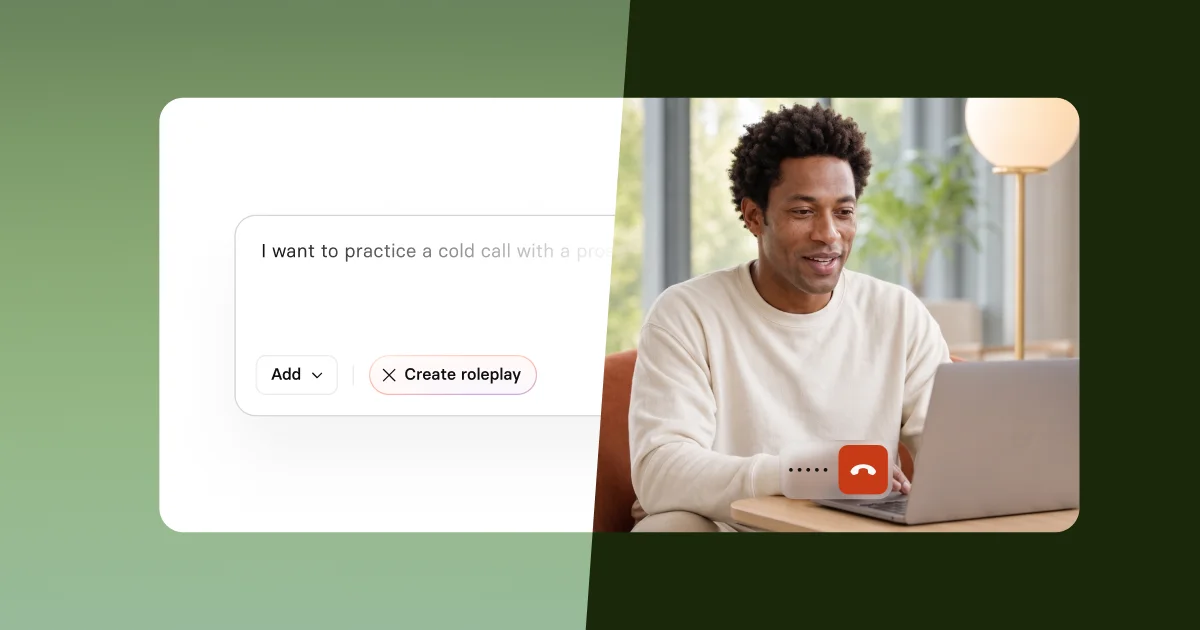
Practice real sales conversations with Interactive Avatars.
Nearly all sales teams have their sales process documented, but only 36% of reps consistently follow it. This enablement execution gap is one of the biggest variables in sales performance.
The good news is that you can close this gap. What it takes is an effective sales enablement plan, a strategy that guides your roadmap, and leadership reinforcement along the way. (So easy, right?)
What is sales enablement?
Sales (or revenue) enablement is a dynamic organizational capability. It’s the ability to anticipate what reps need, and to get that support to them in a way that sticks. And it has to continuously adapt as the industry changes (that’s why it's a dynamic capability).
Sales enablement is often the responsibility of a small team or individual reporting into sales leadership, a sales operations team, or corporate learning and development (I’ve seen all of the above).
Did you know, the term sales enablement was coined by John Aiello and Drew Larsen in 1999? They built a platform to improve communication between the people creating customer-facing assets and the reps using them.
The three layers of effective sales enablement
Effective sales enablement requires three things working together: diagnostics, operations, and development. (Or, if you prefer the academic jargon: insight triangulation, enablement infrastructure, and sales support envelopment.)
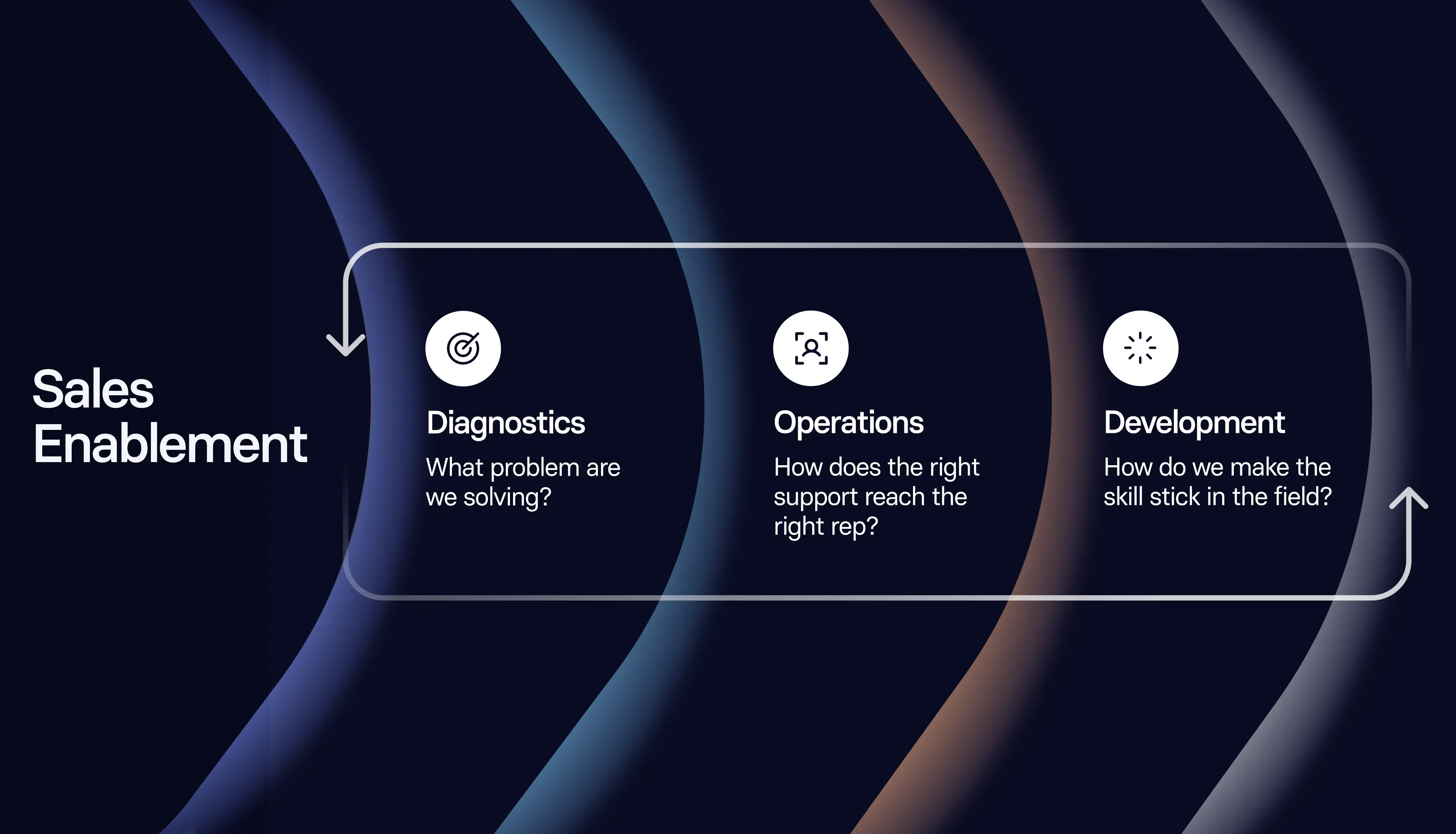
First, you need to diagnose what’s happening in the field: what’s working and what isn’t. Then, you need a system to take those insights and do something with them. Reps need support in the flow of work. Finally, you need a way to give feedback to reps, whether that’s through coaching or practice opportunities, so they can change their behavior.
Most organizations have one of these layers working well (usually, it's the operational one). Few have all three working together and continuously adapting. That's what an enablement strategy and roadmap are for.
Why you need a sales enablement plan
A sales enablement plan is a strategy that defines what you’re building toward and a roadmap that sequences how you get there.
A strategy is a vision for bringing together the three layers of sales enablement, your top priorities, and how you'll measure success. Your vision should be aspirational, but achievable. For example, "All sales reps consistently follow the sales process.” That’s something you can build a roadmap around, and importantly, it’s something you can measure.
A roadmap is a plan to execute the strategy. It's how you can manage your team's capacity and sequence work. Most importantly, it's how you get managers on board to support your work.
How to build a roadmap
The scope of your roadmap will depend on the maturity of your sales organization. If you're at a company that's quickly scaling, you might build a roadmap one quarter at a time. If your company is well-established, you can likely build a roadmap for the fiscal year.
Here's why it matters what you're planning for. A roadmap is your way to be accountable for work. It gives you permission to push back when someone tells you what they need from you. It's how you reconcile your expert analysis of what the team needs with what the business is asking for.
Watch this overview of how to build a roadmap, or read on.
Step 1: Assess
When I'm building a roadmap, I find it helpful to think through a series of questions (ideally, with your team, or if you're running solo, a trusted sounding board). That starts with:
What problem are we really solving?
At this point you likely have two lists: one of support requested by stakeholders, and one of support you think is needed based on your strategy. Your goal is to pressure-test both of these against the data you have access to, such as:
- Call recordings or conversation intelligence
- CRM stage analysis
- Manager feedback
- New hire surveys
- Performance reviews
- LMS or LXP records
Say a sales leader comes to you with a training request. They want to focus on discovery calls because reps aren’t landing follow-up calls. So you go to Gong, and look at discovery call transcripts. What you discover is that reps are spending more than 75% of calls talking. They’re not asking the right questions, but rambling through talk tracks. That’s the behavioral gap. Another training on discovery call talk tracks isn’t going to change that.
An LLM can help you identify patterns across these data sources (try the prompt below). You're looking to surface behavioral gaps, and then come to an evidence-based conclusion about what support you need to prioritize.
If you're in an industry where most sales interactions are happening in person (e.g., medical sales), you will need to augment your data with direct field observation (things like completed observation rubrics, debrief surveys, or manager scorecards).
Step 2: Prioritize
Hopefully you now have a shorter list of priorities. It's time to decide:
What are we committing to this cycle, and what are we not doing?
By cycle, I mean the length of time your roadmap covers: a quarter, half a year, the fiscal year.
I think of this like a children's seesaw (a teeter-totter). On one end you have your team's capacity, on the other end you have the list of priorities. You'd like to find a balance between the two, so you don't send your team flying off (metaphorically).
For each item on your list, I want you to think through a few things:
- The importance or time sensitivity: rank it low, medium, or high
- The team resources needed to execute: a time horizon in weeks or months
- The additional resources needed to execute: anything required to make this happen, from existing tools and resources to net new budget asks
With this information you can start to map out what's feasible, and what is dependent on things like approval from Finance.
Suppose your shortlist includes the following: personalized coaching for reps, a new training, and an onboarding program update.
The coaching is high-priority, but depends on leadership to align on an evaluation framework and budget. The onboarding program update needs to be completed before the next cohort starts. The new training request is low-priority, but the team and SME have upcoming availability.
You start with new training, slot in the onboarding program, and wait for alignment around coaching before executing.
Step 3: Plan
Once you have a better understanding of what you're committing to, it's time to plan the work. Every stakeholder conversation eventually lands on the same question:
Why are you doing this work now, instead of something else?
Your roadmap is your answer.
The first step is to map out the rhythm of the business work you already support, like regular onboarding, quarterly sales kickoffs, or annual leadership gatherings. Anything consistent you know you need to plan around. Your new work maps onto this calendar, not the other way around.
Don't forget to include holidays, flagship marketing events requiring sales presence, performance review cycles, hiring surges, and product launches.
You'll be glad you didn't try to launch a major initiative the same week the entire team is in Vegas for a conference or heads-down trying to close out the quarter.
If you’re interested in seeing how a sales enablement team at a large company manages product changes, read about Zoom.
Step 4: Share
When you have a working draft of the roadmap, it's time to get feedback from your stakeholders. You're asking:
Are we aligned on what this means?
Depending on your organization, you'll likely want to share the draft with your leadership, SMEs who will support content development, and L&D or HR partners.
You're walking a fine line between creating alignment around your roadmap, and opening yourself up to too much input. That's why I recommend carefully structuring how you share any draft:
- Never share a draft without context. If your leadership asks for a pre-read, share your strategy document or the decision-making process leading up to the draft, including a summary of the data you reviewed.
- Prepare structured feedback questions to ask, like: are we solving the right problems? Is there something we've missed?
- Identify what the roadmap means for the stakeholders in question. Is there anything you're compromising on in their eyes?
You want to make it as easy as possible for stakeholders to get on board with your plans. Successful enablement depends on reinforcement, and you'll need it from your entire org. Approach this accordingly. The feedback you receive here won't always change your current roadmap, but it will shape the next one.
Step 5: Iterate
Throughout the year, something will shift. Maybe managers are inconsistently reviewing call transcripts, so only some team members are getting feedback. In that case, you'll need to figure out:
What do we change based on what we're seeing?
This is where measurement comes into play. For every deliverable on your roadmap, you'll want to define how you'll evaluate its success. Enablement can be challenging to measure. It's hard to isolate whether better coaching causes more deals to close, or whether the two are simply correlated.
When you're determining measurement criteria, I recommend going back to the data sources you started with in Step 1. What repeatable evidence do you have access to? Could you confidently create a baseline to determine a before and after of an enablement intervention? This is impact measurement. You can pair this with snapshot data — things like how many people participated in coaching sessions, and how often.
Your goal is what I call good enough measurement. You want evidence that the work is having an impact and that it is a worthwhile investment, or that it is not having the intended effect. That way you can confidently adjust your roadmap.
What’s next?
AI is transforming every layer of sales enablement, from how you surface behavioral gaps to how you can scale coaching without managers using AI sales roleplay tools. Before you finalize your sales enablement plan, consider how you can leverage your existing tech stack to reduce administrative overhead and free up your team to focus on strategic work.
If you’re interested in learning more about how Synthesia can support your sales enablement plan, schedule some time with the team.
Amy Vidor, PhD, is the Learning and Development Evangelist at Synthesia, where she researches learning trends and helps organizations apply AI at scale. With 15 years of experience, she has advised companies, governments, and universities on skills.
Frequently asked questions
What is a sales enablement plan?
A sales enablement plan (or roadmap) is how you will execute your strategy. It is how you prioritize and sequence work alongside the rhythm of the business. A sales enablement plan is how you communicate priorities and tradeoffs to your stakeholders.
What should a sales enablement strategy include?
A sales enablement strategy should include:
- A vision: something aspirational, but achievable
- Priorities across your enablement layers: diagnostics, operations, and development
- How you will measure success
You're identifying what matters in a given period of time, and why.
What is the difference between sales enablement and sales training?
The easiest way to distinguish between sales training and enablement is through time. Training has a start and an end (although it can go on for months or longer). Enablement is ongoing.
Training is about the transfer of knowledge, skills, and expertise. Enablement is how you reinforce training.
How do you measure sales enablement effectiveness?
There are several things you might be looking to measure. The first is how well you executed your strategy. To do this, go back to your vision statement and identify what signals you can use for your evaluation.
If your vision was, “All sales reps consistently follow the sales process,” then you’ll want to look for data sources that would support adherence or deviation from the process. This might involve an LLM analyzing call transcripts over a specific period of time, plus a survey of managers. It really depends on the data sources available to you.
Because it can be tricky to determine causation and correlation with enablement, my recommendation is to identify what constitutes “good enough” measurement for you. That’s data that gives you confidence that your enablement is either working, or it isn’t. Both at the strategic-level, and at the deliverable-level.
How do you get leadership buy-in for sales enablement?
The best way to get leadership buy-in for sales enablement is to align your enablement strategy and roadmap with revenue goals and company-wide performance management. Make it explicit how enablement is supporting those structures by using that language. They need to understand what you’re committing to, and why, from the lens of the business.