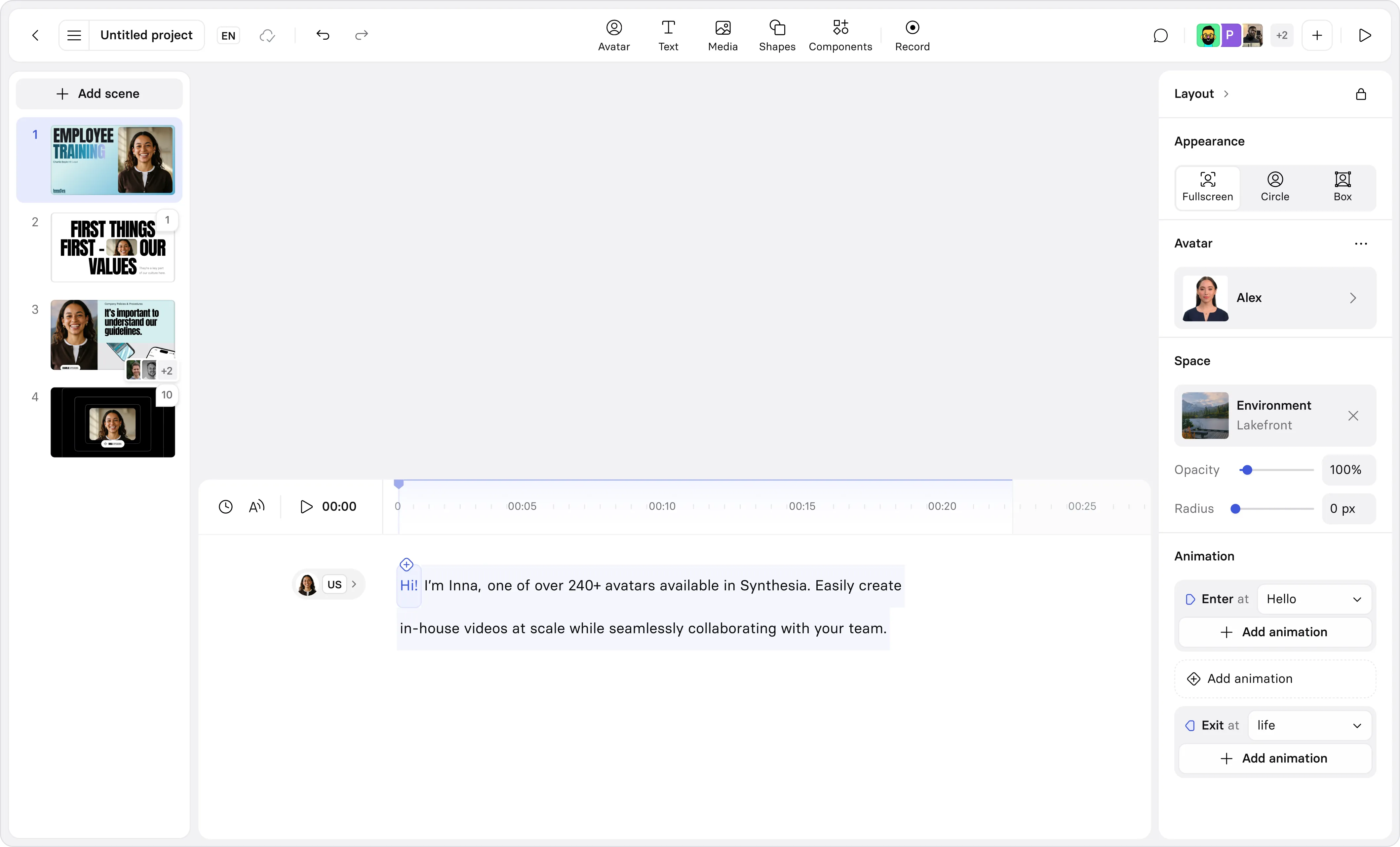


Create AI videos with 240+ avatars in 160+ languages.
🎬 What is the best AI video generator?
- Veo 3.2: Best realism, lighting, physics, and audio
- Sora 2: Best storytelling and emotion, but slow and expensive
- Kling 2.6: Best price-to-quality with strong, reliable visuals
- Seedance 1.5: Longer clips and strong cinematic world-building
- Runway Gen-4.5: Best camera movement, weaker realism
- Luma Ray3: Beautiful look and UI, weak motion, no audio
- PixVerse 5.5: Great short-form motion, limited duration and realism
- Grok Imagine: Fast and artistic, low physical and narrative depth
- Wan 2.6: Very reliable and tolerant, not cinematic
- Pika 2.5: Fun and social-first, low realism
- Adobe Firefly: Strong images, weak video motion
- Hailuo 2.3: Outdated visuals and weak motion
📊 My favorite AI video generator for business
- Synthesia: Best for avatar-driven corporate and training videos
How I tested these AI video generators
To compare these AI video generators fairly, I ran the same set of prompts and reference images through every tool, testing both text-to-video and image-to-video where available.
For each run, I recorded generation time, resolution, audio support, and any failures or artifacts, then reviewed the results side-by-side for prompt fidelity, motion coherence, realism, visual consistency, and usability of the interface and editing controls.
I also repeated key prompts after minor tweaks to see how sensitive each model was to wording and how reliably it could reproduce a look or scene, which helped surface where each tool really excels and where it breaks down in real, hands-on use.
How do these AI video generators compare?
Veo
What is Veo?
Veo 3.2 is currently the most complete, film-grade AI video generator on the market, positioned at the very top in terms of realism, lighting accuracy, physical coherence, and integrated audio. It sits in the same premium tier as Sora, but is more production-ready and visually grounded, making it the strongest all-around cinematic model today.
How good is Veo’s video quality?
Veo’s output is defined by physical credibility. Lighting behaves naturally, shadows and reflections are coherent, materials respond correctly to light, and camera motion preserves spatial continuity. Motion physics are among the most stable in any model I tested, with far fewer distortions in fabric, vehicles, and environmental effects than most competitors.
Image-to-video is especially strong, with consistent depth, believable scale, and minimal temporal artifacts. The main trade-offs remain short clip duration and relatively long render times, but visual stability and realism are best-in-class.
How cinematic is Veo?
Veo interprets prompts with high cinematic discipline. Composition, framing, and color grading feel deliberately directed rather than randomly assembled.
While it is slightly less “imaginative” than Sora in narrative invention, it excels at translating intent into visually precise, emotionally legible scenes. Atmosphere, mood, and environmental storytelling are handled with professional film language rather than experimental abstraction.
How good is Veo’s audio?
The built-in audio is one of Veo’s major differentiators. Sound design is clean, well-timed, and tightly synchronized with visual events, outperforming most competitors in clarity and realism. While not yet studio-mix quality, it adds genuine cinematic completeness without requiring external tools.
What use cases does Veo excel at?
- High-end cinematic shots with realistic lighting and physics
- Premium branded films, trailers, and mood pieces
- Emotionally grounded scenes with strong atmosphere
- Professional visual concepting where realism is critical
What use cases does Veo struggle with?
- Long, dialogue-heavy multi-scene narratives
- Fast, low-cost iteration at scale
- Users without access to premium plans or aggregators
What are Veo's strengths?
- Best-in-class realism and lighting behavior
- Strong physical motion and material consistency
- High-quality integrated audio and sound sync
- Stable, production-ready visual output
What are Veo’s weaknesses?
- Expensive per generation
- Short maximum clip duration
- Less narrative intelligence than Sora
How does Veo compare to other models?
How does Veo compare to Sora?
Sora is more emotionally and narratively intelligent, but Veo delivers superior physical realism, lighting accuracy, and overall visual stability, making it more production-ready.
How does Veo compare to Kling?
Kling offers outstanding price-to-quality and strong physics, but Veo surpasses it in lighting realism, audio integration, and cinematic polish.
How does Veo compare to Seedance?
Seedance excels in world-building and longer clips, while Veo maintains significantly better physical coherence, texture stability, and sound design.
How does Veo compare to Runway?
Runway leads in camera experimentation and creative tooling, but Veo is far stronger in realism, motion stability, and final-output credibility.
What is the verdict on Veo?
Veo 3.2 is the closest thing today to true AI cinematography. While Sora leads in storytelling intelligence, Veo wins overall by combining film-grade lighting, physics, camera coherence, and integrated audio into the most stable and professionally usable video output available. For creators who prioritize visual credibility and production quality over experimental narrative freedom, Veo 3.2 is currently the gold standard.
Sora
What is Sora?
Sora 2 is the most advanced AI video model for narrative intelligence and emotional storytelling, positioned just behind Veo in overall ranking due to slightly weaker physical realism and production control.
It is the only model that truly behaves like an AI director, capable of understanding story, dialogue, and scene logic rather than just generating visually impressive clips.
How good is Sora’s video quality?
Sora delivers highly cinematic visuals with convincing lighting, natural character motion, and strong spatial coherence. Fabric, hair, facial animation, and environmental motion feel organic, and camera movement supports storytelling rather than just spectacle.
While overall realism is excellent, it is marginally less physically grounded than Veo in areas like micro-texture stability, light interaction, and complex motion consistency. Render times are long and clip duration is limited, but visual quality remains among the best available.
How cinematic is Sora?
This is Sora’s defining strength. It interprets prompts with an almost human-level understanding of mood, pacing, and narrative intent. Scenes feel composed, emotionally directed, and context-aware, with strong continuity and cinematic rhythm.
Sora doesn’t just visualize instructions, it builds story structure, making it uniquely suited for dialogue-driven, character-focused, and multi-beat sequences.
How good is Sora’s audio?
Sora supports native audio and dialogue generation, including voice and lip sync. Sound adds emotional depth and narrative clarity, though it is still less clean and technically refined than Veo’s audio pipeline. Even so, the ability to generate synchronized speech and atmosphere directly in-model is a major creative advantage.
What use cases does Sora excel at?
- Cinematic storytelling and short narrative films
- Character-driven scenes with dialogue and emotion
- Concept trailers and story-driven visual experiments
- AI-assisted directing and world-building
What use cases does Sora struggle with?
- Fast, high-volume content production
- Physically perfect realism and simulation-heavy scenes
- Users needing precise manual camera and timeline control
What are Sora’s strengths?
- Unmatched narrative and emotional intelligence
- Natural dialogue, voice, and lip sync
- Strong cinematic composition and pacing
- Multi-scene and story-level coherence
What are Sora’s weaknesses?
- Very slow generation times
- High cost and limited access
- Slightly weaker physical realism than Veo
How does Sora compare to other models?
How does Sora compare to Veo?
Sora is superior in storytelling, emotional direction, and dialogue, but Veo delivers more physically accurate lighting, motion, and overall production stability.
How does Sora compare to Kling?
Kling is more efficient and cost-effective for commercial workflows, while Sora offers far deeper narrative intelligence and character performance.
How does Sora compare to Seedance?
Seedance excels at world expansion and scale, but Sora leads in character emotion, scene logic, and story continuity.
How does Sora compare to Runway?
Runway provides strong creative tooling and camera experimentation, but Sora operates on a much higher level of narrative understanding and cinematic coherence.
What is the verdict on Sora?
Sora 2 is the most creatively intelligent AI video model available today. While Veo 3.2 leads in physical realism and production readiness, Sora remains unmatched in storytelling, emotional depth, and dialogue-driven scenes. For filmmakers, storytellers, and creators focused on narrative impact rather than pure visual simulation, Sora 2 is the most powerful creative engine in the market.
Kling
What is Kling?
Kling 2.6 is the most reliable and cost-efficient cinematic AI video generator available today, positioned as the best price-to-quality option for professional use. While it doesn’t reach Veo’s lighting realism or Sora’s narrative intelligence, it delivers the strongest balance of physical accuracy, visual quality, stability, and scalability for real production workflows.
How good is Kling’s video quality?
Kling’s visual output is highly realistic, with excellent lighting, texture detail, and physically believable motion. Fabric simulation, character movement, camera motion, and depth handling are among the most stable in the market, with far fewer distortions than creative-first models like Runway or PixVerse. Background elements can soften slightly during motion, but overall scene coherence, material behavior, and temporal stability make Kling feel genuinely film-like and production-ready.
How cinematic is Kling?
Kling interprets prompts with strong cinematic discipline. Composition, framing, and color grading are consistently on point, and mood translation is highly accurate. While it is less imaginative and story-driven than Sora, it excels at turning a visual concept into a clean, believable, professional-looking shot. It feels more like a precision camera system than a narrative director.
How good is Kling’s audio?
Built-in audio is supported, but remains a secondary strength. While usable for atmosphere, it can occasionally introduce unwanted voices or lack refinement, making external sound design preferable for high-end work.
What use cases does Kling excel at?
- Commercial advertising and branded visuals
- Realistic character-driven cinematic shots
- High-volume professional production workflows
- Physically believable motion and lighting tests
What use cases does Kling struggle with?
- Long narrative sequences with dialogue
- Highly experimental or abstract visual styles
- Creators who need integrated, polished audio
What are Kling’s strengths?
- Best price-to-quality ratio on the market
- Strong physical realism and lighting
- Stable motion and texture consistency
- Production-ready reliability and scalability
What are Kling’s weaknesses?
- Audio quality still inconsistent
- Limited clip length
- Less narrative intelligence than Sora
How does Kling compare to other models?
How does Kling compare to Veo?
Veo surpasses Kling in lighting realism, audio quality, and cinematic polish, but Kling is far more cost-efficient and easier to scale for continuous production.
How does Kling compare to Sora?
Sora is vastly superior in storytelling, emotion, and dialogue, while Kling is more physically grounded, predictable, and suitable for commercial pipelines.
How does Kling compare to Seedance?
Seedance offers longer clips and stronger world-building, but Kling delivers better motion physics, texture stability, and production consistency.
How does Kling compare to Runway?
Runway excels in creative camera experimentation and tooling, but Kling is far stronger in realism, physical coherence, and repeatable professional output.
What is the verdict on Kling?
Kling 2.6 is the most practical professional AI video generator available today. It may not have Sora’s narrative intelligence or Veo’s ultimate cinematic polish, but it delivers the best balance of realism, stability, and cost efficiency for real-world production. For creators who need reliable, film-quality results at scale, Kling remains the strongest workhorse in the market.
Seedance
What is Seedance?
Seedance 1.5 is one of the most creatively ambitious AI video generators in the current landscape, positioned just below the top tier but ahead of most competitors in cinematic scope and world-building. It stands out for its longer clip durations and its ability to expand a single image into a coherent, large-scale environment, making it one of the most promising models for future real-time world generation.
How good is Seedance’s video quality?
Seedance produces visually rich, cinematic footage with strong lighting, atmosphere, and sense of scale. Camera movement feels intentional and scene pacing is well handled, especially in image-to-video where environments expand naturally and maintain stylistic consistency. Motion physics are slightly less stable than in Veo or Kling, with occasional softness and minor inconsistencies in interacting objects, but overall temporal coherence and visual continuity are impressive, particularly given the longer output durations.
How cinematic is Seedance?
Creativity is one of Seedance’s core strengths. It shows a strong understanding of composition, depth, and environmental storytelling, often building out worlds rather than isolated shots. Mood and atmosphere are rendered with cinematic intent, and prompt interpretation feels imaginative while still grounded. Compared to narrative-focused models like Sora, Seedance is less character- and dialogue-driven, but excels at visual world expansion and scene continuity.
How good is Seedance’s audio?
Seedance supports built-in audio, which integrates well with the visuals and adds atmosphere to scenes. While not as clean or precise as Veo’s audio, it is stable and usable, reinforcing the cinematic feel without requiring immediate external sound design.
What use cases does Seedance excel at?
- Large-scale world-building and environment expansion
- Longer cinematic clips and establishing shots
- Image-to-video continuation and scene exploration
- Experimental visual storytelling with strong atmosphere
What use cases does Seedance struggle with?
- Physically perfect realism and complex interaction physics
- Dialogue-driven or character-centric narratives
- Budget-limited, high-volume production workflows
What are Seedance’s strengths?
- Up to ~12-second output, longer than most competitors
- Excellent image-to-video world continuation
- Strong cinematic atmosphere and sense of scale
- Built-in audio support
What are Seedance’s weaknesses?
- Motion physics less stable than Veo or Kling
- High credit cost per generation
- Limited post-generation editing and camera control
How does Seedance compare to other models?
How does Seedance compare to Veo?
Veo delivers superior physical realism, lighting accuracy, and audio quality, while Seedance stands out for longer clip duration and more ambitious world-building.
How does Seedance compare to Sora?
Sora excels in narrative intelligence and character emotion, whereas Seedance focuses on environmental scale, visual continuity, and cinematic scene expansion.
How does Seedance compare to Kling?
Kling is more physically stable and cost-efficient, but Seedance offers longer shots and more impressive large-scale visual construction.
How does Seedance compare to Runway?
Runway leads in creative tooling and camera experimentation, while Seedance produces more cohesive, cinematic worlds and longer continuous scenes.
What is the verdict on Seedance?
Seedance 1.5 is one of the most exciting models to watch in the current AI video space. While it does not yet match Veo or Kling in physical accuracy, its ability to generate longer, cohesive, and atmospherically rich scenes gives it a unique edge in world-building and cinematic scope. For creators exploring large environments, visual storytelling, and the future of prompt-driven worlds, Seedance is one of the most promising tools available today.
Runway
OverviewWhat is Runway?
Runway Gen-4.5 is a director-oriented AI video platform known for its cinematic camera movement and powerful creative ecosystem rather than raw physical realism. It sits in the upper-mid tier of the market, positioned more as a visual experimentation and workflow tool than a fully production-ready realism engine like Veo or Kling.
Visual quality and performanceHow good is Runway’s video quality?
Runway’s biggest strength is camera choreography. Tracking shots, pans, and cinematic motion feel intentional and fluid, often more expressive than in most competitors. However, during movement, fine detail stability breaks down: motion blur becomes excessive, textures soften, and objects can deform. Lighting and composition are strong at a glance, but micro-detail and physics lag behind top-tier models. Image-to-video in Gen-4.5 is notably weaker than text-to-video, with reduced motion coherence and loss of atmosphere. Generation is also relatively slow and expensive per second.
How cinematic is Runway?
Creatively, Runway is one of the most “director-friendly” tools available. It understands framing, shot language, and cinematic rhythm extremely well, and its node-based workflow encourages experimentation, scene chaining, and visual iteration. Prompt interpretation is solid in composition and mood, even if physical realism and world logic sometimes collapse under scrutiny. It feels like a creative studio more than a simulation engine.
How good is Runway’s audio?
Runway does not generate audio directly in the video model, but its broader platform includes strong voice, music, and sound tools that can be integrated in post. Audio is part of the ecosystem, not the generation core.
What use cases does Runway excel at?
- Cinematic camera experiments and shot prototyping
- Visual mood boards and concept development
- Creative workflows combining multiple AI tools in one platform
- Directors and designers exploring motion language
What use cases does Runway struggle with?
- Physically realistic simulations
- High-fidelity commercial production without heavy post
- Budget-constrained, high-volume rendering
What are Runway’s strengths?
- Best-in-class cinematic camera movement
- Powerful creative ecosystem and workflow tools
- Clean, intuitive interface
- Strong integration of image, video, and audio pipelines
What are Runway’s weaknesses?
- Weak detail stability and motion physics
- High cost per second of video
- Image-to-video weaker than text-to-video
How does Runway compare to other models?
How does Runway compare to Veo?
Veo delivers far superior realism, lighting, physics, and audio, while Runway focuses on camera artistry and creative tooling rather than physical accuracy.
How does Runway compare to Sora?
Sora is vastly more intelligent narratively and emotionally, whereas Runway excels in manual creative control and visual experimentation.
How does Runway compare to Kling?
Kling offers much stronger physical coherence and production reliability, while Runway provides a more flexible and exploratory creative environment.
How does Runway compare to Seedance?
Seedance builds larger, more coherent worlds with longer clips, while Runway leads in camera choreography and platform-level workflow design.
What is the verdict on Runway?
Runway Gen-4.5 is a filmmaker’s sketchbook rather than a finished film camera. It offers the most expressive AI camera movement and one of the strongest creative ecosystems, but falls behind leaders like Veo, Sora, and Kling in physical realism and motion stability. For directors, designers, and experimental creators exploring cinematic language and visual workflows, Runway is invaluable. For realism-critical or production-grade output, it is better seen as a creative companion than a final renderer.
Luma Dream Machine
What is Luma?
Luma Dream Machine (Ray3) is a design-first, cinematic AI video tool positioned between high-end realism engines and creative playgrounds. It stands out for its beautiful interface, refined aesthetic output, and strong image-to-video capabilities, but prioritizes atmosphere and visual elegance over physical accuracy or narrative depth.
How good is Luma’s video quality?
Luma produces visually clean, well-composed footage with pleasing lighting, balanced color, and stable camera motion, especially in slower, calmer scenes. Image-to-video performs better than text-to-video, with improved consistency and less motion breakdown. However, under fast camera movement or complex physical interactions, motion physics soften, fine details blur, and realism drops below top-tier models like Veo, Kling, or Sora. Resolution and upscaling options (including 4K) are a strong plus, but clip duration remains short.
How cinematic is Luma?
Aesthetically, Luma is one of the most refined tools available. Composition, mood, and visual tone are handled with great taste, making outputs feel cinematic, calm, and art-directed. Prompt interpretation is accurate for atmosphere and framing, though less inventive than Sora and less physically grounded than Veo. Luma excels at elegance rather than spectacle or simulation.
How good is Luma’s audio?
Native audio is not supported in the core generation model. Sound must be added in post, either through Luma’s Modify tools or external editors, which limits its use for dialogue-driven or fully finished scenes.
What use cases does Luma excel at?
- Atmospheric cinematic shots and mood pieces
- Image-to-video animation with strong visual continuity
- Artistic storytelling and visual concepting
- Creators who value UI, workflow, and aesthetic polish
What use cases does Luma struggle with?
- Physically complex motion and action scenes
- Dialogue-heavy or lip-synced content
- Projects requiring fully integrated sound
What are Luma’s strengths?
- One of the best-designed and most intuitive interfaces
- Strong image-to-video stability and composition
- Beautiful lighting and color grading
- 4K upscaling and flexible visual presets
What are Luma’s weaknesses?
- Weak physical realism in fast or complex motion
- No native audio or lip sync
- Short clip duration
How does Luma compare to other models?
How does Luma compare to Veo?
Veo is vastly superior in physical realism, lighting accuracy, and integrated audio, while Luma focuses on aesthetic refinement and user experience.
How does Luma compare to Sora?
Sora offers deep narrative intelligence and emotional performance, whereas Luma is better suited for calm, visually driven scenes without dialogue.
How does Luma compare to Kling?
Kling delivers stronger physics and production reliability, while Luma excels in UI design and artistic presentation.
How does Luma compare to Runway?
Runway provides more experimental camera control and workflow depth, while Luma offers cleaner visuals and a more elegant creative environment.
What is the verdict on Luma?
Luma Dream Machine is a beautifully crafted cinematic tool that prioritizes visual taste, atmosphere, and user experience over physical simulation or narrative complexity. It is not the most realistic or technically powerful model, but it is one of the most pleasant and refined to work with. For creators focused on mood, composition, and aesthetic storytelling, Luma offers exceptional value, even if it requires external tools to complete the full audio-visual pipeline.
PixVerse
What is PixVerse?
PixVerse 5.5 is a fast, accessible, short-form cinematic video generator positioned between creative experimentation tools and high-end realism engines. It competes with Runway and Pika in the social-first, visually striking segment, but stands out for its dynamic camera motion, built-in audio, and strong price-to-performance ratio for short clips.
How good is PixVerse’s video quality?
PixVerse delivers visually engaging results with energetic camera movement, solid scene coherence, and good overall stability for 5–6 second clips. Lighting and color grading create a cinematic look, but fine details soften during fast motion and physical realism remains below top-tier models like Veo, Kling, or Sora. At 1080p, micro-detail and texture sharpness feel slightly underwhelming, though temporal consistency is generally good and artifacts are limited.
How cinematic is PixVerse?
PixVerse interprets prompts with a strong sense of mood, scale, and visual storytelling. Composition and camera dynamics are among its strongest features, giving even short clips a sense of cinematic flow. While it does not reach Sora’s narrative intelligence or Veo’s physical precision, it excels at translating atmosphere and visual intent into punchy, engaging scenes suitable for social and promotional use.
How good is PixVerse’s audio?
Built-in audio generation is supported and synchronized with visuals. While usable for mood and basic sound design, audio quality lacks depth and cleanliness compared to Veo and Sora, and may require post-processing for professional results.
What use cases does PixVerse excel at?
- Short-form cinematic social media content
- Fast generation of atmospheric promo clips
- Template-driven or viral video formats
- Creators needing affordable access to motion and sound
What use cases does PixVerse struggle with?
- Long-form storytelling and multi-scene narratives
- High-realism or simulation-heavy visuals
- Projects requiring pristine audio quality
What are PixVerse’s strengths?
- Dynamic and engaging camera movement
- Built-in audio support
- Very accessible pricing and generous free credits
- Fast generation for short clips
What are PixVerse’s weaknesses?
- Very short maximum duration (~6 seconds)
- Reduced fine-detail fidelity and physical realism
- Audio quality still feels rough
How does PixVerse compare to other models?
How does PixVerse compare to Runway?
PixVerse is faster, cheaper, and more practical for short-form content, while Runway offers more advanced camera control and a broader creative workflow.
How does PixVerse compare to Pika?
PixVerse delivers stronger cinematic motion, better prompt interpretation, and built-in audio, making it more suitable for polished short videos.
How does PixVerse compare to Kling?
Kling far surpasses PixVerse in realism, physics, and professional output, but PixVerse is much more accessible and optimized for rapid social-content creation.
How does PixVerse compare to Veo?
Veo offers film-grade realism and sound, while PixVerse focuses on speed, affordability, and visual punch for short-form formats.
What is the verdict on PixVerse?
PixVerse 5.5 is a strong short-form cinematic generator that prioritizes speed, mood, and accessibility over physical accuracy or narrative depth. It will not replace high-end tools like Veo, Sora, or Kling for serious filmmaking, but for social videos, quick promos, and visually striking micro-stories, it offers one of the best price-to-performance ratios currently available.
Grok Imagine
What is Grok Imagine?
Grok Imagine is a fast, creatively oriented AI video generator that stands out more for its artistic interpretation and speed than for strict physical realism. It sits in the experimental–creative tier, offering visually expressive results with extremely short render times, but without the cinematic stability or production polish of top models like Veo, Sora, or Kling.
How good is Grok Imagine’s video quality?
Grok’s output is visually pleasing and stylistically coherent, with smooth camera motion and balanced lighting, especially impressive given its very fast generation speed. However, realism is limited: textures are softer, physics are simplified, and motion lacks the physical grounding seen in higher-end models. Image-to-video shows better stability than text-to-video and, in your tests, produced results stylistically similar to Luma, suggesting a shared or comparable visual pipeline. Overall consistency is good, but the look remains more artistic than film-real.
How cinematic is Grok Imagine?
Creatively, Grok is surprisingly strong. It interprets prompts in a poetic, imaginative way, often adding emotional tone and visual flair rather than rigidly literal translations. Composition and mood are handled with taste, making it well suited for conceptual or atmospheric pieces. Narrative logic and deep scene understanding, however, are not on the level of Sora, and prompt-to-story coherence remains limited.
How good is Grok Imagine’s audio?
Grok Imagine does not support native audio generation. All sound must be added in post-production, which limits its use for dialogue-driven or fully finished cinematic scenes.
What use cases does Grok Imagine excel at?
- Fast visual concepting and mood exploration
- Artistic, painterly short clips
- Social or experimental content where speed matters
- Early-stage storyboards and motion sketches
What use cases does Grok Imagine struggle with?
- High-realism or physics-critical scenes
- Dialogue, lip sync, or sound-driven storytelling
- Professional film or commercial production
What are Grok Imagine’s strengths?
- Extremely fast generation (near real-time)
- Creative and emotionally expressive prompt interpretation
- Clean, simple interface
- Stable output for quick iteration
What are Grok Imagine’s weaknesses?
- No native audio or lip sync
- Limited physical realism and motion accuracy
- Few post-generation editing controls
How does Grok Imagine compare to other models?
How does Grok Imagine compare to Luma?
Both share a refined, aesthetic look, but Luma offers a more mature interface, better image-to-video stability, and higher-resolution workflows, while Grok is significantly faster.
How does Grok Imagine compare to PixVerse?
PixVerse provides stronger camera dynamics, built-in audio, and more cinematic energy, whereas Grok focuses on artistic mood and rapid iteration.
How does Grok Imagine compare to Runway?
Runway offers far deeper creative tooling and camera control, while Grok trades workflow depth for speed and simplicity.
How does Grok Imagine compare to Veo?
Veo operates on a completely different level in realism, narrative intelligence, and production readiness. Grok is best viewed as a creative sketch tool rather than a cinematic engine.
What is the verdict on Grok Imagine?
Grok Imagine is a surprisingly expressive and lightning-fast AI video generator that excels at turning ideas into visual mood pieces with minimal waiting time. It is not built for realism, sound, or professional filmmaking, but as a rapid concepting and artistic exploration tool, it offers a refreshing mix of speed and creative personality.
Wan
What is Wan?
Wan 2.6 is a practical, reliability-first AI video generator positioned as a “workhorse” rather than a cinematic flagship. It is less focused on photorealism or artistic polish than top-tier models, but stands out for its prompt tolerance, stable output, built-in audio, and ability to generate scenes that stricter systems often block.
How good is Wan’s video quality?
Wan produces clean, coherent videos with consistent lighting and stable camera motion, though the overall look leans slightly stylized rather than fully cinematic. Object physics and fine-detail realism are weaker than in Veo, Kling, or Sora, and some elements can appear soft or float slightly. That said, temporal stability is good, artifacts are limited, and the model supports longer clip durations (up to ~15 seconds), making it practical for continuous storytelling despite its lower realism.
How cinematic is Wan?
Prompt interpretation is reliable and flexible, especially for emotionally charged or sensitive scenarios that other platforms tend to censor. Composition and scene structure are clear, and camera movement feels intentional, even if the visual style is more animated than film-real. Wan prioritizes completion and coherence over visual spectacle or physical simulation.
How good is Wan’s audio?
Built-in audio is supported and synchronized with the visuals. While sound quality contains artifacts and lacks depth compared to Veo or Sora, it is functional and useful for basic storytelling without requiring immediate external tools.
What use cases does Wan excel at?
- Storytelling with sensitive or emotionally complex prompts
- Practical, censorship-tolerant video generation
- Longer continuous clips and basic narrative scenes
- Creators needing reliable completion over visual perfection
What use cases does Wan struggle with?
- Photorealistic or film-grade visuals
- High-end advertising or cinematic trailers
- Precision physics and detailed material simulation
What are Wan’s strengths?
- Very low prompt rejection and strong tolerance
- Stable and reliable generation
- Built-in audio support
- Longer maximum clip duration than most competitors
What are Wan’s weaknesses?
- Stylized, sometimes cartoon-like visuals
- Weak object physics and fine-detail realism
- Audio quality contains artifacts
How does Wan compare to other models?
How does Wan compare to Sora?
Sora offers vastly superior cinematic quality and narrative intelligence, but is far more restrictive and expensive. Wan succeeds where Sora blocks prompts.
How does Wan compare to Veo?
Veo delivers film-grade realism and audio, while Wan prioritizes accessibility, tolerance, and practical completion over visual perfection.
How does Wan compare to Kling?
Kling is more physically accurate and production-ready, whereas Wan is more flexible and less constrained by content filters.
How does Wan compare to Hailuo?
Wan is significantly more reliable, visually coherent, and usable in real workflows.
What is the verdict on Wan?
Wan 2.6 is not a cinematic leader, but it is one of the most dependable and creator-friendly tools in real-world use. When prompt freedom, reliability, and longer clips matter more than absolute realism, Wan becomes an invaluable fallback and a surprisingly capable storytelling engine.
Pika
What is Pika?
Pika 2.5 is a social-first, creative AI video generator focused on fast, playful, and visually expressive content rather than cinematic realism. It sits in the lower mid-tier of the market, aimed primarily at influencers, trend-driven creators, and short-form experimentation rather than professional filmmaking or high-end visual production.
How good is Pika’s video quality?
Pika shows noticeable improvement over earlier versions in color grading and overall atmosphere, but physical realism remains limited. Motion physics are simplified, depth and lighting lack true cinematic behavior, and fine details degrade quickly during movement. Resolution on the free tier is low, and even at higher tiers the output does not approach the stability or realism of tools like Kling, Veo, or Sora. Temporal consistency is acceptable for short loops, but scenes feel more animated than film-like.
How cinematic is Pika?
Where Pika performs better is in visual flair and stylistic expression. It interprets prompts in a bold, playful way, often producing eye-catching compositions and trendy effects suited for social platforms. However, narrative understanding, emotional continuity, and cinematic composition remain shallow compared to director-style models like Sora or world-building systems like Seedance.
How good is Pika’s audio?
Pika does not currently offer native audio generation for video. Sound must be added externally, limiting its usefulness for dialogue-driven or immersive scenes.
What use cases does Pika excel at?
- Viral social media loops and short-form visual effects
- Playful, experimental creative content
- Influencer-style videos and trendy ad formats
- Rapid ideation and visual sandboxing
What use cases does Pika struggle with?
- Cinematic storytelling or emotional narratives
- Physically realistic motion and lighting
- Professional commercial or film production
What are Pika’s strengths?
- Fast and easy to use
- Expressive, eye-catching visual style
- Improved color and mood handling in version 2.5
- Accessible entry point for casual creators
What are Pika’s weaknesses?
- Weak physics and low realism
- No native audio or lip sync
- Limited resolution and professional control
How does Pika compare to other models?
How does Pika compare to PixVerse?
PixVerse delivers stronger camera dynamics, better realism, and built-in audio, making it more suitable for polished short-form videos.
How does Pika compare to Runway?
Runway offers far superior cinematic language, camera control, and production tools, while Pika remains a lightweight creative toy.
How does Pika compare to Kling?
Kling is on an entirely different level in realism, stability, and professional usability.
How does Pika compare to Hailuo?
Pika is more expressive and visually engaging, but both lag far behind current cinematic leaders.
What is the verdict on Pika?
Pika 2.5 is best viewed as a creative playground rather than a cinematic tool. It’s fast, fun, and visually expressive, but lacks the realism, physics, audio, and narrative depth required for serious video production. For social-first creators and experimental visuals, it can be enjoyable and useful; for professional filmmaking or high-fidelity storytelling, it remains far behind the state of the art.
Adobe Firefly
What is Adobe Firefly?
Adobe Firefly Video is Adobe’s early-stage entry into AI video generation, positioned more as an extension of its creative ecosystem than as a standalone cinematic engine. While its image generation is among the strongest in the market, the video model currently lags behind leaders like Veo, Sora, and Kling in realism, motion quality, and camera intelligence.
How good is Adobe Firefly’s video quality?
Firefly’s video output is clean and stable but lacks physical credibility. Motion feels simplified, depth and fabric behavior are weak, and lighting does not yet reach true cinematic consistency. Text-to-video performs slightly better than image-to-video, but both remain behind even mid-tier competitors in realism and motion coherence. Generation speed is fast and reliable, but visual fidelity and physical simulation are not yet competitive for high-end use.
How cinematic is Adobe Firefly?
Creatively, Firefly shows more strength in still images than in motion. While it can produce visually interesting compositions and color palettes, prompt interpretation in video often loses nuance and narrative detail. Compared to Sora’s storytelling intelligence or Runway’s camera language, Firefly’s scene construction feels more literal and less directed.
How good is Adobe Firefly’s audio?
Native audio generation is not integrated into the video model. Sound can be generated separately within the Adobe ecosystem and added in post, but lip sync and in-scene audio realism are not supported.
What use cases does Adobe Firefly excel at?
- Concept animation and motion sketches
- Creators already working inside the Adobe Creative Cloud
- Quick visual exploration and iteration
- Early-stage marketing visuals and idea prototyping
What use cases does Adobe Firefly struggle with?
- Cinematic storytelling and film-grade realism
- Physically accurate motion and lighting
- Dialogue-driven or emotionally nuanced scenes
What are Adobe Firefly’s strengths?
- Strong integration with the Adobe Creative Cloud
- Fast and reliable generation
- Excellent still-image quality
- Professional-grade post-production pipeline
What are Adobe Firefly’s weaknesses?
- Video realism and physics are far behind leaders
- Overly complex interface for AI-first workflows
- High credit cost for relatively low visual fidelity
How does Adobe Firefly compare to other models?
How does Adobe Firefly compare to Veo?
Veo delivers vastly superior realism, lighting, physics, and integrated audio, while Firefly remains in an early, experimental stage for video.
How does Adobe Firefly compare to Sora?
Sora offers deep narrative intelligence, character emotion, and dialogue, which Firefly currently cannot approach.
How does Adobe Firefly compare to Runway?
Runway provides much stronger camera language and cinematic motion, whereas Firefly relies more on post-production inside Adobe tools.
How does Adobe Firefly compare to Pika?
Pika is more playful and visually expressive, while Firefly benefits from a mature professional ecosystem but weaker generative motion.
What is the verdict on Adobe Firefly?
Adobe Firefly Video is a promising foundation rather than a finished cinematic tool. Its strength lies in ecosystem integration and high-quality image generation, but its video realism, motion physics, and camera intelligence are still far behind the current leaders. For Adobe users, it works well as a concept and motion-bridging tool; for serious AI filmmaking, it is not yet competitive.
Hailuo
What is Hailuo?
Hailuo 2.3 is an AI video generator that currently sits behind the leading models in both realism and motion quality, positioning it in the lower tier of the market. While it shows some creative potential in still image generation and visual atmosphere, its video capabilities feel outdated compared to modern cinematic systems like Veo, Sora, Kling, or even mid-tier tools such as Runway and PixVerse.
How good is Hailuo’s video quality?
In video generation, Hailuo struggles with physical realism and motion dynamics. Camera movement is minimal, depth and lighting lack cinematic coherence, and fine details degrade quickly, especially in distant objects and complex scenes. Image-to-video performs slightly better than text-to-video in terms of atmosphere and fabric motion, but overall temporal stability and physical plausibility remain weak. Render times can be long relative to output quality, and higher-resolution or longer clips are limited.
How cinematic is Hailuo?
Creatively, Hailuo’s strength lies more in concept and mood than in execution. Prompt interpretation is generally correct, but visual direction feels dated, often resembling older game cinematics rather than modern film language. Composition and atmosphere can be pleasant in still frames, yet once animated, the lack of dynamic camera work and convincing physics reduces emotional impact.
How good is Hailuo’s audio?
Hailuo does not support native audio generation for video, requiring all sound design to be handled externally.
What use cases does Hailuo excel at?
- Experimental concept art and visual style exploration
- Fabric and atmospheric lighting tests in still imagery
- Users exploring alternative visual aesthetics
- Early-stage creative experimentation
What use cases does Hailuo struggle with?
- Cinematic video production
- Physically realistic motion and lighting
- Commercial, branded, or narrative-driven projects
What are Hailuo’s strengths?
- Interesting visual atmosphere in still images
- Distinct fabric and color treatment
- Supports both text-to-video and image-to-video workflows
- Accessible through aggregators
What are Hailuo’s weaknesses?
- Weak motion physics and camera dynamics
- No native audio support
- Outdated overall video quality compared to current leaders
How it comparesHow does Hailuo compare to other models?
How does Hailuo compare to Kling?
Kling delivers far superior realism, motion stability, and production readiness, while Hailuo remains at an experimental or early-generation level.
How does Hailuo compare to Veo?
Veo operates in a completely different class in terms of lighting, physics, and cinematic polish.
How does Hailuo compare to Runway?
Runway offers more dynamic camera movement, stronger visual coherence, and a much more advanced creative ecosystem.
How does Hailuo compare to Pika?
Pika is more expressive and playful for short-form visuals, while Hailuo’s output feels heavier and less refined.
What is the verdict on Hailuo?
Hailuo 2.3 currently feels behind the curve in AI video generation. While its still imagery and atmospheric style show some creative promise, its video output lacks the realism, motion quality, and cinematic language required for professional or narrative work. For serious creators, it is best seen as an experimental side tool rather than a competitive production solution.
About the author
Video Editor
Kyle Odefey
Kyle Odefey is a London-based filmmaker and content producer with over seven years of professional production experience across film, TV and digital media. As a Video Editor at Synthesia, the world's leading AI video platform, his content has reached millions on TikTok, LinkedIn, and YouTube, even inspiring a Saturday Night Live sketch. Kyle has collaborated with high-profile figures including Sadiq Khan and Jamie Redknapp, and his work has been featured on CNBC, BBC, Forbes, and MIT Technology Review. With a strong background in both traditional filmmaking and AI-driven video, Kyle brings a unique perspective on how storytelling and emerging technology intersect to shape the future of content.

Frequently asked questions
What’s the best AI video generator for business use cases like training, onboarding, and internal comms?
Synthesia. It turns scripts and docs into presenter-led videos with realistic avatars, 1-click translation, LMS exports, brand kits, and team workflows. If you want extra B-roll, pair Synthesia with Veo 3.1 or Sora 2 clips inside the same project.
What’s the best AI video generator for cinematic short films and emotional storytelling?
Veo 3.1 for the most natural acting, lighting, and camera language. If you have access, Sora 2 is excellent for multi-scene narrative flow. For strong results at a saner price, Kling is the practical alternative. Learn more about other AI video generator models.
What’s the best AI video generator for fast social ads with sound in one tool?
PixVerse. Quick renders, built-in audio and optional speech, solid prompt control, and handy features like Fusion and Swap. Runners-up: Runway (great polish and 4K upscale) and Seedance for clean, stable motion.
What’s the best budget-friendly AI video generator for quick, reliable output?
Wan. Very low cost for short 720p/1080p clips, fast, and stable. Consider Seedance for similarly clean, dependable motion, and PixVerse off-peak pricing when you also want audio.
What’s the best AI video generator for product demos and app promos?
Runway. Excellent UI, strong image-to-video, scene expansion, and 4K upscale. If you’re starting from high-quality stills, Seedance or Kling add smooth motion and good physics.
What’s the best AI video generator for fashion, perfume, or mood-driven brand visuals?
Hailuo for gorgeous lighting, texture, and cinematic feel when atmosphere matters most. Luma Dream Machine is a close second for elegant, dreamy aesthetics and a great UX. For fast, artsy sketches, Grok Imagine is interesting.
What’s the best AI video generator for YouTube explainers and tutorials?
Synthesia. Presenter-led formats, clear voice options, templates, on-brand visuals, and translations make repeatable explainer production easy. Add Runway or PixVerse for quick B-roll, motion accents, and sound.
What’s the best AI video generator for multilingual localization at scale?
Synthesia. It handles 160+ languages with 1-click translation, natural voices, localized avatars, and LMS-friendly exports—perfect for turning one master video into many regional versions. For on-brand visuals, layer in Veo 3.1 or Sora 2 B-roll where needed.