



How to Choose an eLearning Development Company (And When to Build In-House)

Create engaging training videos in 160+ languages.
It's nearly impossible to give you a list of the "best" eLearning development companies with zero context about your company and your needs.
If you're here, it's because you're trying to evaluate whether or not to hire a vendor for support. Perhaps you're lacking the internal capacity or capability to manage something in-house. Or maybe you're dealing with budget cuts, and although you lost FTEs, somehow still have contract funds available.
Whatever your situation, here's my guarantee: I'll help you make a more informed decision about whether to hire a third party at all. I include vendor recommendations based on my experience and recommendations from my network, but the final call is yours.
This list is curated to include vendors who have the capacity to support global enterprise projects. There are many fantastic boutique agencies and regional specialists I can recommend depending on your scale and budget.
Getting started
The first thing you need to do is find out how procurement works in your organization. You may have a team that partners with you throughout this process, or a more laissez-faire approach where you manage your own sourcing.
If you don't have a standardized approach to working with vendors, here's what I recommend. Draft a statement of work that includes the anticipated scope of the eLearning project, including performance expectations and deadlines, even if they're tentative. Don't be afraid to get picky. If you need a vendor who is experienced with a certain LMS or requires someone who can support localization into a specific language, note it.
Then, identify any evaluation criteria. Depending on the project, that may include:
- How they do their work
Their philosophy on instructional design, how they conduct needs analysis, and who on their team is responsible for what. - How you'll work together
How they manage approvals and version control, and what updates look like post-launch. - How they deliver their work
Whether what they produce is compatible with your tech stack, including your LMS or LXP. - How they evaluate their work
What success looks like to them, how they measure it, and how that connects to what your business actually cares about. This is most often overlooked. - Whether they can scale with you
What happens after the content is launched, including localization, delivery at scale, and how revisions are handled. - What it will cost and how long it will take
Ask for realistic estimates early. Scope creep is real, and can change the cost and time estimates, so the more context you give upfront, the more useful the proposals you'll get back.
I recommend using an LLM to turn your specific requirements into an evaluation rubric. The more time you invest in this part of the process, the more realistic estimates you'll get back from vendors.
Selecting a vendor
Because eLearning development can be anything from a one-off compliance course to a global onboarding program, I've organized this list into four categories:
Learning design studios
Learning design studios, or agencies, typically manage an experience end-to-end. This includes the instructional design but also how the experience fits into the broader audience journey. If you're looking for creative thought partners, this is the type of vendor you need.
- AllenComm has over 40 years of experience partnering with Fortune 500 companies, specifically in industries like retail, financial services, and manufacturing. They're known for their instructional design depth and ability to support flagship programs like onboarding, leadership development, and sales enablement. (Based in Salt Lake City.)
- ELM Learning blends neuroscience with design-first thinking. Their clients include Google, Estée Lauder, UBS, Sony, and MillerCoors. They helped Sony convert a live logistics training program into an eLearning without reducing learner engagement. (Based in New York City.)
- SweetRush has 25 years of experience building immersive learning, VR/AR, and blended programs. Their clients include Hilton, Capgemini, Google, Bayer, and Bridgestone. In one case study, they highlight helping a tech company scale a cloud certification program. (Based in San Francisco.)
Managed learning services
If you've inherited a stale content library, or have been tasked with building a scalable one, you're likely looking for managed learning services. These providers work well with structure. They can help with high volume production and ongoing maintenance.
- GP Strategies has over 60 years of experience and is one of the largest global managed learning service providers. They're known for helping L&D teams connect their programs to measurable business outcomes. They helped Lockheed Martin create a performance management eLearning program for 15,000 employees in 90 days. (Headquartered in the US with global offices.)
- Infopro Learning has over 30 years of experience operating across 150+ countries in 20+ languages. They serve banking, finance, healthcare, pharma, and technology sectors. In one case study, they led a blended leadership program for nearly 2,000 leaders, achieving 75% leadership capability growth. (Based in Plainsboro, NJ.)
- NIIT works with many Fortune 500 organizations, with a global network of 2,500+ instructors. They support consistency at scale. (Headquartered in India, with global offices.)
Program providers
If you're looking for someone to design eLearning as well as facilitation and reinforcement, you probably want a program provider. You're vetting them for facilitation expertise as much as instructional design.
- CCL (Center for Creative Leadership) is one of the most recognized names in leadership development. They work with two-thirds of the Fortune 1000 across 160+ countries. They developed a blended eLearning program for frontline supervisors at Essilor, replacing an off-the-shelf solution that hadn't delivered impact. (Headquartered in Greensboro, NC, with global offices.)
- Cegos trains 250,000+ people annually across 50 countries in 20+ languages. They won a Brandon Hall Gold Award for Best Use of a Blended Learning Program for a project management program delivered across four continents. (Headquartered in Paris, with global offices.)
- LifeLabs Learning has trained 500,000+ people at 2,400+ companies including Etsy, BlackRock, Target, and Kaiser Permanente. They focus on behavior-based manager development. One professional services client reported halving regretted attrition after working with them. (Based in New York.)
Production specialists
Sometimes you need a specific skillset, like localizing a set of courses into Mandarin. In that case, you need a specialist. These vendors can focus on anything from accessibility to animation and even simulations.
- Skillwell (formerly ETU) specializes in scenario-based, first-person simulation training. If you're looking to build a practice environment where your employees can apply their skills, this may be the vendor for you. They helped Merck transform their compliance training into a scenario-based experience, leading to 15x faster deployment compared to the previous instructor-led approach. (Headquartered in Dublin, with global operations.)
- TransPerfect is the world's largest professional language services provider, with 30+ years of experience and 90% of Fortune 500 companies among their clients. They handle everything related to localization of eLearning content in over 200 languages. They partnered with ResMed to transform their global training strategy with localized interactive digital learning across diverse markets. (Headquartered in New York, with offices in 90+ cities globally.)
In my experience, teams may blend how they use vendors. A team might need support to quickly launch a program, then shift maintenance to their in-house team. Others might partner with specialists to conduct something like a needs analysis for high-visibility programs, like Executive Development (it can be nice to have a neutral party run those stakeholder interviews, if you know what I mean.)
Managing in-house
Sometimes, L&D teams will go through this process and realize they should manage the eLearning development in-house. Sticker shock is real, but so is the overhead of managing a vendor when you don't have the capacity for it.
If you come to that conclusion, think through what it would take to manage the work internally, whether that's deprioritizing something, reallocating work, or even bringing on a contractor for additional support.
Start by assessing your annual strategy and roadmap to see how you can plan out the work. Then consider whether your tech stack supports your needs or if you need to source another tool.
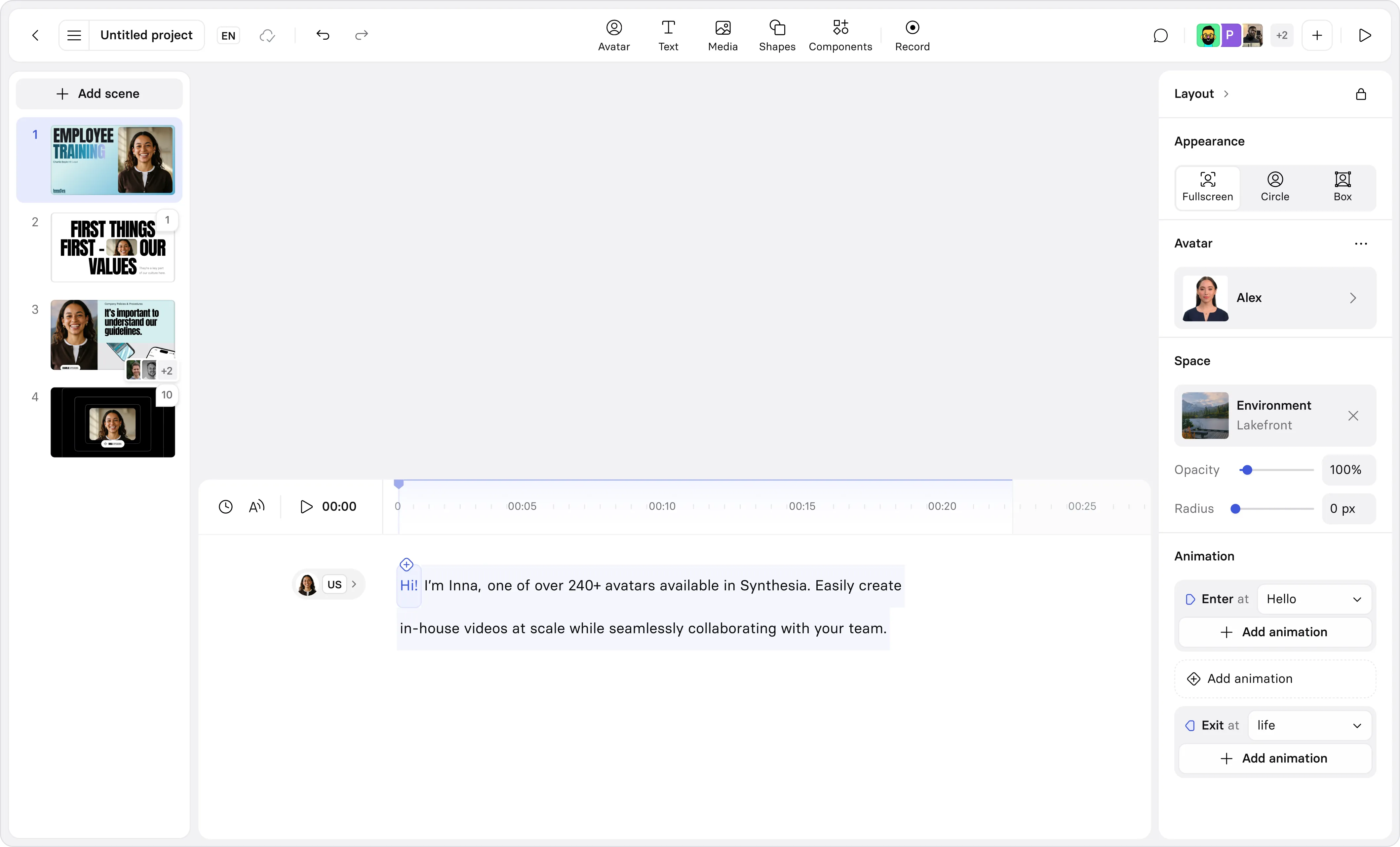
If you're interested in learning how Synthesia can support your eLearning projects, schedule some time with our team.
Amy Vidor, PhD, is the Learning and Development Evangelist at Synthesia, where she researches learning trends and helps organizations apply AI at scale. With 15 years of experience, she has advised companies, governments, and universities on skills.
Frequently asked questions
What is an eLearning development company?
An eLearning development company is a vendor that designs and produces digital learning content. They can be full-service studios or agencies that build tailored programs or specialists focusing on a single capability, like accessibility.
What should enterprises ask before selecting an eLearning development partner?
I recommend creating a structured evaluation criteria based on the scope of your project. This should include considerations such as technical requirements as well as budget, but also should incorporate how updates and revisions are handled. Finally, be sure to ask about evaluation. How is success measured by the vendor (and does it align with your goals)?
When should I hire an eLearning development company vs. use an AI tool?
Hire an agency when you don't have the capability or capacity to manage the work in-house. This is usually the case for programs that require stakeholder discovery, instructional design expertise, or a level of interactivity your team can't produce on their own.
Use an in-house tool when the work is primarily production. Think video-based content, compliance updates, onboarding, or anything that needs to be updated and republished regularly.
Can AI replace eLearning development companies?
That depends on the scope of your project and your internal capabilities. I only feel confident recommending AI as a replacement for expertise when you have someone on the team who can be responsible for maintaining the quality of AI output. Having a human-in-the-loop is essential for any AI use, but especially if you’re looking to have it support instructional design or program architecture.