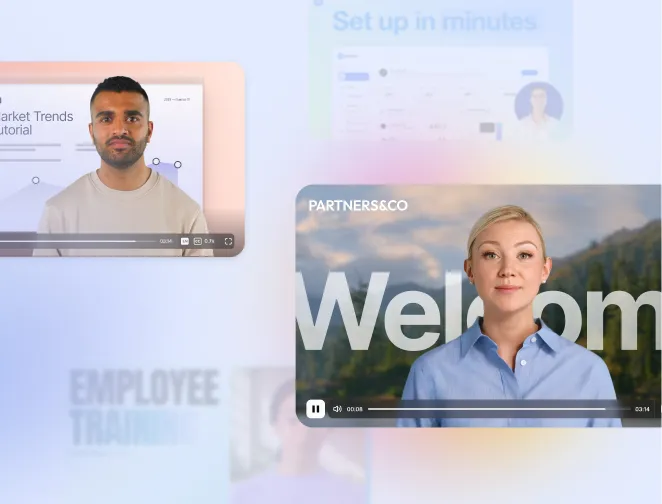




Create AI videos with 240+ avatars in 160+ languages.
Check out the video below to quickly see the 12 best cinematic AI video generators compared side by side with the same prompt.
The best AI video generators
For cinematic video:
- Veo 3.2: Best realism, lighting, physics, and audio
- Sora 2: Best storytelling and emotion, but slow and expensive
- Kling 2.6: Best price-to-quality with strong, reliable visuals
- Seedance 1.5: Longer clips and strong cinematic world-building
- Runway Gen-4.5: Best camera movement, weaker realism
- Luma Ray3: Beautiful look and UI, weak motion, no audio
- PixVerse 5.5: Great short-form motion, limited duration and realism
- Grok Imagine: Fast and artistic, low physical and narrative depth
- Wan 2.6: Very reliable and tolerant, not cinematic
- Pika 2.5: Fun and social-first, low realism
- Adobe Firefly: Strong images, weak video motion
- Hailuo 2.3: Outdated visuals and weak motion
For work:
- Synthesia: Best for avatar-driven internal comms and training videos
How I tested these cinematic AI video generators
To compare these cinematic AI video generators fairly, I ran the same set of prompts through each one, testing both text-to-video and image-to-video where available.
My test prompt
A cinematic aerial shot of a floating city above glowing clouds at golden hour. The camera follows a cloaked traveler riding a hovering speeder, weaving between crystal towers suspended in the air. Below, rivers of light flow between floating islands with waterfalls pouring into mist. Airships drift past in the background, their metallic hulls reflecting sunlight and lens flare. Magic runes flicker on tower surfaces as drones circle. The traveler’s cape ripples in the wind while the camera performs a smooth tracking orbit with natural motion blur and shallow depth of field. Soft volumetric rays pierce through the clouds, creating prismatic reflections. Hyper-realistic textures (metal, glass, fog), cinematic teal-orange color grading, and a warm, atmospheric tone.
My evaluation criteria
To evaluate each AI video generator, I assessed performance across the following criteria
- Generation time: Time required to produce a video (impacts iteration speed)
- Output resolution: The clarity and quality of the final video
- Audio support: Ability to generate or handle synchronized sound
- Failures or visual artifacts: Presence of glitches, distortions, or rendering errors
- Prompt fidelity: How accurately the output matches the prompt’s intent and details
- Motion coherence: Smoothness and logical consistency of movement over time
- Realism: How believable the visuals appear (lighting, physics, textures)
- Visual consistency: Stability of characters, objects, and scenes across frames
- Usability & editing controls: Ease of use and effectiveness of tools for refining outputs
- Prompt sensitivity & reproducibility: How consistent results are with small prompt changes or repeated runs
Comparison table
1. Veo
Quick verdict
Veo 3.2 is one of the most consistently cinematic tools I’ve used, especially when it comes to realism and audio integration. When I tested it, the first thing I noticed was how clean and detailed everything looked. Lighting, atmosphere, and overall scene composition felt very intentional, and the model followed my prompts precisely without any hallucinations or visual drift. The audio also stood out immediately. It was clear, well-synced, and noticeably more polished than most other tools I’ve tried.
What impressed me most was how stable the outputs were. Across both text-to-video and image-to-video, scenes held together well, with strong physical behavior and very few artifacts. Image-to-video in particular felt even stronger, especially in terms of depth, lighting, and environmental detail. The main limitation I felt while using it was in camera movement, which can feel slightly restrained compared to other tools. Generation time is also slow, and with short clip limits, it’s not something I’d use for rapid iteration. Still, in terms of realism, stability, and sound integration, it feels like one of the most production-ready tools available.
Key specs
- Generation time: ~5 to 7 minutes
- Resolution: 1080p (up to 4K)
- Audio: Built-in
- Duration: ~6 to 8 seconds
Performance
- Prompt fidelity – Follows my prompts precisely with no hallucinations
- Consistency – Stable scenes with no visible drift
- Motion – Strong physics, slightly restrained camera dynamics
- Realism – Cinematic lighting, atmosphere, and physical plausibility
- Artifacts – Minimal, with only minor instability in small details
Pros
- I consistently get highly detailed, cinematic visuals
- Prompt adherence is extremely accurate and reliable
- Audio is clean, well-synced, and adds real immersion
- Outputs are stable with very few artifacts
Cons
- Generation takes several minutes per clip
- Camera movement feels somewhat limited
- Clip duration is very short
- Access requires VPN or aggregator in many cases
Best for
I use it when I need maximum realism, strong atmosphere, and clean audio. It works especially well for cinematic shots and short film-style scenes where visual quality and sound design matter most.
2. Sora
Quick verdict
Sora feels like the closest thing to AI-directed filmmaking I’ve used. When I tested it, what stood out immediately was how naturally it builds scenes. It doesn’t just follow the prompt, it adds its own sense of pacing, dialogue, and emotional flow, which makes the output feel like a real short film rather than a generated clip. I saw this most clearly in text-to-video, where character movement, lighting, and environment all came together in a way that felt intentional and cinematic.
At the same time, using it isn’t frictionless. Every generation took close to 10 minutes, and access is still limited, so it doesn’t feel like a tool I can iterate with freely. Audio is promising but not fully polished yet, and the lack of direct editing means I’m relying entirely on prompting. Even with those constraints, it still feels like a step ahead of other tools, especially for storytelling and emotional depth.
Key specs
- Generation time: ~9 to 10 minutes
- Resolution: 720p to 1080p
- Audio: Built-in
- Duration: ~4 to 12 seconds
Performance
- Prompt fidelity – Understands tone, emotion, and narrative extremely well
- Consistency – Scenes feel coherent and story-driven
- Motion – Natural movement with strong camera logic
- Realism – Film-like lighting, physics, and depth
- Artifacts – Very stable with no major issues
Pros
- I can create multi-scene, story-driven videos with dialogue
- Characters feel expressive and emotionally believable
- Cinematic lighting, physics, and world-building are top-tier
- Dialogue, lip sync, and sound are integrated into the scene
Cons
- Generation takes around 10 minutes per clip
- Very expensive per render
- Limited access with invite-only and region restrictions
- No real post-generation editing controls
Best for
I use it when I want to create narrative-driven, emotional scenes that feel like short films. This is the only tool that consistently delivers that level of storytelling.
3. Kling
Quick verdict
Kling 2.6 is the tool I keep coming back to in my workflow because it consistently delivers a strong balance between realism, control, and cost. When I tested it, the results felt immediately cinematic, especially in lighting, textures, and character motion. There were moments where the output genuinely looked like a frame from a sci-fi film, with believable fabric movement, natural lighting, and smooth camera motion that followed the subject in a very controlled way.
What stood out most while using it was how reliable it felt. It consistently understood the mood and visual intent of my prompts, and I didn’t have to fight the system to get usable results. Motion physics are among the most convincing I’ve seen, which makes a big difference for character-focused scenes. There are still some weaknesses, especially in background detail where elements can become soft or slightly unstable, and audio can occasionally behave unpredictably. But overall, it feels like one of the most production-ready tools available, especially considering its price-to-quality ratio.
Key specs
- Generation time: ~3 to 4 minutes
- Resolution: 1080p
- Audio: Built-in
- Duration: ~10 seconds
Performance
- Prompt fidelity – Strong understanding of mood, lighting, and intent
- Consistency – Generally stable, with some softness in background elements
- Motion – Very strong physics and camera movement
- Realism – High-quality lighting, textures, and cinematic depth
- Artifacts – Minor instability in distant or complex details
Pros
- I get very realistic lighting and textures, especially on characters
- Motion physics feel natural and physically believable
- Prompt interpretation is reliable and consistent
- Strong balance between quality and cost
Cons
- Background elements can become soft or unstable
- Maximum clip length is limited
- Audio can be inconsistent or include unwanted voice elements
Best for
I use it as my default tool for cinematic video generation, especially for character-driven scenes, commercial work, and projects where I need a strong balance between realism, reliability, and cost.
4. Seedance
Quick verdict
Seedance 1.5 surprised me more than I expected. When I tested it, the results felt creative and cinematic right away, especially in how scenes were constructed and paced. The model doesn’t just generate motion, it builds out environments with a clear sense of direction. I noticed this most in text-to-video, where camera movement and composition felt intentional rather than random.
What stood out even more was image-to-video. It was able to expand a single image into a much larger, coherent world while keeping the original style intact. The sense of scale and atmosphere was impressive, and it felt like the tool was moving toward real scene continuation rather than just short clips. That said, motion physics are not as stable as in Kling or Veo. I could see inconsistencies in object interactions, which makes it less reliable for realism-focused work. Still, the longer clip duration and strong creative direction make it one of the most interesting tools I’ve tested.
Key specs
- Generation time: ~2 to 3 minutes (text-to-video), up to ~7 minutes (image-to-video)
- Resolution: 1080p
- Audio: Built-in
- Duration: ~8 to 12 seconds
Performance
- Prompt fidelity – Strong interpretation with creative extensions
- Consistency – Visually coherent, with some instability in motion physics
- Motion – Good camera work, weaker object interaction
- Realism – Cinematic atmosphere, but less physically accurate
- Artifacts – Minor issues tied to physics instability
Pros
- I can generate longer clips than most tools
- Strong cinematic atmosphere and scene composition
- Image-to-video creates impressive world expansion from a single frame
- Results feel creative and visually ambitious
Cons
- Motion physics are less stable than top-tier tools
- High credit cost per generation
- Limited control beyond prompting
- Access is mostly through aggregators
Best for
I use it when I want longer cinematic clips or to expand a single image into a larger scene. It works especially well for atmospheric storytelling and creative world-building, where realism is less critical than visual direction.
5. Runway
Quick verdict
Runway Gen-4.5 feels more like a creative experimentation tool than something I’d rely on for final output. When I tested it, the first thing that stood out was the camera work. The tracking shots felt smooth and intentional, and in text-to-video it created a strong cinematic feel right away. It’s one of the better implementations of camera movement I’ve seen across these tools.
But once I looked closer, the limitations became obvious. As soon as the camera starts moving, detail quality drops, objects blur, and parts of the scene lose stability. The overall result feels closer to a game cinematic than a film-level render. Image-to-video was even more disappointing. The original image looked strong, but the moment it was animated, the scene lost clarity, motion consistency, and even prompt accuracy in some cases.
What I do like about Runway is the broader ecosystem. The interface is clean, the workflow tools are powerful, and it clearly supports more advanced creative pipelines. But purely in terms of video output quality, it still lags behind tools like Kling, Veo, or Sora.
Key specs
- Generation time: ~5.5 minutes (text-to-video), ~30 seconds (image-to-video)
- Resolution: 720p
- Audio: Not supported in video generation
- Duration: ~10 to 12 seconds
Performance
- Prompt fidelity – Follows core idea, but loses accuracy in motion
- Consistency – Breaks down during camera movement
- Motion – Strong camera work, weaker object stability
- Realism – Good composition, but lacks detail and physical accuracy
- Artifacts – Noticeable blur and distortion in motion
Pros
- Camera movement feels smooth and cinematic
- Interface is clean and intuitive
- Strong ecosystem with editing and workflow tools
- Good for creative experimentation
Cons
- Detail breaks down during motion
- Image-to-video loses quality and consistency
- No built-in audio in video generation
- Expensive relative to output quality
Best for
I use it when I’m exploring visual ideas or testing creative concepts, especially when camera movement matters. It works better as a prototyping tool than for final, production-ready video.
6. Luma Dream Machine
Quick verdict
Luma feels like one of the most polished and enjoyable tools to use from a design perspective. When I tested it, the interface immediately stood out. Everything is clean, intuitive, and thoughtfully designed, which makes the whole experience feel smooth and creative rather than technical. It’s one of the few tools where I actually enjoyed the process of generating, not just the result.
In terms of output, the results are visually strong but more stylistic than realistic. I found it performs best with calm, atmospheric scenes where lighting, composition, and mood take priority. In those cases, the visuals feel elegant and cohesive. However, as soon as I pushed it into faster motion or more complex action, physics started to break down and objects blended unnaturally. Image-to-video handled motion slightly better, but it still doesn’t reach the realism of top-tier tools like Veo or Sora.
What makes Luma stand out is the balance between usability and creative control. Features like presets, camera options, and the Modify editor make it easy to refine outputs without overcomplicating the workflow. It’s not the strongest tool for realism or action, but it’s one of the most enjoyable and well-designed tools I’ve used.
Key specs
- Generation time: ~2 to 7 minutes depending on mode
- Resolution: 720p to 4K (up-res available)
- Audio: Not supported natively
- Duration: ~5 to 10 seconds
Performance
- Prompt fidelity – Strong understanding of visual tone and style
- Consistency – Stable in slower scenes, weaker in fast motion
- Motion – Smooth in simple scenes, unstable in complex movement
- Realism – Stylized and aesthetic rather than fully realistic
- Artifacts – Visible issues during fast motion or complex action
Pros
- The interface is clean, intuitive, and genuinely enjoyable to use
- Strong visual style with beautiful lighting and composition
- 4K up-res option adds flexibility
- Modify editor and presets make refinement easy
Cons
- Struggles with complex motion and physics
- No built-in audio generation
- Text-to-video is less dynamic than competitors
- Short clip duration
Best for
I use it when I want aesthetically driven visuals, especially for atmospheric scenes, design work, or mood-based storytelling where style matters more than realism.
7. PixVerse
Quick verdict
PixVerse V5.5 feels fast, accessible, and surprisingly capable for short-form content. When I tested it, what stood out immediately was how quickly I could go from prompt to result. In under two minutes, I had a fully generated clip that already felt cinematic in terms of mood and camera movement. It’s one of the few tools where iteration feels easy and responsive.
The model handles atmosphere and composition well, and camera dynamics are genuinely engaging. Scenes feel alive and visually interesting, especially for short clips. At the same time, the limitations become clear as soon as you look closer. During faster motion, details break down, objects blur, and physics lose accuracy. The short duration cap also cuts scenes off just as they start to develop, which makes it harder to build narrative depth.
Overall, it feels like a tool optimized for speed and impact rather than precision. I wouldn’t rely on it for high-end cinematic work, but for quick, visually engaging clips, it performs very well.
Key specs
- Generation time: ~1.5 to 2 minutes
- Resolution: 1080p
- Audio: Built-in
- Duration: ~5 to 6 seconds
Performance
- Prompt fidelity – Strong on mood and composition, less precise in motion
- Consistency – Holds together visually, but detail drops during movement
- Motion – Dynamic and engaging camera work
- Realism – Good cinematic feel, limited fine detail accuracy
- Artifacts – Blur and instability during fast motion
Pros
- Very fast generation makes iteration easy
- Strong cinematic atmosphere and visual style
- Dynamic camera movement keeps scenes engaging
- Affordable and accessible with generous free credits
Cons
- Very short clip duration limits storytelling
- Loss of detail during fast motion
- Audio quality lacks clarity and depth
- Not suitable for high-realism projects
Best for
I use it when I need fast, visually engaging clips for social content or quick experiments. It works best for short-form videos where speed and impact matter more than precision or realism.
8. Grok Imagine
Quick verdict
Grok Imagine was one of the biggest surprises for me. I went into testing it without expectations, but the first result immediately stood out. The output felt creative, expressive, and different from anything else I’ve used. It doesn’t just follow the prompt literally, it interprets it in a more artistic and sometimes unpredictable way, which gives the results a unique personality.
What really stood out while using it was the speed. Generations completed in seconds, which made it incredibly easy to experiment and iterate. At the same time, it’s clear this tool is not focused on realism. The visuals feel more stylized and sometimes closer to Luma in tone, especially in image-to-video. It also lacks key features like audio and deeper editing controls, which limits how far you can take the output.
Overall, it feels more like a creative sketch tool than a production system. It’s fast, expressive, and fun to use, but not something I’d rely on for high-end cinematic work.
Key specs
- Generation time: ~10 to 15 seconds
- Resolution: 720p
- Audio: Not supported
- Duration: ~5 to 15 seconds
Performance
- Prompt fidelity – Creative and expressive, but less precise
- Consistency – Generally stable, with stylized interpretation
- Motion – Smooth and simple, not physically accurate
- Realism – Stylized and artistic rather than realistic
- Artifacts – Minimal technical issues, limitations are more stylistic
Pros
- Extremely fast generation makes experimentation easy
- Unique, artistic interpretation of prompts
- Simple and intuitive interface
- Stable and reliable performance
Cons
- Lacks realism compared to top-tier tools
- No audio or lip sync support
- Limited editing and customization options
- Feels less production-ready overall
Best for
I use it when I want to quickly explore ideas or create stylized, expressive clips. It works well as a fast creative tool for mood, concepts, or visual experimentation rather than polished final output.
9. Wan
Quick verdict
Wan 2.6 feels like a practical, reliable tool that I can depend on when others fail, rather than something I’d use for cinematic quality. When I tested it, it handled prompts clearly and consistently, and the overall scene structure made sense right away. Camera movement and lighting were solid, and the results were usable without much effort.
What stood out most in practice was how flexible it is with prompts. In cases where other tools refused to generate certain scenes, Wan handled them without issues, which makes it very useful in real workflows. At the same time, the visual style leans more toward stylized or slightly cartoonish rather than truly realistic. Motion and physics are not as strong as top-tier tools, and audio, while present, still contains noticeable artifacts.
Overall, it feels like a dependable workhorse. It may not deliver cinematic perfection, but it consistently gets the job done and allows ideas to move forward without unnecessary friction.
Key specs
- Generation time: ~1 to 5 minutes depending on mode
- Resolution: up to 1080p
- Audio: Built-in
- Duration: up to ~15 seconds
Performance
- Prompt fidelity – Handles intent well, even with sensitive prompts
- Consistency – Stable and reliable across outputs
- Motion – Decent camera movement, weaker object physics
- Realism – Stylized rather than fully cinematic
- Artifacts – Noticeable issues in physics and audio quality
Pros
- Very reliable and consistent generation
- Handles prompts that other tools may block
- Supports longer clip durations than most tools
- Built-in audio adds basic immersion
Cons
- Visual style is less realistic and more stylized
- Weak object physics and interaction
- Audio quality includes noticeable artifacts
- Limited editing and control options
Best for
I use it as a fallback or support tool when other models fail to generate a scene. It works well for practical storytelling and workflows where flexibility and reliability matter more than cinematic realism.
10. Pika
Quick verdict
Pika 2.5 feels more like a creative playground than a serious production tool. When I tested it, I could see improvements compared to earlier versions, especially in color grading and overall atmosphere. The model communicates the idea of the prompt more clearly now, and the results are more engaging than before.
That said, it still feels far from cinematic. Motion physics are simplified, scenes lack depth, and the overall output doesn’t hold up against tools like Kling or Veo. Image-to-video in particular struggled. While it’s slightly improved, motion still feels fragile, with visible blur and weak interaction between objects and the environment. The lack of audio is also a major limitation.
Overall, it’s fun and expressive to use, but it doesn’t meet the standard I’d need for professional or high-quality video work.
Key specs
- Generation time: ~1.5 to 4 minutes
- Resolution: up to 480p (free plan)
- Audio: Not supported
- Duration: ~5 to 10 seconds
Performance
- Prompt fidelity – Understands ideas, but lacks depth in execution
- Consistency – Fragile during motion, especially in image-to-video
- Motion – Simplified and not physically accurate
- Realism – Low, more stylized and playful
- Artifacts – Blur and instability during movement
Pros
- Improved color grading and atmosphere compared to earlier versions
- Fast and easy to experiment with
- Good for playful, attention-grabbing visuals
- Accessible through a free plan
Cons
- Very low resolution on free plan
- Weak motion physics and object stability
- No audio support
- Not suitable for cinematic or professional use
Best for
I use it for quick experiments or playful, social-style content. It works as a creative sandbox, but not for polished or production-ready video.
11. Adobe Firefly
Quick verdict
Firefly feels like an early-stage video tool inside a very mature ecosystem. When I tested it, the first thing I noticed was the interface. It felt cluttered and harder to navigate compared to other AI tools, especially at the beginning. There are a lot of panels and options, and it took time to figure out where everything was. That said, once I got used to it, the integration with the broader Adobe environment started to make more sense.
Generation speed was surprisingly fast. I was getting results in about a minute, which made it easy to test ideas quickly. But the actual video output didn’t match that speed. The results felt underwhelming in terms of realism, motion, and prompt execution. Scenes lacked depth, physics didn’t feel convincing, and important elements from the prompt were sometimes simplified or missing.
Where Firefly stood out more was in image generation and ecosystem integration. It works well as part of a larger workflow, especially if I’m already using tools like Photoshop or Premiere. But as a standalone video generator, it doesn’t compete yet with tools like Kling, Veo, or Sora.
Key specs
- Generation time: ~60 to 75 seconds
- Resolution: up to 1080p
- Audio: Not supported natively
- Duration: ~5 seconds
Performance
- Prompt fidelity – Inconsistent, some elements are lost or simplified
- Consistency – Stable generation, but weak scene depth
- Motion – Limited and not physically convincing
- Realism – Lacks cinematic quality and detail
- Artifacts – No major glitches, but overall quality is low
Pros
- Fast generation makes it easy to test ideas
- Strong integration with Adobe Creative Cloud
- Image generation quality is very strong
- Stable and reliable performance
Cons
- Video quality is not competitive with top tools
- Interface feels cluttered and unintuitive at first
- No native audio support
- High credit cost per generation
Best for
I use it as part of a broader Adobe workflow when I need quick motion from static visuals. It works best for concepting and creative exploration, not for final cinematic output.
12. Hailuo
Quick verdict
Hailuo 2.3 feels outdated compared to most of the other tools I tested. I had higher expectations going in based on earlier versions, but the results didn’t hold up. The model follows prompts on a basic level, but the output lacks depth, realism, and overall visual quality. The scenes felt more like older game cinematics than anything close to film-level rendering.
I also ran into practical issues while testing. On one platform, the tool wouldn’t generate results at all for certain prompts, which forced me to switch to another aggregator just to complete the test. Even when it worked, the results were underwhelming. Motion felt limited, camera movement was minimal, and the overall scene lacked energy. Image-to-video was slightly better visually, but still not strong enough to compete with other tools.
Overall, it doesn’t feel like a tool I’d use in my workflow. It may have some interesting elements in image generation, but for video, it falls behind current standards.
Key specs
- Generation time: ~3 minutes (text-to-video), up to ~12 minutes (image-to-video)
- Resolution: up to 1080p
- Audio: Not supported
- Duration: ~6 to 10 seconds
Performance
- Prompt fidelity – Follows prompts at a basic level
- Consistency – Stable, but visually weak
- Motion – Minimal camera movement and weak dynamics
- Realism – Low, feels outdated compared to competitors
- Artifacts – Low detail and lack of polish rather than specific glitches
Pros
- Decent atmosphere and color grading in some scenes
- Interesting fabric simulation in certain cases
- Stable generation when it works
Cons
- No audio support
- Weak realism and outdated visual quality
- Minimal camera movement and low detail
- Not competitive with leading tools
Best for
I wouldn’t include it in my regular workflow. It may be useful for basic experimentation or concept visuals, but not for cinematic or production-quality video.

Kyle Odefey is a London-based filmmaker and Video Editor at Synthesia. His content has reached millions across TikTok, LinkedIn, and YouTube, even inspiring an SNL sketch, and has been featured by CNBC, BBC, Forbes, and MIT Technology Review.


Frequently asked questions
What’s the best AI video generator for business use cases like training, onboarding, and internal comms?
Synthesia. It turns scripts and docs into presenter-led videos with realistic avatars, 1-click translation, LMS exports, brand kits, and team workflows. If you want extra B-roll, pair Synthesia with Veo 3.1 or Sora 2 clips inside the same project.
What’s the best AI video generator for cinematic short films and emotional storytelling?
Veo 3.1 for the most natural acting, lighting, and camera language. If you have access, Sora 2 is excellent for multi-scene narrative flow. For strong results at a saner price, Kling is the practical alternative. Learn more about other AI video generator models.
What’s the best AI video generator for fast social ads with sound in one tool?
PixVerse. Quick renders, built-in audio and optional speech, solid prompt control, and handy features like Fusion and Swap. Runners-up: Runway (great polish and 4K upscale) and Seedance for clean, stable motion.
What’s the best budget-friendly AI video generator for quick, reliable output?
Wan. Very low cost for short 720p/1080p clips, fast, and stable. Consider Seedance for similarly clean, dependable motion, and PixVerse off-peak pricing when you also want audio.
What’s the best AI video generator for product demos and app promos?
Runway. Excellent UI, strong image-to-video, scene expansion, and 4K upscale. If you’re starting from high-quality stills, Seedance or Kling add smooth motion and good physics.
What’s the best AI video generator for fashion, perfume, or mood-driven brand visuals?
Hailuo for gorgeous lighting, texture, and cinematic feel when atmosphere matters most. Luma Dream Machine is a close second for elegant, dreamy aesthetics and a great UX. For fast, artsy sketches, Grok Imagine is interesting.
What’s the best AI video generator for YouTube explainers and tutorials?
Synthesia. Presenter-led formats, clear voice options, templates, on-brand visuals, and translations make repeatable explainer production easy. Add Runway or PixVerse for quick B-roll, motion accents, and sound.
What’s the best AI video generator for multilingual localization at scale?
Synthesia. It handles 160+ languages with 1-click translation, natural voices, localized avatars, and LMS-friendly exports—perfect for turning one master video into many regional versions. For on-brand visuals, layer in Veo 3.1 or Sora 2 B-roll where needed.