



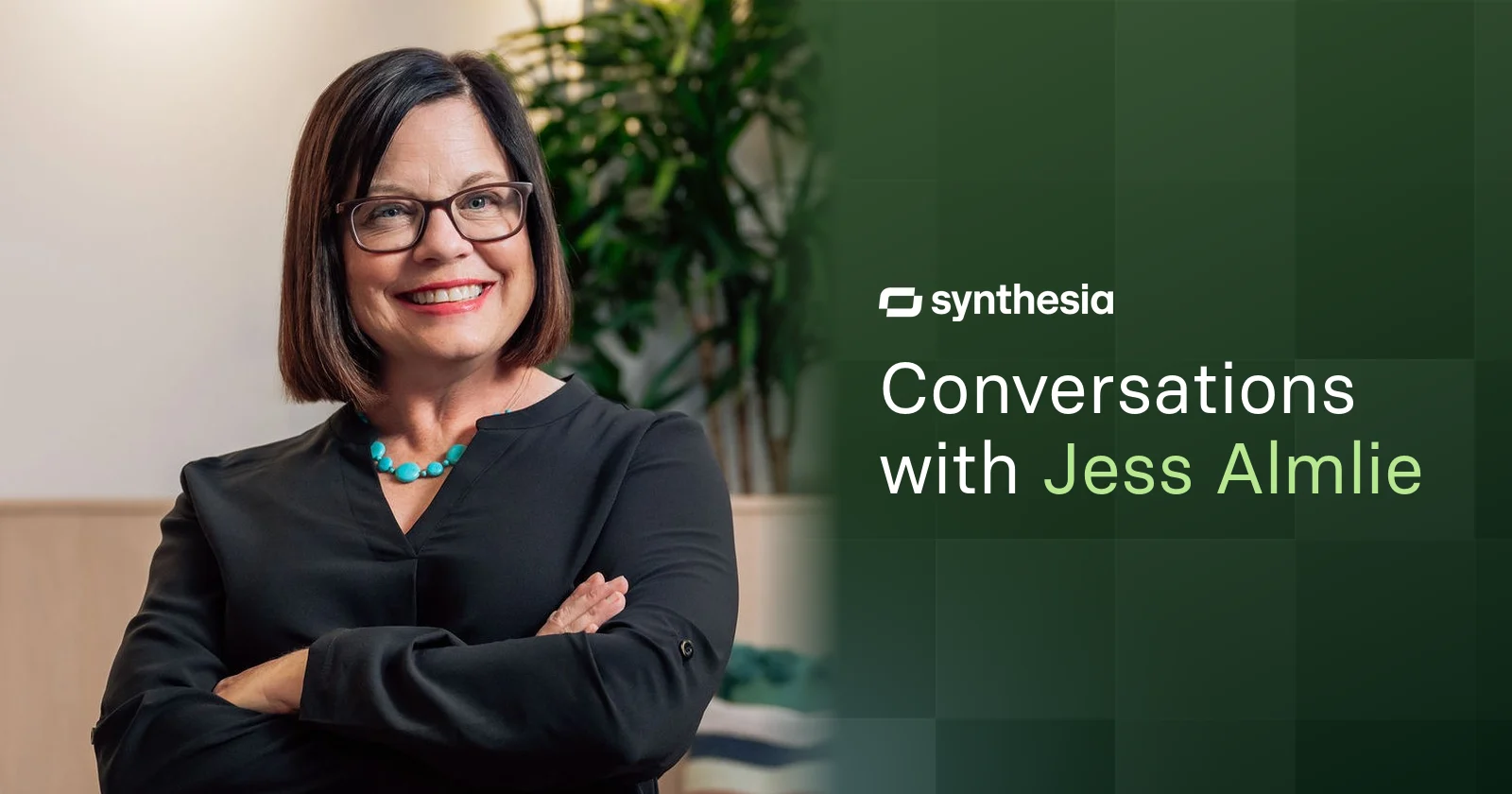
Conversations with Jess Almlie: From Order Taker to Strategic Business Partner

Create training videos aligned to your business goals.
Key Takeaways
To move from being Order Takers to Strategic Business Partners, L&D professionals should:
- Build business acumen and change management skills
- Join cross-functional meetings and ask really good questions, so you can align your L&D work with business priorities
- Use AI to learn the business faster and make time for strategic work
- Treat measurement as a collaborative activity and evaluate training with the measures the business already tracks
I had the pleasure of interviewing Jess Almlie, author of L&D Order Taker No More! and host of the L&D Must Change podcast. We talked about her career in L&D, the skills needed to transform how L&D approach and measure their work, and how AI is (or isn’t) changing the work we do.
Our Conversation
You’ve spent your career working in L&D. What keeps you here?
If I go all the way back, I’ve been in a learning and talent development role in some way, shape, or form my entire career.
It started in college, when I was a trainer at McDonald’s. I come from a family of teachers and software engineers, and I love education, communication, and development. But even in college I knew I didn’t want to stand in front of a classroom all day or do classroom management.
My first role out of college was orientation coordinator at a company in the Twin Cities, running new employee orientation. I thought, this is fun. I moved into a training coordinator role, and from there I’ve had really all the jobs, from coordinator to LMS administrator to design, development, and delivery.
What keeps me here is three things. People fascinate me. Then there’s creativity and strategy. Learning and talent development is this role where we have the opportunity to be creative, come up with creative solutions to problems. And we can do that strategically, in alignment with whatever the larger goals are of whatever we’re working at, or the highest priority.
Speaking of classroom management, a lot of teachers transition into L&D roles. What do you think is hardest about making that transition?
When I was leading learning and talent development teams, I hired a lot of former teachers, and I loved it. They were super organized, could get more done in a day than anyone else, and were creative.
The thing they always had the hardest time with was how to work within a business setting. They understood learning, working with people, organizing, and managing projects. What I had to bring people along on was what it means to work in a business. As a teacher, you’re pretty solo. You may have a curriculum you’ve been asked to teach, but you have a lot of bandwidth in how you do it, and you don’t really run it by people.
In an organization, you have to create learning that aligns to the greater business, and you have continuous, collaborative conversations with stakeholders. It isn’t necessarily your subject matter expertise that you’re teaching or creating. That requires you to think, act, and conduct yourself a little differently.
In your book, L&D Order Taker No More!, you write about how L&D professionals can stop being Order Takers and become Strategic Business Partners (SBPs). What skills does an SBP need?
There are two key skills.
The first is business acumen. What business acumen means to me is the context of the entire business and how it operates.
If we’re really going to show up as people who are there to advance the business through the development of people, we have to know what the business is and what it does.
If you can amp up your business acumen, it increases your credibility. It allows you to walk into conversations with stakeholders in a different way, because you’re speaking the same language. Then you can figure out where learning and talent development fits.
The second is change management. It’s important to understand how change management happens, whether or not you have control of it. You can even just understand what’s happening, and maybe where you need to ask questions.
How would you encourage someone, whether they’re new to L&D or a seasoned practitioner, to learn how the business really works, especially when the company goes through a change like a re-org, merger, or acquisition?
When your organization is acquired, it’s like you have a new job and nobody told you. You work for a new organization even though you’re doing the same thing, and a lot of the rules that used to apply no longer do.
If the change management isn’t done well, and in my experience, and talking with others, it’s not done well very often, some of those things will pop up as surprises. And so it’s important to be nimble and communicate transparently. I was always a very transparent communicator with my team, no matter what. I’d say, “As soon as I know and I can tell you, I will.”
When I was doing the research for the book, I realized that nobody in L&D is given this lovely handbook when you start at a new organization, or an organization acquires you, either way, that has everything in it: who makes decisions, how the org is structured, where the major revenue sources are, and those unwritten rules of communication and culture.
The people who succeed are really scrappy. They’re picking up puzzle pieces about the organization everywhere they go. Every conversation they have is an opportunity to garner a new insight about how the organization works. And so a lot of it is just paying attention, because those things aren’t written down, and asking really good questions.
In your book, you share an anecdote about how to insert yourself in meetings to learn more about the business. A leader tells his team that if they aren’t invited, they should “drag their own chair up to the table,” kindly and excitedly, ready to help (p. 45). When you work with L&D teams, which conversations do you tell them to pull their chair up to?
Drag your chair into any conversation where you think you’ll learn something about the business specifically, or about an area of the business that you work with on a regular basis.
When I was interviewing folks, they did insert themselves. They were scrappy, they were assertive. I asked them, “Do you ever get pushback on that, pulling your chair up?” Most of them said, “Not really. And if we do, we say something like, ‘I don’t need to speak in the meeting. I just want to sit in and listen so I can learn more about your part of the business so I can be a better learning partner to you.’” And usually that got them in the door.
I find that when you start at a new organization, you have more leeway to ask people for their time and learn how they work. But that goodwill period doesn’t last. What advice do you have for people who have been operating as Order Takers at their company for years and want to change their relationship with the business?
It’s easier when you can play the new card, but I don’t think you need the new card. People are usually still willing to share. If you say, “I’d like to learn more about how sales operates. Are you a good person that I could learn that from, or is there somebody else who’d be willing to sit down with me for 20 minutes so I can ask a few questions? I’m trying to be the best partner I can to the entire organization, which means I want to really understand it.” That can still work.
You don’t have to wait for a meeting to learn about the business. It’s great because it also helps in building a relationship when you can get a meeting, but there are a lot of other ways to find out about what’s going on in a part of the organization without having a meeting first.
You can access some kind of report, or you can dive into the intranet, or you can ask AI some questions about that area. And then you have a different way of asking for that. You can say, “I’ve been learning more about the business, and I’ve been reviewing the different sales reports that you put out recently, and I just have some questions as to what they mean. Would you be willing to explain them to me?”
And so now I’m having a different conversation, because I’m able to zoom in a little bit more, because I’ve done a little bit of research first. It up-levels your credibility a little bit that way, too. It’s as much internal networking as it is anything else.
A lot of times we only think about networking when we’re looking for a job, and we want to go out and meet people. Networking you should be doing all the time, even if you’re in an organization, just so that you’re creating those relationships. And especially in L&D, because part of our job is usually to work with a lot of different stakeholders, and so getting to know people across the organization is helpful.
If you do get time with somebody, it’s a combination of curiosity, assertiveness, and humility. The humility to say, “I don’t really know all of this, and you’re the expert, so I’d love to learn from you.” But then also, as people say something, the ability to ask additional questions and get a little bit deeper.
Working at an AI-native company, I’ve been struck by how much information about the business I have access to thanks to AI tools, like why decisions were made and how priorities shifted. How can L&D professionals use AI to learn more about how their business really works?
I do train several workshops on acquiring business acumen, and we do use AI. That’s one of the things I say: go out to your favorite AI and just start asking questions about the company that you work for. What are the biggest challenges here? Just see what it comes back with. Then you can verify that, but it gets you much further, much faster.
That is probably, right now, what I see as the biggest advantage to AI in our profession when it comes to learning more about how the business works.
How else is AI changing the way L&D spends its time, and what does that make possible for partnering with the business?
We’re able to shift and do a lot of transactional and operational tasks using AI, and that makes it a lot faster than it has in the past.
Now, I would also argue that we’re all figuring it out right now, just like everyone else. Nobody has this nailed down. But I do think it makes it easier. If we have more time available, it allows us more time to dive into strategic and collaborative work that we might not have had time to do before.
And when I do that type of work, what I’m looking for is, what are the challenges happening in the organization right now?
It doesn’t matter how much AI we have, we’re always going to have talent challenges. And talent challenges are what learning and talent development is made to solve for.
And so we are listening for that, we’re asking about that, we’re diving in, so that then we can proactively make recommendations about where the best use of our expertise is.
Instead of waiting for somebody else to come to us and say, “I need this,” we’re saying, “Hey, I’ve been seeing on your report, for example, or I’ve been hearing in your communications that you’re not meeting the turnaround times in your customer service team right now. Can we dive into that a little bit more? I’d like to learn more about that.” Not from a “I want to hold you accountable,” but from a “I want to partner with you in problem solving this.”
If you could change one thing about how L&D measures impact, what would it be?
The thing we get tripped up on sometimes, and for good reason, is that we think we have to figure out all of the measures ourselves. Often, we’ll do a survey. But the measures we should be leaning on already exist. We don’t own them. They exist in the business.
One of the mantras I find myself repeating a lot is that measurement is a collaborative activity.
What are the measures you’re watching in the business that show whether things are changing, or whether people are doing their work well and succeeding? Now let’s see if we can impact those measures. Let’s not create a separate survey that somebody has to find time in their day to take. It’s not worth it.
I always start with what already exists. And what already exists means we usually have to collaborate with the business in order to at least see, if not have access to, that data.
Any last thoughts on what it will take for L&D to make this shift?
There’s a lot of us trying to say, think about the work we do differently. As long as we stay at the surface level, we will never get any further. But it’s a culture change. That’s what we’re talking about, because it’s not just L&D saying we need to change. It’s us, and everybody else that we work with, realizing that we can do work differently. And that’s been deeply embedded for many years.
Read Jess's book: L&D Order Taker No More!
Listen to Jess's podcast: L&D Must Change
About Jess
Jess Almlie is an award-winning Learning and Talent Development Transformation Leader and former Vice President of Learning who helps organizations mature their L&D function from transactional order taking to strategic business partnership. With over 30 years of experience, she works with leaders and teams to align learning to business strategy, strengthen capability, and drive measurable performance.
Amy Vidor, PhD, is the Learning and Development Evangelist at Synthesia, where she researches learning trends and helps organizations apply AI at scale. With 15 years of experience, she has advised companies, governments, and universities on skills.