



How to Create Leadership Training Videos that Scale

Create engaging training videos in 160+ languages.
Leadership is a skill, not a job title.
I used to facilitate a program for emerging engineering leaders. Each cohort included two dozen engineers, nominated by someone in the org. Someone who viewed them as belonging to the next generation of company leaders. Not necessarily the next CTO, but the individuals who would have influence over the business.
So the company invested in a program that brought these engineers together to build skills, like influencing without authority and collaborating cross-culturally. These skills were chosen because they laddered into leadership principles articulated by the org's leadership committee.
The success of any leadership training starts with a shared understanding of leadership principles, what it means to be a leader in your company. Once those principles exist, they need a way to reach every leader. That's where training videos come in.
How to map leadership principles to capabilities
If you already have leadership principles and capabilities, skip right along to learn more about how to use videos as part of your training strategy.
Before you can create a training video, you need to know which capabilities align to your leadership principles.
Think of it this way: if principles describe what an organization expects from leaders, then a capability map translates those expectations into observable behaviors. That's what tells you which capabilities you're building with any given training, so you can write an accurate learning objective and business outcome.
Let's say one of my leadership principles is, "Leaders understand their impact on others." (I know, broad and vague, like most principles I've seen written.) The capability that ladders up to this principle is emotional intelligence.
To build a capability map from this principle, I would:
- Define several observable behaviors related to this capability (e.g., adapting to others' emotional needs, being empathetic)
- List examples of when these behaviors commonly show up (e.g., during 1-on-1s, in high-pressure situations)
- Prioritize these examples in order of impact
From this mapping exercise, I would then decide what to turn into training videos.
I might decide to teach Daniel Goleman's emotional intelligence framework to build this capability, a good fit for capability building, since I'm developing multiple skills toward one capability rather than responding to a single moment. I might then break his framework down into a four-part series on self-awareness, self-management, social awareness, and relationship management.
How to create leadership training videos with AI
Once you have your leadership principles and capability map, you're ready to build your leadership training videos. You can do that a few different ways: hand off production to a vendor, design a traditional training video using eLearning authoring tools, or use an AI platform like Synthesia.
No matter your production method, for video-based training to be effective, it needs to be grounded in a clear learning objective and business outcome. You can use a template like this:
This video is for [specific role] who currently [context or gap]. After watching, [specific role] should be able to [observable action] so that [business outcome].
I’ll be using an example from the emotional intelligence series above to illustrate how to build a training video in Synthesia.
Step 1. Generate a first draft
Head over to our free AI video generator to get started. You can upload existing source materials, paste a script, or enter a prompt, like I’ve done below.
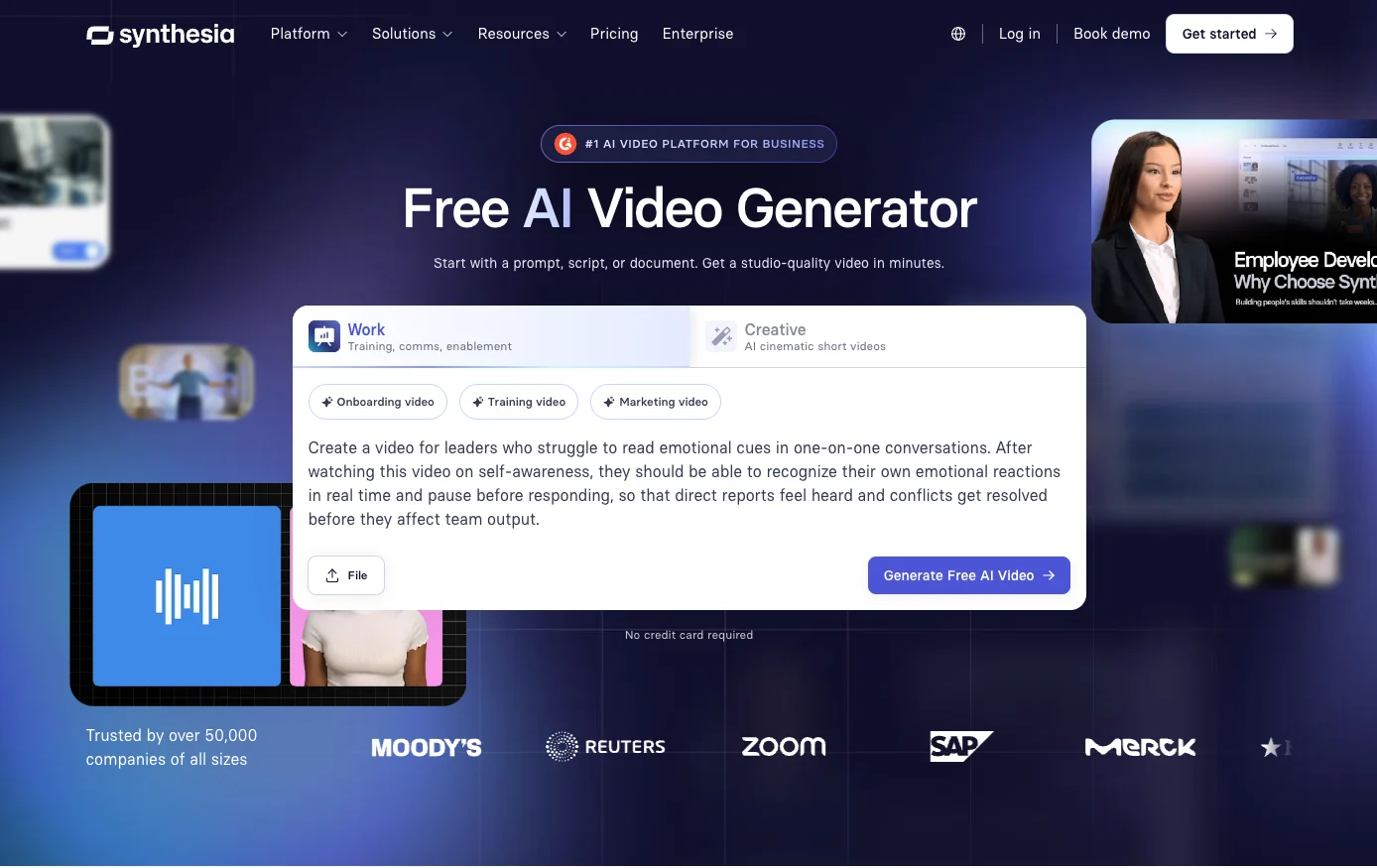
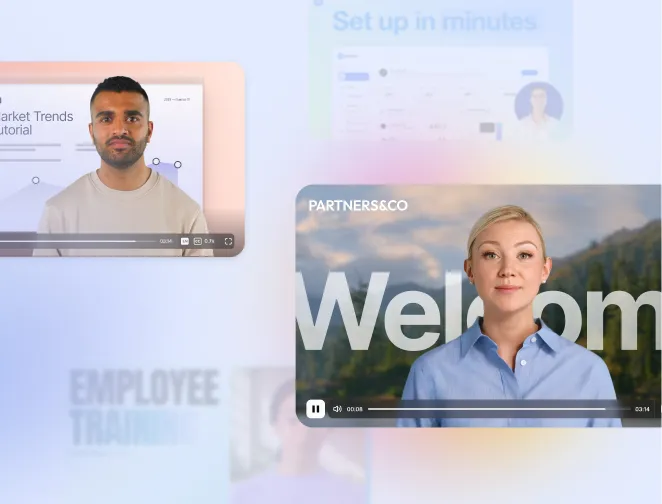
Or, if you prefer a more structured approach to building your video, try out one of our templates, like the one below. If you prefer to focus on the content, or find it hard to make videos “look nice,” I recommend this approach. You’ll still have full editorial control over the final product.
Step 2. Choose your avatar
Next, choose your avatar. The avatar sets the tone for the training, which is especially important for leadership training. (Our enterprise customers often create a digital twin of themselves to use.)
Customize their appearance and voice to match your brand and audience. Pay attention to accent and pronunciation. You have full control over how things get pronounced, which helps you create consistency across your training library.
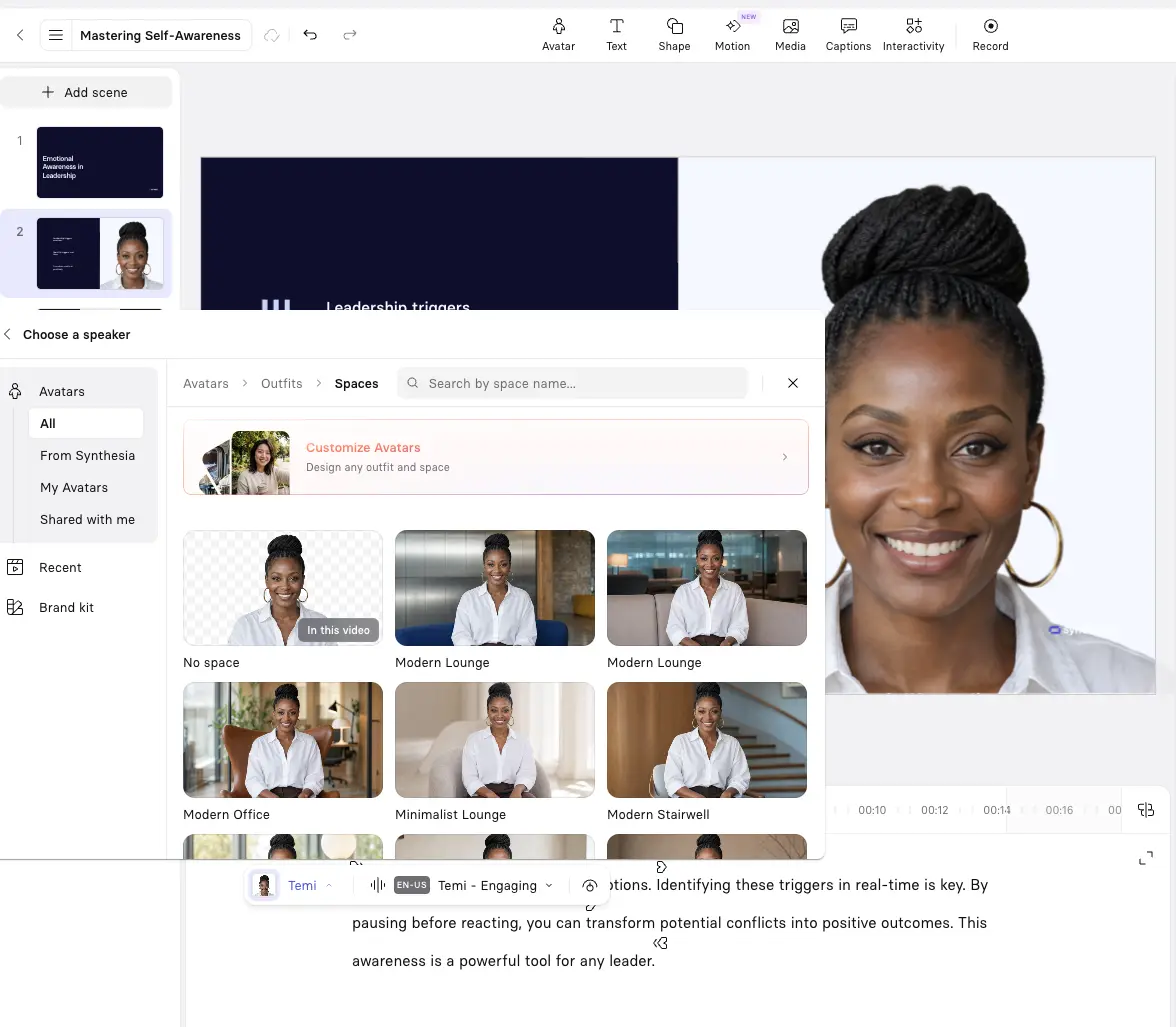
Some customers prefer to use only narration in some scenes, as having an avatar onscreen adds to cognitive load.
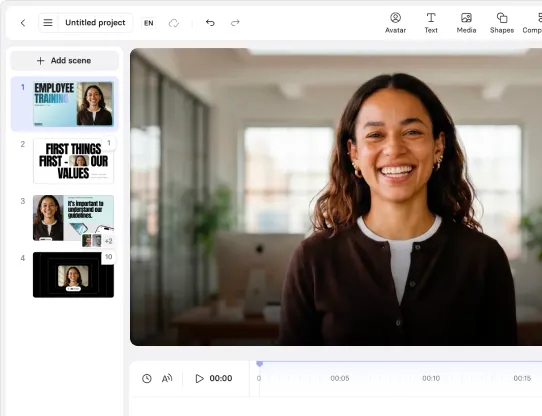
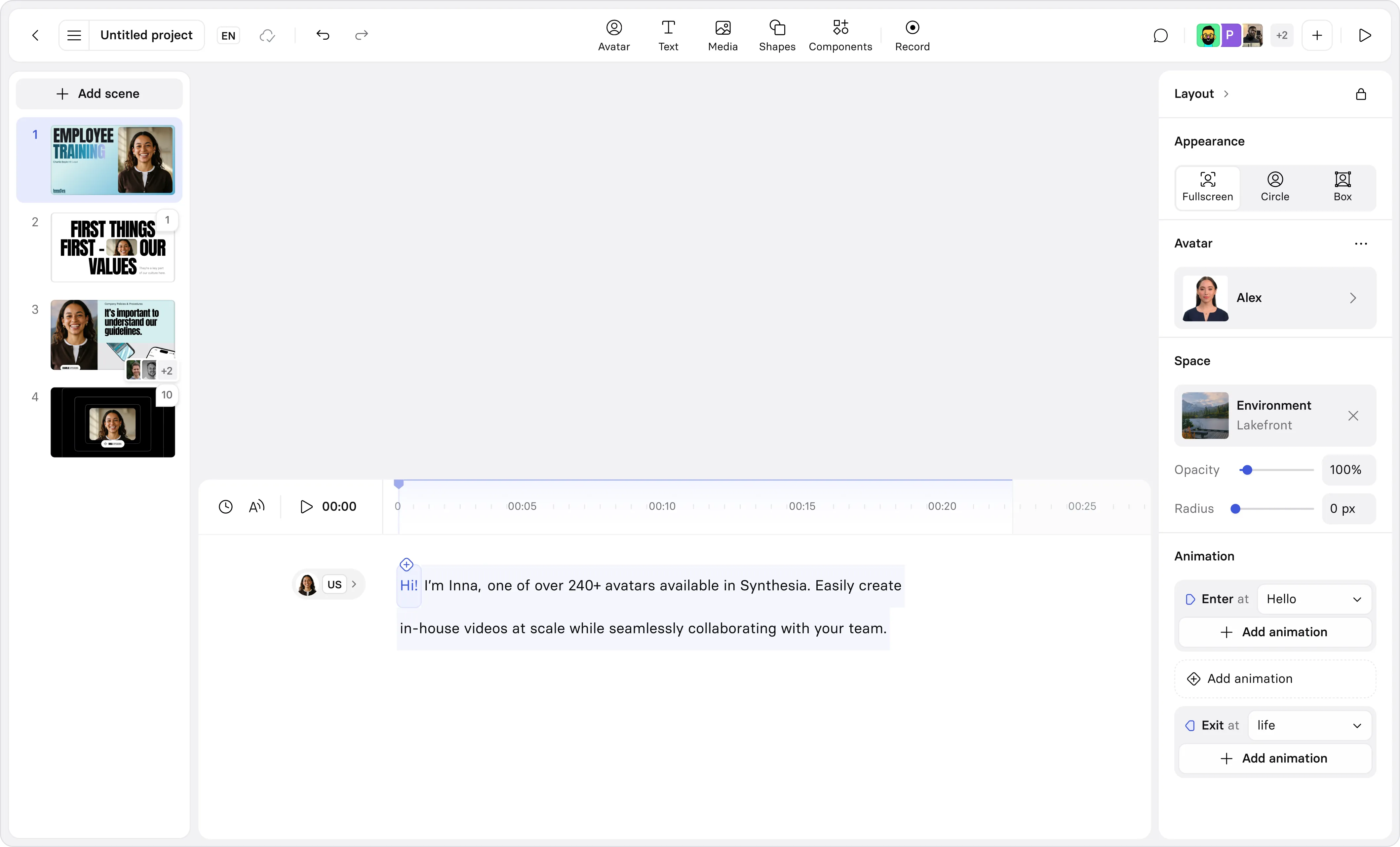
Step 3. Customize your scenes
Whether you want to add motion graphics, b-roll, or interactivity, be intentional about how each addition improves engagement. Leaders are busy, so keep attention focused. It can be easy to get carried away with features.
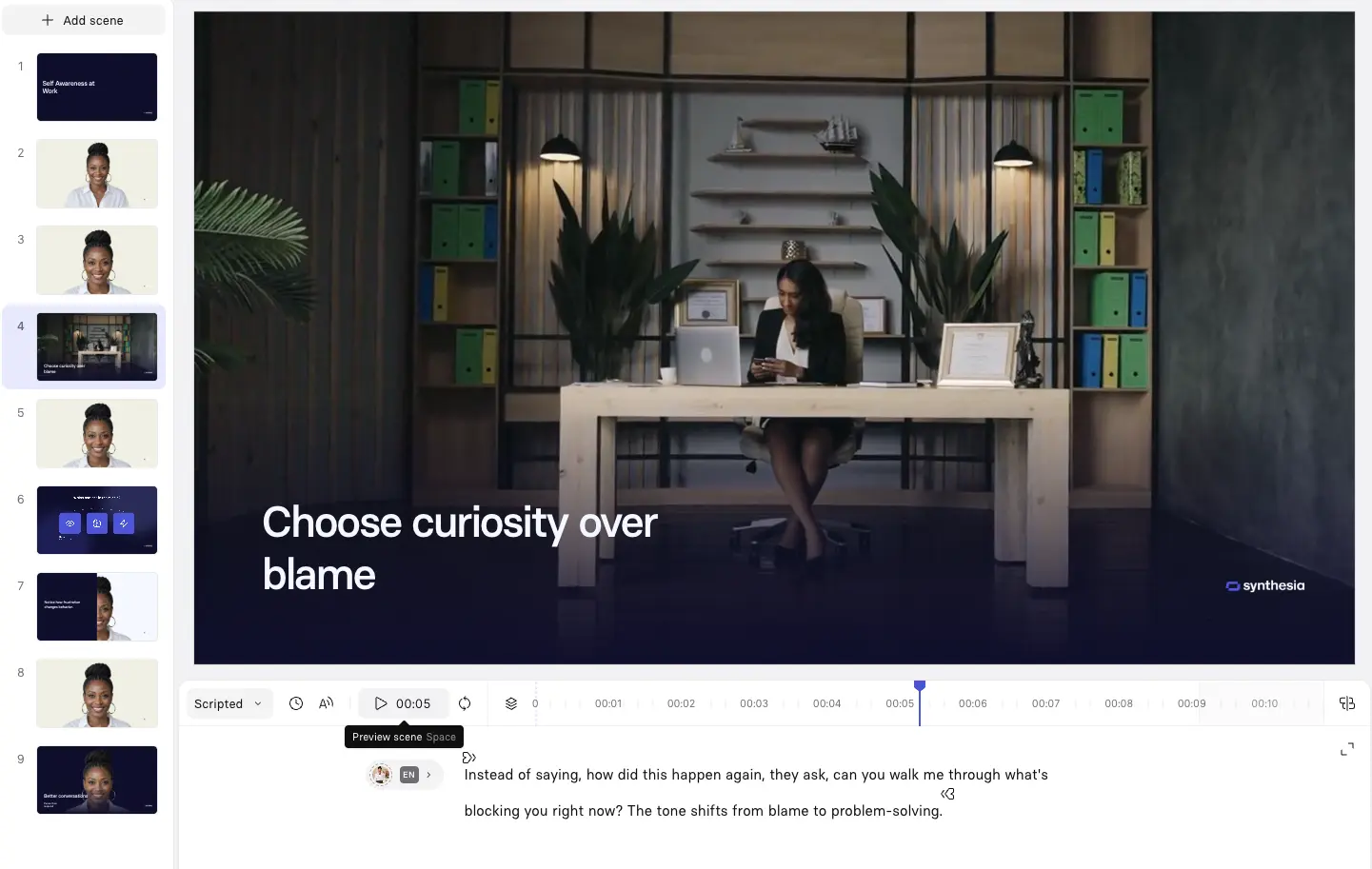
Preview your video before generating, and double-check that everything from the pronunciation to the flow makes sense. Some generated assets may appear as placeholders or low-fidelity previews until you generate the final video.
Step 4. Localize your video
When you're satisfied with your video, you can localize it into over 160 languages with a few clicks. If you're localizing, always include native speakers in your review process. They can catch shifts in tone or note areas where an expression may not translate.
If you want to see how a global nonprofit organization uses localized videos to train leaders, read more about Young Life.
Step 5. Distribute to leaders
Our Academy team recommends thinking through three things before distributing your training video:
- Where will the video live (e.g., in an LMS), and how will leaders find it (e.g., via a Slack message)?
- Who will have access to the video, and what happens when it’s shared (whether through a link or another way)?
- How do you plan to update content without creating confusion around which version is accurate?
The decisions you make around your video will shape how you can evaluate its impact (more on that next).
Step 6. Measure your training videos
In my experience, most teams skip this step. That's because evaluating leadership training is complex. You're trying to measure capabilities, like emotional intelligence, which on a good day can be subjective when observed.
I recommend approaching this through the lens of good enough measurement. Find two types of data that you can reliably track: one should be snapshot data, such as how many people watched the video over a period of time, the other should be impact data, such as results from an engagement survey.
The data isn't going to be perfect, but at least it will be directional. It will help you decide if you need to modify the content or even where the video is hosted.
Rethinking leadership development with video
If I were rebuilding the emerging engineering program I described at the beginning of this, I would likely incorporate training videos in a few ways. (And no, I'm not just saying that because I work at an AI video company.) But first, a caveat. I would still invest in an in-person program. A well-designed cohort experience is invaluable for leaders. They learn as much from each other as they do from the formal program.
Where I would modify the program is in how it was facilitated. I would likely transform each of the teaching pieces into training videos, distributed in advance of the program. By delivering the content in advance, I would free up more in-person time for problem-solving and hands-on practice. I also would have created a content library that the leaders could access in the flow of work when needed as a reference.
More importantly, the capabilities we taught in the program weren't exclusive to this emerging engineering audience. One of those skills, collaborating cross-culturally, applies to every leader at a global company, not just one cohort. Erin Meyer's The Culture Map is a good example of a framework I'd teach as a crash course on exactly that. With AI, I could quickly swap out contextual components to ensure the training lands for a senior leader just as well as someone early in their career.
If you're interested in learning more about how Synthesia can support your leadership development, book some time with the team.
Amy Vidor, PhD, is the Learning and Development Evangelist at Synthesia, where she researches learning trends and helps organizations apply AI at scale. With 15 years of experience, she has advised companies, governments, and universities on skills.
Frequently asked questions
How long should a leadership training video be?
The length of a leadership training video will likely vary by topic. An alignment update may be 2 minutes, and a scenario-based video closer to 5 or 6. There is no right length. However, there is research suggesting that engagement begins to dip after the 6 minute mark.
Keep in mind leaders are busy. Expect that they will have to "squeeze" watching this video into their schedules, perhaps on a train home or while on the treadmill. Make it easy for them to fit this into their day.
How do you know if a leadership training video is engaging?
To measure whether training is engaging, look for signs of cognition. Are people pausing and rewatching? Are they giving quality responses in scenarios? After the training, you can look for signals of behavioral change based on the targeted leadership capability.
How much does it cost to produce leadership training videos?
The cost to produce a leadership training video depends on the scope of your project: the type of videos, the production and instructional approaches, the timeline, and any revisions. If this is your first time working with a vendor, I'd recommend requesting a range of estimates before finalizing a budget request from Finance.