



How Much Does Employee Training Cost?

Create engaging training videos in 140+ languages with Synthesia.
"I don't know if what I'm spending is normal."
"I can't see where my budget is going."
"I need to justify my spend to leadership."
If you're here because you have a rough sense of what you spend on training, but not a clear picture of what's driving that spend, you're in good company.
It's hard to translate industry benchmarks into something actionable. And it's even harder to figure out how to use that number to make more informed decisions.
That's why I'm going to help you calculate what training is costing you, so that you can make the business case for L&D.
What does employee training cost?
According to Training Magazine, companies spent an average of $874 per learner on training in 2025, up from $774 in 2024. Added up, that's about $102.8 billion across the U.S., a 4.9% increase year-over-year.
Now, here's where those benchmarks get more complicated.
Notice how I said per learner.
Training Magazine's data reflects employees who participated in training. It is not a per-employee average. And importantly, it only includes data collected from U.S.-based organizations with 100 or more employees.
Here's the problem. Benchmarks can tell you roughly where the industry sits, and senior leaders will ask for them. But they can't tell you whether your spend is right for your organization. Because if you can't filter by industry, location, learner audience, L&D team size, or tools in your tech stack, you can't get to a true comp.
The $874 figure is a useful number to have in your back pocket. Your job is to calculate a more relevant one.
What to factor into employee training costs
To understand your employee training costs, you'll need to begin by deciding what gets factored into your calculation, and what doesn't.
I've compiled a list of the most common costs I've seen included below, but it isn't exhaustive.
Direct costs
- Content creation and delivery
Instructional design time, production costs, facilitator or consultant fees - Tools and platforms
Tech stack license fees, whether for authoring or delivering content - Travel, facilities, and logistics
Venue costs, catering, equipment and materials, and any costs L&D owns for facilitators and participants
Indirect costs
- Employee time in training
The number of hours employees spend in training multiplied by their fully loaded hourly rate (more on that below) - Administration and coordination
The time your team spends on scheduling, communications, and tracking - SME and manager time
The time spent reviewing content or reinforcing learning through coaching, feedback, and practice - Content maintenance
The ongoing cost of keeping training up-to-date and relevant
No one is expecting you to gather all of these inputs. Even ATD and Training Magazine judiciously select their factors. Feel free to do the same. Just be sure to document your rationale so you can explain your reasoning to Finance or leadership.
How to calculate your training cost per employee
Hopefully, you've decided what you can feasibly include as inputs into your total training costs from the list above. Once you have that, it is basic arithmetic to calculate the training cost per employee:
Training cost per employee = total training cost / number of learners
If only it were that simple. There's so much variation in how you can calculate this, depending on what leaders care about.
Why training costs vary so much
The only constant is change. You could be mid-calculations when one of your cost inputs shifts substantially.
A major re-org is announced and suddenly your target audience for a program has doubled in size.
A contract is finally approved by procurement for your new AI authoring tool, allowing you to cut an inflated vendor contract but also factor in the new tool fee.
Any of the inputs into training costs can and will move. But two tend to have the biggest impact: how you create content and how you deliver it. They're also the two you have the most control over, which is why I recommend focusing there first.
On the delivery side, the numbers are significant. According to Training Magazine's 2025 Training Industry Report, 62% of all instruction and facilitation is outsourced. And when you look at how training hours are distributed, 34% online, 28% in a classroom setting, and 24% via virtual classroom, you're looking at a substantial line item just to pay someone to run those sessions.
Every time you repeat a live program, that cost compounds.
On the content creation side, the same logic applies. Whether you're designing new content or keeping existing content current, the costs add up.
That's where format decisions made early tend to have the longest tail on your budget.
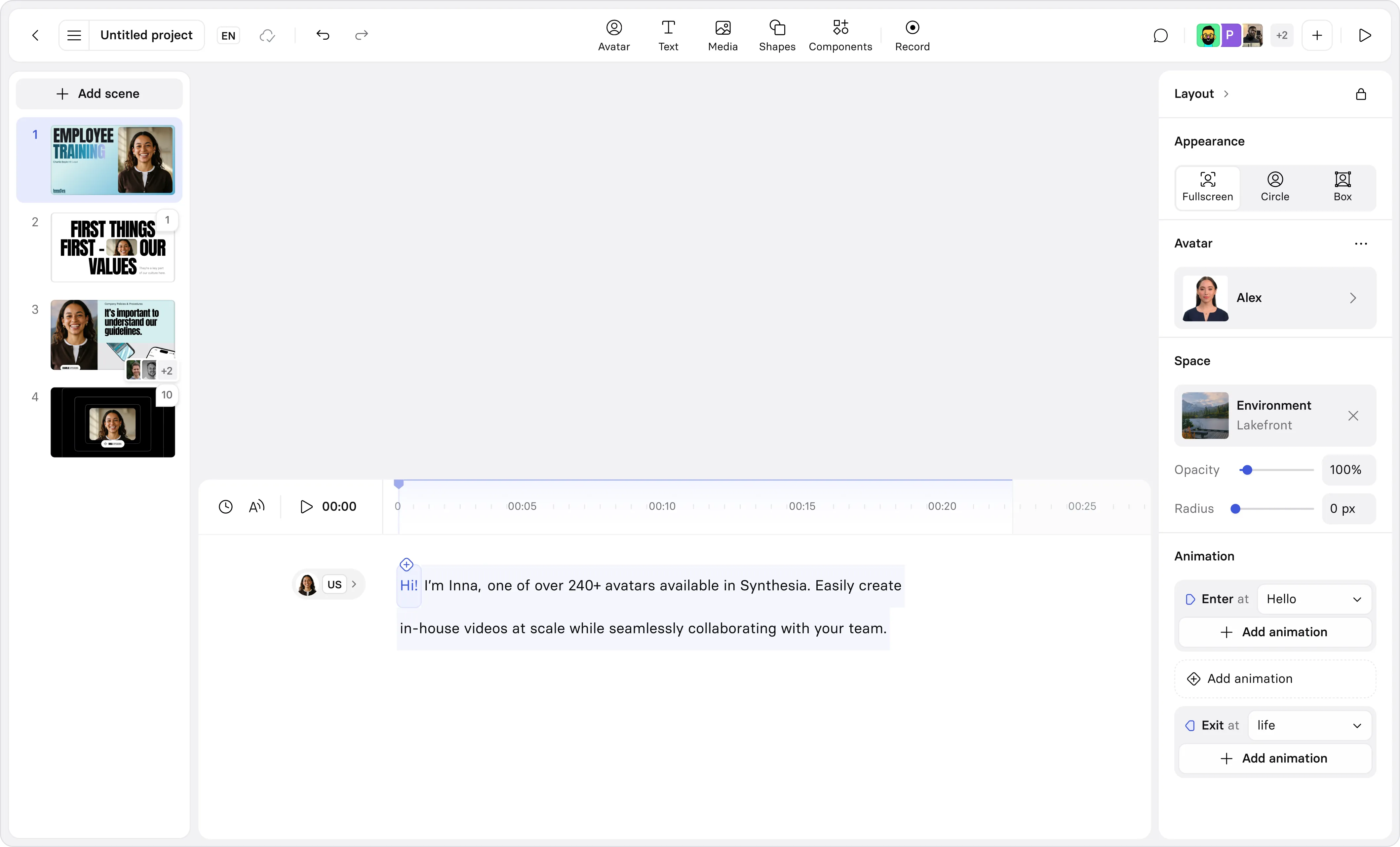
Brink's built 15 videos in a single day. If you want to see how that works, try our free AI video generator. You can use existing training materials like a PDF or a slide deck, or build from scratch with a prompt.
How to reduce your training costs
If you're looking to reduce your training spend, I recommend 5 strategies:
- Reduce live facilitation
- Evolve content creation
- Plan for updates
- Reduce localization rework
- Streamline administrative tasks
I cover these in detail in my guide to reducing training costs, but here's an example of how using these strategies can impact your training costs per employee.
A note for scaling companies
If you look at Training Magazine's data, one of the clearest takeaways is that large companies spend less per employee on training than small companies. This year, large companies spent $468 per employee on training compared to small companies that spent $1,091.
As your company scales, the unit economics (i.e., the cost to train one employee) start to decrease. That's because some costs are fixed. Let's say you have a course created by an instructional designer that's hosted in your LMS. Whether you assign it to 10 or 100 people doesn't impact the cost to create. Plus, the costs for additional seats in your LMS decrease as the volume increases.
The challenge you'll likely face is knowing when the unit economics will flip. If you find yourself in limbo — spending like a small company, but scaling like a large one — your job is to figure out what isn't scaling. The usual suspects are one-off programs and live facilitation, especially if it is in-person.
Note: Based on the data, smaller companies are getting more efficient with their spend, while large company spend has remained relatively flat since 2023.
Is your training spend justified?
Once you have a better idea of how much it costs to train your employees, you might be asking yourself whether you can justify this spend. The honest answer is, I don't know. I can't say with certainty how your leadership will react. Surprised? Supportive? Outraged?
That's why you need a compelling business case grounded in measurement data.
I recommend framing it in workplace research if your stakeholders would benefit. You can cite statistics like "organizations with strong learning cultures see 57% higher retention rates" (LinkedIn Workplace Learning Report 2025), but be prepared to make it specific to your organization. If you have low attrition rates and haven't historically invested in L&D, someone might question why you need to start. (Not me, I would never.)
Anticipate this pushback. Even if you have low attrition now, that can change quickly. And the cost of losing a tenured employee is significantly higher than losing someone early in their tenure. Gallup suggests that replacing an employee can cost anywhere from 50% to 200% of their annual salary, and that figure skews higher the more senior the individual.
And remember, be honest. Sometimes you go through this exercise and uncover unnecessary spend that balloons your per-employee costs. Identify it and make a plan to reallocate those resources.
Amy Vidor, PhD, is the Learning and Development Evangelist at Synthesia, where she researches learning trends and helps organizations apply AI at scale. With 15 years of experience, she has advised companies, governments, and universities on skills.