



Synthesia vs HeyGen vs Tavus vs Anam: Best Interactive Avatar Platform (2026)

Build real-time conversational avatar experiences in your product or website.
Summary
- Best for visual quality and enterprise teams: Synthesia — Synthesia has the highest visual-quality score in our evaluation, the broadest documented compliance set (SOC 2 Type II, ISO 27001, ISO 27701, ISO 42001, GDPR), up to 100 concurrent sessions on paid plans, and both a managed widget and a BYO-agent API.
- Best for in-call forms and scheduling: Tavus — Tavus's Magic Canvas renders cards, forms, charts and scheduling inside the conversation, alongside built-in perception and per-participant memory.
- Best for deployment flexibility: HeyGen — HeyGen's LiveAvatar offers integrations for LiveKit, Pipecat/Daily, Agora, and VisionAgents to fit into your existing conversational AI setup.
- Best for performance diagnostics: Anam — provides detailed analytics to help identify and troubleshoot response delays, and showed lifelike listening behavior in our hands-on testing.
An interactive avatar platform allows you to build live conversational video agents that your users can talk to in real time. The avatar listens to your users, generates a response, and speaks through an animated face with synchronized lip movements.
Unlike a pre-generated avatar video, an interactive avatar video responds to what your user says and supports a two-way, back-and-forth conversation. They can be used to answer product questions, guide a customer through a process, act as a training partner, or a wide variety of other use cases.
This post is a direct comparison of the four most popular interactive avatar platforms. We've also done a broader roundup of the best interactive avatar platforms that you might be interested in.
Avatar-only or full stack: which do you need?
Before comparing platforms, decide whether you want to give an existing AI agent a face or buy a complete conversational experience. All four platforms offer ways to do both, but the implementation work, included features, and pricing differ.
A real-time conversational avatar brings together six layers, from understanding what the user says to displaying the agent’s response:
- Speech recognition: Converts the user’s spoken words into text the agent can process.
- Model/agent: Interprets the request, retrieves relevant knowledge, calls tools when needed, and decides how to respond.
- Speech generation: Turns the agent’s response into spoken audio, shaping its voice, pronunciation, and delivery.
- Avatar rendering: Generates the avatar’s facial animation and synchronizes its lip movements with the audio.
- Transport: Streams audio and video between the user and the system through real-time infrastructure such as LiveKit or Daily.
- App interface: Provides the widget, player, or custom application where users start conversations and interact with the avatar.
The first part of the buying decision is how many of these layers you want the vendor to run for you.
With an avatar-only integration, you operate the conversational stack and add the vendor’s avatar rendering layer.
With a managed offering, the vendor runs more of the pipeline, reducing setup work but giving you less direct control over its components.
How I evaluated these interactive avatar platforms
My goal in this post is to give you a balanced and comprehensive comparison of the top four interactive avatar platforms available on the market today: Synthesia, Tavus, HeyGen, and Anam.
In this post I have combined:
- A blind human evaluation conducted by Synthesia
- Hands-on impressions
- User interviews
- Vendor documentation
Blind evaluation
The blind evaluation scored interactive avatars on six dimensions, from visual quality to interruptibility. Here are the methodology details:

Blind evaluation methodology
How we tested:
- In July 2026, Synthesia ran a blind human evaluation of interactive avatars from Synthesia, HeyGen, Tavus and Anam, selecting the newest avatars available on each platform.
- 157 raters scored 609 conversations.
- Every platform ran the same short conversational guessing game through the same rating interface, on a 512×512 display.
- Raters scored six dimensions on a −2 (strongly disagree) to +2 (strongly agree) scale, with 95% confidence intervals.
What we didn't test:
- 30-minute-plus sessions
- Complex tool use or form completion
- Mobile connections
- High concurrency
- Specific custom avatars and languages
- Anything beyond the specific product versions tested
The results
These results can be interpreted as follows:
- Synthesia had the highest average on 5 of 6 dimensions. It led visual quality by +0.53 to +0.61 over Tavus and HeyGen, and by a smaller +0.25 over Anam, where the confidence intervals slightly overlap.
- Synthesia and Anam were statistically tied on overall experience, since their confidence intervals overlap.
- Anam led lip sync.
- Naturalness was hard for every provider. Only Synthesia (0.22) and Anam (0.11) scored above zero.
Synthesia
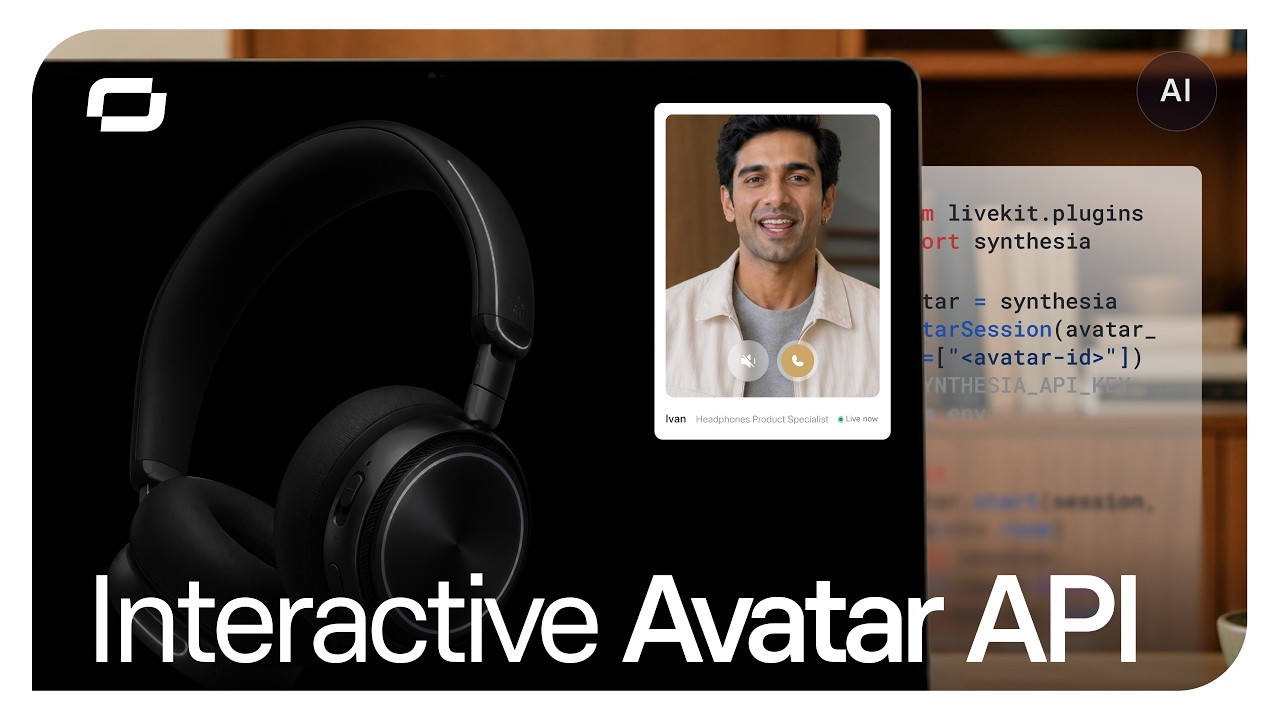
Synthesia offers two routes for using its real-time interactive avatars:
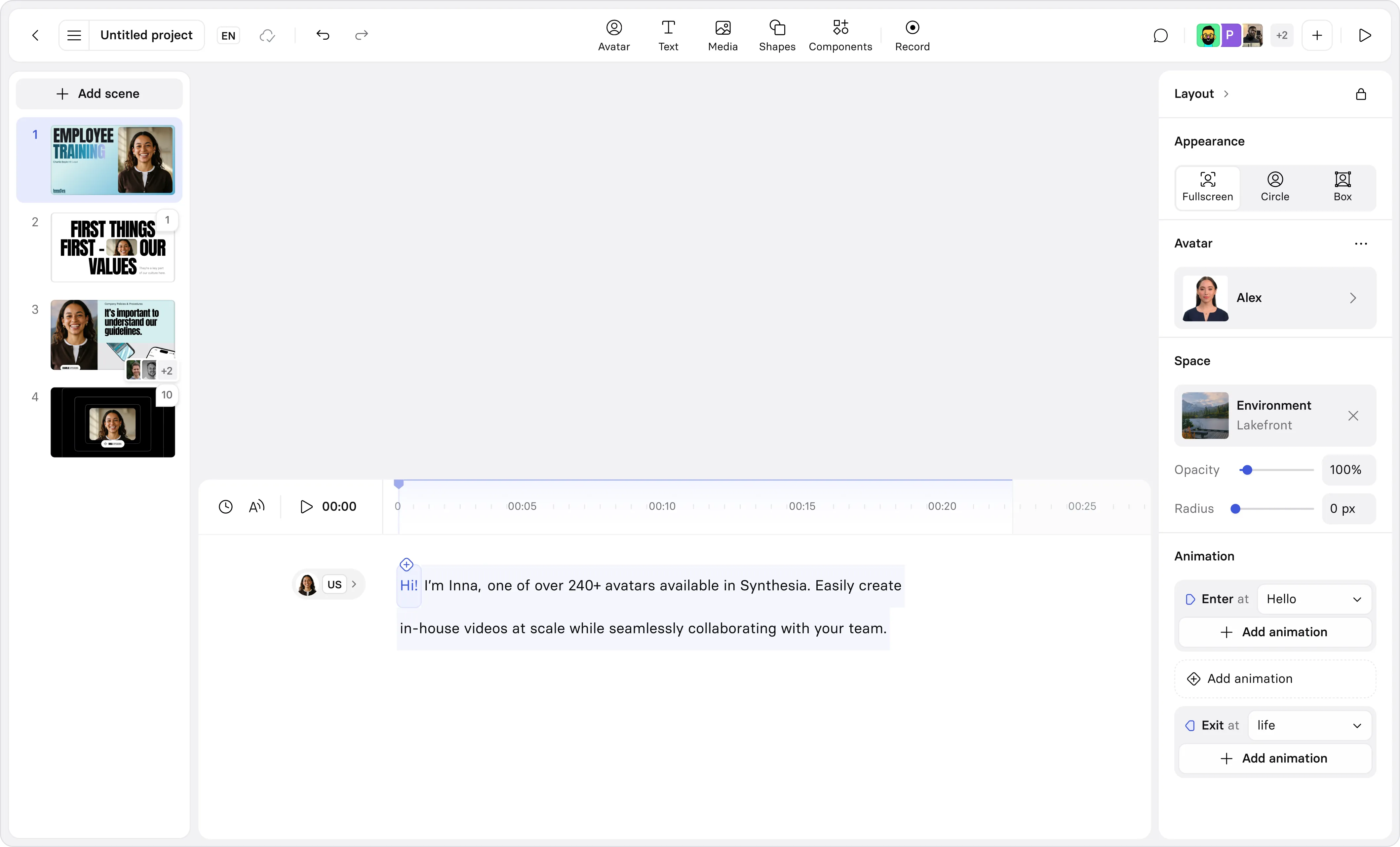
- Interactive Avatars Widget: Create an agent in Synthesia Studio, ground it on a PDF, publish it and embed it on your site. Synthesia runs speech recognition, the LLM, voice, rendering and transport for you, so there are no model credentials or infrastructure to manage.
- Interactive Avatars API: Bring your own model and speech stack, then attach a Synthesia avatar to your agent through the LiveKit Agents plugin. Synthesia TTS is available through the plugin at no extra per-minute charge.
Strengths
- Highest visual quality in our evaluation (0.95), vs. Anam (0.70), Tavus (0.42) and HeyGen (0.34), and the highest average on 5 of 6 evaluation dimensions.
- 125.5 ms p95 video end-to-end latency on the avatar pipeline.
- 100 concurrent sessions on all paid plans, with custom limits above that.
- Broadest documented governance set in this comparison: SOC 2 Type II, ISO 27001, ISO 27701, ISO 42001 and GDPR, with consent-based avatar creation and content moderation.
- Competitive and easy-to-understand pricing: $0.10/min on the API and $0.20/min on the widget. Enterprise volume discounts available.
- Established enterprise adoption: Synthesia is used by 90% of Fortune 100 companies.
Limitations
- The API runs on LiveKit only. This mainly limits developers who want a different transport, but doesn't impact customers embedding the widget.
- The API does not provide a native session list, transcripts or recordings; you have to capture these in your own stack. The managed widget does however provide session records, transcripts and optional audio recording.
- Limited built-in grounding and tools. The widget supports PDF grounding and a limited built-in tool set. With the API, knowledge retrieval and tools come from your own agent.
- Limited framing and motion control. Bust framing only, with no gesture, hand or full-body control.
- Web-first rather than mobile-first. Mobile is not a primary target, and there are no dedicated mobile SDKs in the widget’s initial scope, although that doesn't mean the web widget cannot be used in a mobile browser.
Pricing
API $0.10/min plus your own speech/model costs. Widget pricing is $0.20/min. Enterprise volume discounts are available.
Best for
Enterprises that want polished, customer-facing avatars, with either a fast managed launch or full control over an approved AI stack.
HeyGen LiveAvatar
HeyGen's real-time avatar product has two modes. Avatar-only (LITE mode) works for teams that already have a conversational stack. FULL mode bundles speech recognition, LLM, TTS and voice activity detection.
Strengths
- Most framework plugins documented: LiveKit, Pipecat/Daily, Agora and VisionAgents.
- Hosted connectors for ElevenLabs, Cartesia, OpenAI Realtime and Gemini Live, plus any OpenAI-compatible LLM endpoint, a hosted embed and a free sandbox mode.
- Very simple SDK integration.
- Unlimited concurrency on paid plans.
- Enterprise rates down to $0.01/min, although it's unclear what volume commitment is required for that price.
Limitations
- Lowest naturalness score (−0.38) and second-lowest overall experience (0.15) in our evaluation.
- No native tool calling documented; FULL-mode memory is a single rolled-up summary.
- Sessions are capped at 20 minutes on the Essential plan and 60 minutes on the Business plan.
- Customers in our research have reported turn-taking problems and false starts in production workflows.
- Chest-up framing only; full-body isn't supported.
Pricing
HeyGen LiveAvatar costs around $0.079–$0.095/min avatar-only and $0.158–$0.19/min in FULL mode. There are a few plan options:
- Essential is $99/month (1,100 avatar-only or 550 FULL minutes included, then $0.095 or $0.19 per extra minute).
- Business is $475/month (6,000 or 3,000 minutes, then $0.09 or $0.18).
- Enterprise is custom, with rates as low as $0.01 per minute but you have to commit to a lot of volume.
Best for
Fast prototypes, and teams that want to plug an avatar into an existing voice-agent provider.
Tavus
Tavus offers a Conversational Video Interface (CVI) and PALs, its agent layer. It can run as a full conversational agent, with knowledge, memory, perception and tools built in, or as an avatar on top of a stack you already run.
Strengths
- Most built-in agent features of the four platforms: knowledge base, objectives and guardrails, memory, perception-triggered tools, post-call actions, MCP connectors and meeting participation.
- Magic Canvas for in-call cards, forms, charts and scheduling, rendered inside the conversation.
- Claims ~600 ms reply time and 134 ms audio-to-video with its latest avatar models (Phoenix-4.5).
- Latest models extend motion through the head, shoulders and torso.
Limitations
- Lowest overall-experience score in our evaluation (0.08), though HeyGen's 0.15 is within the margin of error and the evaluation predates Phoenix-4.5.
- The knowledge base only supports English-language documents.
- Concurrency tops out at 15 sessions on self-serve plans (you'll need to talk to sales to get higher concurrency).
- Avatar-only modes aren't compatible with Tavus's perception or speech recognition layers.
- One customer reported cold starts and latency variance at scale.
Pricing
Tavus has four plans:
- Starter is $22/mo for 60 minutes (~$0.37/min), with no additional minutes available.
- Builder is $59/mo for 175 minutes (~$0.34/min), then $0.35 per additional minute.
- Growth is $397/mo for 1,300 minutes (~$0.31/min), then $0.31.
- Business is $975/mo for 4,000 minutes (~$0.24/min), then $0.26.
- Enterprise is custom.
Best for
Teams that want the avatar to show and collect information on screen during the conversation, such as questions, forms and scheduling, and then act on the answers.
Anam
Anam is a real-time conversational avatar platform offering both a turnkey stack and bring-your-own components, across widget and API.
Strengths
- Highest lip-sync score (0.60) and second-highest overall experience (0.42) in our evaluation.
- Listening behavior in our hands-on testing included nods, eyebrow movement, smiles and quick reactions to interruptions.
- Most detailed operational visibility of the four: per-turn STT/LLM/TTS latency breakdowns, p50–p99 percentiles, error and interruption rates, slowest-turn samples and a concurrency-status endpoint. When a conversation is slow, you can see whether the delay came from speech recognition, the model or voice generation.
- Claims ~150 ms server-side generation latency for its latest avatar model (Cara-4).
- 99.9% uptime SLA on Enterprise plans, a contractual commitment that the service is available 99.9% of the time, which allows roughly 43 minutes of downtime a month.
- 70+ languages, with language, voice and voice-detection settings changeable mid-session without reconnecting.
Limitations
- No built-in in-call UI components or documented cross-session memory.
- Switching language mid-session only changes transcription; your voice and LLM must also support the new language.
- Per-turn analytics only cover sessions Anam runs end to end, not LiveKit or custom-TTS sessions.
- Anam's own benchmark puts median time for the avatar to appear at 1.55 s (p95 3.6 s, July 31, 2026), while its FAQ says connection setup is usually 4–5 seconds.
- Self-serve concurrency tops out at 10 sessions (Professional).
Pricing
Anam has four plans:
- Starter is $12/mo for 50 minutes (~$0.24/min), then $0.16 per additional minute.
- Explorer is $49/mo for 250 minutes (~$0.20/min), then $0.14.
- Growth is $299/mo for 2,000 minutes (~$0.15/min), then $0.12.
- Professional is $999/mo for 8,000 minutes (~$0.12/min), then $0.11.
- Enterprise is custom.
Best for
Conversational-avatar applications where detailed performance diagnostics matter most, and where lifelike listening behavior is a plus.
Interactive avatar platforms compared
Features
Pricing
All prices are USD. Implied cost per minute is the monthly plan price divided by included minutes, assuming the full allowance is used, rounded to three decimals.
How to compare prices fairly
- Compare like with like. Match avatar-only prices with avatar-only, and managed prices with managed. A $0.10 avatar-only minute covers just the avatar, while a ~$0.24 managed minute also covers speech, the language model and streaming, so the two aren't comparable.
- Add what avatar-only prices leave out. You also pay for speech, the language model, streaming, hosting and engineering time, unless the vendor includes them (Synthesia's plugin includes TTS).
- Compare rates of the same kind. Compare plan rates (price divided by included minutes) with plan rates, and the price of additional minutes with the price of additional minutes.
- Treat enterprise rates as negotiated. HeyGen advertises rates down to $0.01/min, but that's a volume deal, not a list price.
- Price the outcome, not the minute. For example, compare how long each platform takes to complete a form with a user. A cheaper minute that doesn't finish the task costs more.
- Check session-length caps and concurrency alongside price. They vary widely by platform and plan.
Latency
Latency covers four different things. Vendors usually quote just one or two of them, and measure them in different ways, so published numbers rarely compare directly.
A fast renderer doesn't guarantee a fast conversation. Rendering is only one stage. The delay users notice most is conversational latency, which adds speech recognition, the model, speech generation and transport on top, and tool calls or knowledge retrieval add more.
On bring-your-own setups most of those stages are your choices, so the same avatar can feel fast or slow depending on the stack around it.
Consistency also matters more than best-case speed. Ask vendors for p95/p99 figures under load, not just averages, and test with your own model, speech provider and region.
Which platform for which buyer?
Buyer's checklist
Final verdict
Synthesia is the best interactive avatar platform for customer-facing enterprise use.
It had the highest visual quality (0.95) and the highest average overall experience (0.48, statistically tied with Anam) in our 609-conversation evaluation, the broadest governance set, and 100 concurrent sessions on every paid plan.
It also lets you choose between a no-code managed widget and an API that plugs into an AI stack you already run.
Check that the widget's built-in tools and PDF grounding fit your use case, or that you're comfortable building tools and retrieval yourself with the API.
Tavus is the pick when you need on-screen cards, forms and scheduling inside the conversation, or perception and per-participant memory out of the box.
Check that the English-only knowledge base and the 15-session self-serve concurrency cap fit your needs.
HeyGen LiveAvatar is the pick for fast prototypes and teams that want the most integration options.
Check turn-taking and naturalness in your target workflow, and the 20- and 60-minute session caps.
Anam is the pick when detailed diagnostics matter most, with lifelike listening behavior in our hands-on testing as a secondary strength.
Check that you don't need built-in in-call UI or cross-session memory, and that your plan includes the enterprise controls you need.
Kyle Odefey is a London-based filmmaker and Video Producer at Synthesia. His content has reached millions across TikTok, LinkedIn, and YouTube, even inspiring an SNL sketch, and has been featured by CNBC, BBC, Forbes, and MIT Technology Review.
Frequently asked questions
What is the best interactive AI avatar platform in 2026?
Synthesia, for customer-facing enterprise use. It led visual quality at 0.95 vs. 0.34–0.70 and had the highest average score on 5 of 6 dimensions in our evaluation, plus the broadest governance set. For the most built-in agent features, choose Tavus. For deployment flexibility, HeyGen LiveAvatar. For performance diagnostics, Anam.
Does Synthesia offer real-time conversational avatars?
Yes. Synthesia offers real-time interactive avatars through a no-code website widget and an API. The widget runs the full conversational stack, from speech recognition and LLM to voice, rendering and transport, at $0.20/min. The API attaches a Synthesia avatar to your own AI agent via LiveKit at $0.10/min.
Is Synthesia better than HeyGen for interactive avatars?
In our blind evaluation, yes on the dimensions with clear gaps: visual quality (0.95 vs. 0.34) and naturalness (0.22 vs. −0.38). Synthesia also scored higher on overall experience (0.48 vs. 0.15) and responsiveness (0.65 vs. 0.43), though those confidence intervals overlap. HeyGen does however offer more framework plugins and unlimited paid-plan concurrency.
Which platform is best if I already have an AI agent?
Synthesia's API is the best fit if avatar quality matters most. It had the highest visual quality in our evaluation (0.95), costs $0.10/min, and attaches to your own model and speech stack through LiveKit. If you're not on LiveKit, HeyGen's avatar-only (LITE) mode supports more frameworks (LiveKit, Pipecat/Daily, Agora and VisionAgents) at about $0.08–$0.10/min. Tavus avatar-only and Anam's custom LLM option also attach an avatar to your existing agent. Tavus (~$0.24–$0.37/min) and Anam (~$0.12–$0.24/min) list the same plan pricing for avatar-only as for their managed stacks.
How many concurrent sessions can I run?
Synthesia allows 1 session on Freemium and 100 concurrent sessions on all paid plans, with more available through sales. HeyGen LiveAvatar allows unlimited concurrency on paid plans. Tavus allows 1–15 depending on plan, with Enterprise custom, and Anam 1–10 on self-serve plans, with 100+ on Enterprise.
Which interactive avatar platform has the lowest latency?
No single platform wins every type of latency. Vendors quote different measures (session startup, video rendering, full conversational response, interruption), so published numbers rarely compare directly, and total response time depends heavily on your model and speech providers. Ask for p95/p99 figures under load and test with your own stack.
Can interactive avatars use my company's knowledge base?
Yes. Synthesia's managed widget grounds on PDFs. HeyGen's FULL mode uses Contexts with FAQ links. Tavus's full pipeline ingests documents, URLs and crawled sites (up to 100 pages). Anam's turnkey stack retrieves from your uploaded documents, with tunable controls. With avatar-only or BYOS setups (Synthesia's API, HeyGen LITE, Tavus avatar-only and Anam custom LLM), knowledge retrieval comes from your own agent.
How much do interactive avatars cost?
Avatar-only rates start at about $0.08–$0.10/min (Synthesia API, HeyGen LITE). Full-stack rates, where the vendor runs the model and speech too, are $0.20/min for Synthesia's widget, ~$0.16–$0.19/min for HeyGen FULL mode, ~$0.24–$0.37/min for Tavus and ~$0.12–$0.24/min for Anam, depending on plan.