



The 6 Best Real-Time Interactive AI Avatar Platforms in 2026

Build real-time conversational avatar experiences in your product or website.
Summary
- Best for visual quality and enterprise teams: Synthesia — Synthesia has the highest visual-quality score in our evaluation, the highest average on 5 of 6 dimensions, SOC 2 Type II, ISO 27001, ISO 27701 and ISO 42001 certification, up to 100 concurrent sessions on paid plans, and both a managed widget and a bring-your-own-agent API.
- Best for performance diagnostics: Anam — Anam provides detailed analytics to help identify and troubleshoot response delays, had the highest lip-sync score in our evaluation, and showed lifelike listening behavior in our hands-on testing.
- Best for in-call forms and scheduling: Tavus — Tavus's Magic Canvas renders cards, forms, charts and scheduling inside the conversation, alongside built-in perception and per-participant memory.
- Best for deployment flexibility: HeyGen LiveAvatar — HeyGen's LiveAvatar offers integrations for LiveKit, Pipecat/Daily, Agora and VisionAgents to fit into your existing conversational AI setup.
- Best for full-body characters: LemonSlice — LemonSlice generates live, full-body characters from a single image, with gestures, actions and scenes you can trigger.
- Best for private-cloud and on-prem deployment: D-ID — D-ID is the only platform here that publicly documents VPC and on-prem deployment, and has the longest list of security certifications.
Interactive AI avatars are video agents your users can talk to in real time. The avatar listens, generates a response and speaks it back with synchronized lip movements, on a website, inside a product, in a training course or even in a video meeting.
Most interactive avatar platforms offer both a managed stack and a way to put an avatar on an AI agent you already run, but they differ in avatar quality, built-in features, deployment options and price. Some also solve specific needs, like full-body characters that move and gesture, or running the whole system in your own private cloud.
Below are the six interactive avatar platforms worth shortlisting in 2026, with the use case each one fits best. For a deeper, data-led look at four of them, see our Synthesia vs HeyGen vs Tavus vs Anam comparison.
We make Synthesia. It's ranked first here, so we've been explicit about how we evaluated every platform and where our evidence comes from. See "How I evaluated these interactive avatar platforms" below.
The best interactive AI avatar platforms
- Synthesia: Realistic interactive avatars for customer-facing enterprise use, with a no-code widget or a bring-your-own-agent API.
- Anam: Conversational avatars with the most detailed performance diagnostics and lifelike listening behavior.
- Tavus: In-call cards, forms and scheduling (Magic Canvas), plus perception and per-participant memory.
- HeyGen LiveAvatar: Deployment flexibility, with avatar-only and full-stack modes and plugins for LiveKit, Pipecat/Daily, Agora and VisionAgents.
- LemonSlice: Full-body characters with live gestures, actions and scenes, from a single image.
- D-ID: Private-cloud and on-prem deployment, with the longest list of security certifications.
How I evaluated these interactive avatar platforms
My goal in this post is to give you a balanced and comprehensive overview of the top six interactive avatar platforms available on the market today: Synthesia, Anam, Tavus, HeyGen LiveAvatar, LemonSlice and D-ID.
In this post I have combined:
- A blind human evaluation conducted by Synthesia (Synthesia, HeyGen, Tavus and Anam only)
- Hands-on impressions
- User interviews
- Vendor documentation
LemonSlice and D-ID weren't part of the blind evaluation, so their sections rely on my hands-on experience and vendor documentation. Performance figures from vendor documentation are labeled as vendor claims. For every platform, features, pricing and limits come from vendor websites, docs and press releases as of October 6, 2026. These tools change quickly, so check each vendor's current documentation before you buy.
Blind evaluation
The blind evaluation scored interactive avatars on six dimensions, from visual quality to interruptibility. Here are the methodology details:

Blind evaluation methodology
How we tested:
- In July 2026, Synthesia ran a blind human evaluation of interactive avatars from Synthesia, HeyGen, Tavus and Anam, selecting the newest avatars available on each platform.
- 157 raters scored 609 conversations.
- Every platform ran the same short conversational guessing game through the same rating interface, on a 512×512 display.
- Raters scored six dimensions on a −2 (strongly disagree) to +2 (strongly agree) scale, with 95% confidence intervals.
What we didn't test:
- 30-minute-plus sessions
- Complex tool use or form completion
- Mobile connections
- High concurrency
- Specific custom avatars and languages
- Anything beyond the specific product versions tested
The results
These results can be interpreted as follows:
- Synthesia had the highest average on 5 of 6 dimensions. It led visual quality by +0.53 to +0.61 over Tavus and HeyGen, and by a smaller +0.25 over Anam, where the confidence intervals slightly overlap.
- Synthesia and Anam were statistically tied on overall experience, since their confidence intervals overlap.
- Anam led lip sync.
- Naturalness was hard for every provider. Only Synthesia (0.22) and Anam (0.11) scored above zero.
For the full four-way breakdown, see our Synthesia vs HeyGen vs Tavus vs Anam comparison.
Evaluation criteria
- Realism: How convincing is the avatar, from visual quality and lip sync to how it behaves while listening?
- Responsiveness: How quickly does it reply, and how well does it handle being interrupted?
- Agent capabilities: What's built in, such as knowledge grounding, tools, memory and guardrails, and what do you have to bring yourself?
- Deployment: Can a non-technical team embed it without code? Does it plug into the frameworks developers already use?
- Avatar range: Can you create custom avatars from photos or video? Are you limited to human talking heads?
- Scale: How many concurrent sessions do plans allow, and how long can sessions run?
- Pricing: How clear is the cost per minute, and what does that minute include?
- Enterprise readiness: Security certifications, data handling and governance controls.
1. Synthesia
Quick summary
- Best for: Enterprises that want polished, customer-facing avatars, with either a fast managed launch or full control over an approved AI stack.
- Key strengths: Highest visual quality and highest average on 5 of 6 dimensions in our evaluation, a choice between a no-code widget and a bring-your-own-agent API, 100 concurrent sessions on all paid plans, and SOC 2 Type II, ISO 27001, ISO 27701, ISO 42001 and GDPR.
- Limitations: Bust framing only, with no gesture, hand or full-body control. The API runs on LiveKit only and doesn't provide session lists, transcripts or recordings. The widget's built-in grounding and tools are limited.
What it does
Synthesia Interactive Avatars put Synthesia's avatars into live, two-way conversation. There are two ways to deploy them:
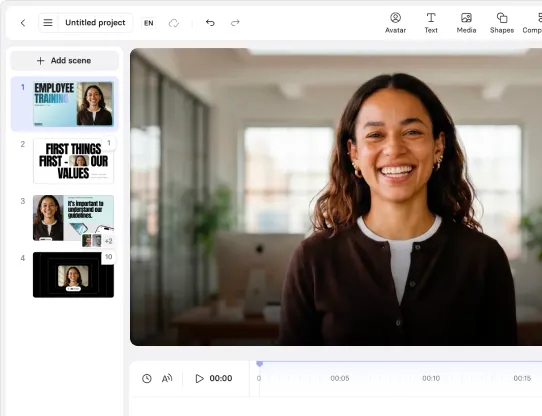
- Interactive Avatars Widget: create an agent in Synthesia Studio, ground it on a PDF, publish it and embed it on your site. Synthesia runs speech recognition, the LLM, voice, rendering and transport, so there are no model credentials or infrastructure to manage. The widget includes session records, transcripts and optional audio recording.
- Interactive Avatars API: attach a Synthesia avatar to your own AI agent with the LiveKit Agents plugin, keeping your own LLM, tools, knowledge base and speech providers. Synthesia TTS is available through the plugin at no extra per-minute charge.
In our evaluation, Synthesia had the highest visual-quality score (0.95, vs. 0.34–0.70 for the others) and the highest average on 5 of 6 dimensions. Its overall-experience score (0.48) was statistically tied with Anam's (0.42). It came second on lip sync (0.32), behind Anam (0.60).
Avatars range from photorealistic people to stylized characters and brand mascots. Personal avatars are created from a photo or short video plus a consent recording, and synthetic avatars from a text prompt.
Synthesia also has established enterprise adoption: it's used by 90% of Fortune 100 companies.
On security, Synthesia holds SOC 2 Type II, ISO 27001, ISO 27701 and ISO 42001 and is GDPR compliant, with consent-based avatar creation and content moderation. All paid plans support up to 100 concurrent sessions, with custom limits above that through sales. Synthesia reports 125.5 ms p95 video end-to-end latency on its avatar pipeline (vendor claim).
Synthesia's main limitations are bust framing only, no gesture, hand or full-body control, and LiveKit-only transport for the API. With the API, knowledge retrieval, tools, session lists, transcripts and recordings all come from your own stack. The widget supports PDF grounding and a limited built-in tool set. It's also web-first: there are no dedicated mobile SDKs, though the widget works in a mobile browser.
Pricing
Synthesia has no plan tiers for interactive avatars, so the rate is the same for every minute. The widget costs $0.20/min for the full managed stack. The API costs $0.10/min for the avatar only, plus your own speech and model costs (Synthesia TTS is included through the plugin). Enterprise volume discounts are available.
Verdict
Synthesia is the best interactive avatar platform for customer-facing enterprise use, with the highest visual quality in our evaluation, strong governance and 100 concurrent sessions on every paid plan. Pick the widget for a fast, no-code launch, or the API if you already run an AI agent on LiveKit. Check that the widget's PDF grounding and built-in tools fit your use case. If you need full-body characters or deep built-in agent features, look at LemonSlice or Tavus.
2. Anam
Quick summary
- Best for: Conversational-avatar applications where detailed performance diagnostics matter most, and where lifelike listening behavior is a plus.
- Key strengths: Highest lip-sync score (0.60) and second-highest overall experience (0.42) in our evaluation, single-photo avatar creation, turnkey or bring-your-own components, and per-turn latency analytics.
- Limitations: No built-in in-call UI components or documented cross-session memory, self-serve concurrency tops out at 10 sessions, and per-turn analytics only cover sessions Anam runs end to end.
What it does
Anam offers both a turnkey stack (speech recognition, LLM, voice and avatar) and bring-your-own components, across a widget, a player, share links and an API, with LiveKit and Pipecat integrations.
Anam scored highest on lip sync (0.60) and second on overall experience (0.42) in our evaluation, statistically tied with Synthesia. In hands-on testing, its listening behavior stood out: nods, eyebrow movement, smiles and quick reactions when interrupted.
Its biggest practical advantage is diagnostics. Anam's session analytics break each turn into speech-to-text, LLM and text-to-speech latency, with p50–p99 percentiles, error and interruption rates, slowest-turn samples and a concurrency-status endpoint. When a conversation feels slow, you can see whether the delay came from speech recognition, the model or voice generation. These analytics don't cover LiveKit or custom-TTS sessions.
Avatars are created from a single photo, with clothing, background and logo editing. Knowledge grounding uses RAG with topK, minScore and token controls, and client, webhook and system tools let the persona trigger actions in your app. Memory is limited to per-session summaries and transcripts. Anam can join Google Meet, Zoom and Teams calls.
Anam supports 70+ languages, and language, voice and voice-detection settings can be changed mid-session without reconnecting. Switching language mid-session only changes transcription, though, so your voice and LLM must also support the new language.
Anam claims ~150 ms server-side generation latency for its Cara-4 model. Its own benchmark puts median time for the avatar to appear at 1.55 s (p95 3.6 s), while its FAQ says connection setup usually takes 4–5 seconds. Enterprise plans include a 99.9% uptime SLA. On security, Anam has a SOC 2 Type II report, HIPAA-aligned controls (BAA by contract) and UK/EU GDPR compliance.
Pricing
Pricing is the same for turnkey and bring-your-own setups.
- Starter: $12/month includes 50 minutes ($0.240/min); then $0.16 per additional minute.
- Explorer: $49/month includes 250 minutes ($0.196/min); then $0.14 per additional minute.
- Growth: $299/month includes 2,000 minutes ($0.150/min); then $0.12 per additional minute.
- Professional: $999/month includes 8,000 minutes ($0.125/min); then $0.11 per additional minute.
Enterprise is custom.
Verdict
Anam is the pick when detailed diagnostics matter most, with lifelike listening behavior in our hands-on testing as a secondary strength. Check that you don't need built-in in-call UI or cross-session memory, and that your plan includes the enterprise controls you need.
3. Tavus
Quick summary
- Best for: Teams that want the avatar to show and collect information on screen during the conversation, such as forms and scheduling, and then act on the answers.
- Key strengths: The most built-in agent features of any platform on this list, including knowledge, per-participant memory, perception, tools, MCP, in-call UI (Magic Canvas) and meeting participation.
- Limitations: Lowest overall-experience score in our evaluation (0.08), an English-only knowledge base, self-serve concurrency capped at 15 sessions, and higher per-minute pricing.
What it does
Tavus combines its Conversational Video Interface (CVI) with PALs, its agent layer. It can run as a full conversational agent or as an avatar on top of a stack you already run. Its managed agent includes:
- a knowledge base that ingests documents, images, URLs and crawled sites (up to 100 pages), with retrieval strategies and tags;
- objectives and guardrails;
- per-participant memory;
- skills;
- perception-triggered tools and post-call actions;
- MCP connectors;
- meeting participation in Google Meet, Zoom and Teams.
Its Magic Canvas adds in-call cards, forms, charts and scheduling, rendered inside the conversation. No other platform here offers built-in in-call UI components.
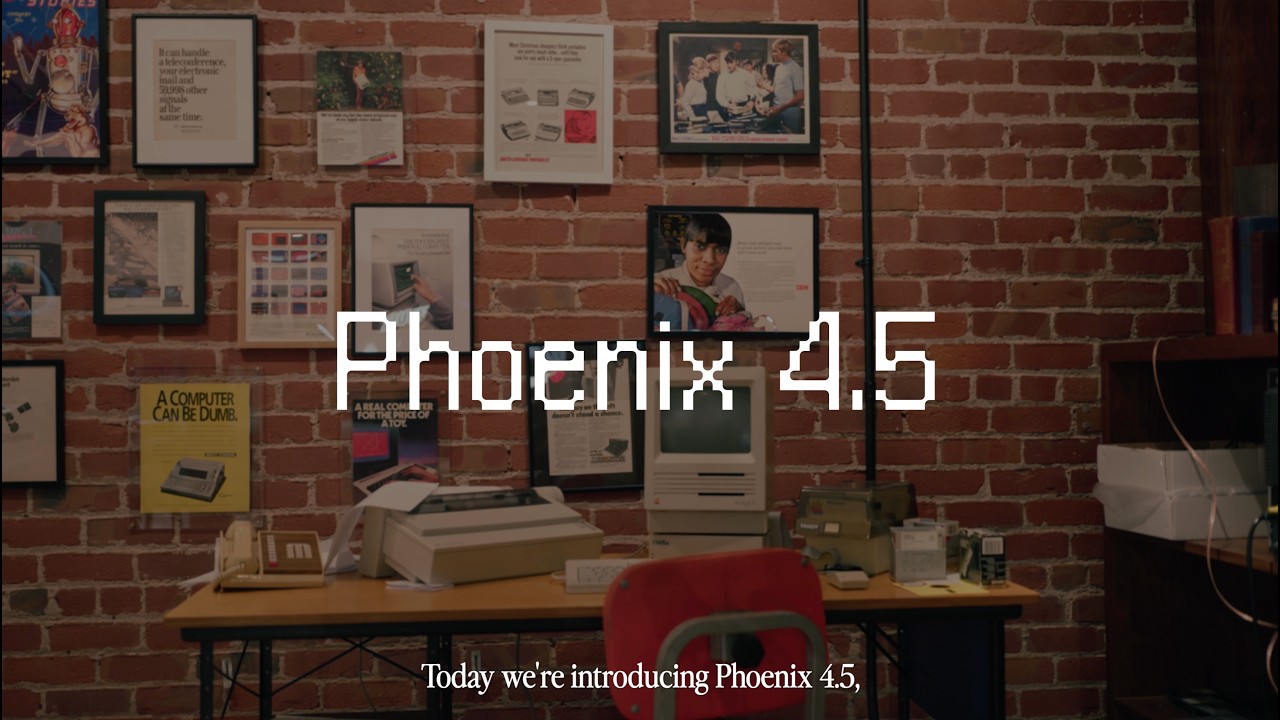
Tavus claims ~600 ms reply time and 134 ms audio-to-video with its latest avatar models (Phoenix-4.5), which also extend motion through the head, shoulders and torso.
Avatar-only modes aren't compatible with Tavus's perception or speech recognition layers. The knowledge base only supports English-language documents, and conversations support 42 languages with the default TTS, with more via Azure. One customer in our research reported cold starts and latency variance at scale.
For enterprise buyers, Tavus covers SOC 2, HIPAA with BAAs, GDPR and the EU AI Act, with Zero Data Retention available. Tavus's hosted pipeline runs on Daily, and it also offers LiveKit and Pipecat integrations.
Pricing
Pricing is the same for the full agent and avatar-only use.
- Starter: $22/month includes 60 minutes ($0.367/min); no additional usage.
- Builder: $59/month includes 175 minutes ($0.337/min); then $0.35 per additional minute.
- Growth: $397/month includes 1,300 minutes ($0.305/min); then $0.31 per additional minute.
- Business: $975/month includes 4,000 minutes ($0.244/min); then $0.26 per additional minute.
Enterprise is custom. Concurrency ranges from 1 to 15 sessions on self-serve plans, with higher limits through sales.
Verdict
Tavus is the pick when you need on-screen cards, forms and scheduling inside the conversation, or perception and per-participant memory out of the box. Because avatar-only use costs the same per minute as the full agent, teams that already run their own AI agent should also compare Synthesia's API, HeyGen's LITE mode or Anam's custom LLM option.
4. HeyGen LiveAvatar
Quick summary
- Best for: Fast prototypes, and teams that want to plug an avatar into an existing voice-agent stack.
- Key strengths: Avatar-only and full-stack modes, plugins for LiveKit, Pipecat/Daily, Agora and VisionAgents, hosted voice-agent connectors, a free sandbox and unlimited concurrency on paid plans.
- Limitations: Lowest naturalness score (−0.38) and second-lowest overall experience (0.15) in our evaluation, no native tool calling in FULL mode, and sessions capped at 20–60 minutes on self-serve plans.
What it does
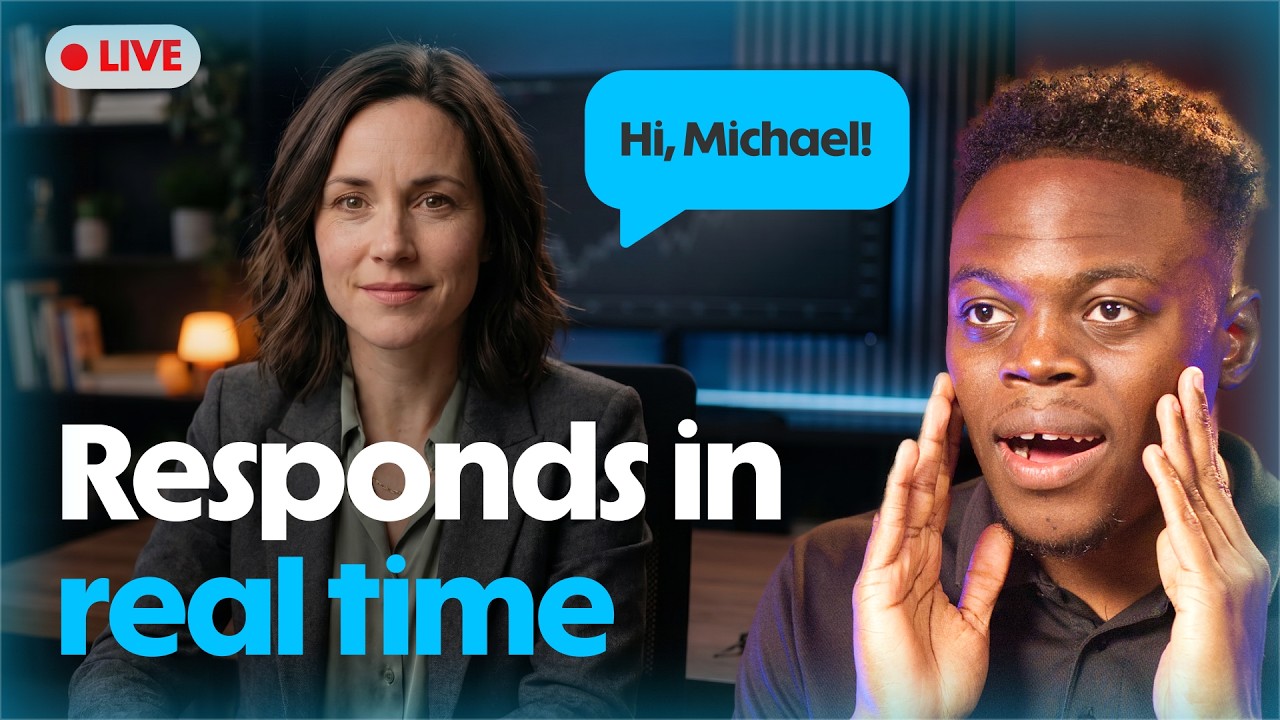
HeyGen LiveAvatar is HeyGen's real-time avatar product. It has two modes:
- Avatar-only (LITE) mode puts an avatar on your own conversational stack.
- FULL mode bundles speech recognition, an LLM, text-to-speech and voice activity detection.
HeyGen has plugins for LiveKit, Pipecat/Daily, Agora and VisionAgents, plus hosted connectors for ElevenLabs, Cartesia, OpenAI Realtime and Gemini Live. It also supports any OpenAI-compatible LLM endpoint, a hosted embed and a free sandbox mode, with a simple SDK integration.
Custom avatars are created from about two minutes of video plus a consent recording, or a single photo, with chest-up framing only. FULL mode adds Contexts with FAQ links for knowledge and a single rolled-up memory summary across sessions. FULL mode has no native tool calling. LITE-mode connectors use the connected agent's own tools.
In our evaluation, HeyGen scored 0.15 on overall experience and −0.38 on naturalness, the lowest naturalness score. Customers in our research also reported turn-taking problems and false starts in production workflows. HeyGen holds SOC 2 Type II, GDPR and CCPA compliance, with a DPA available.
Pricing
Avatar-only (LITE) mode:
- Essential: $99/month includes 1,100 minutes ($0.090/min); then $0.095 per additional minute.
- Business: $475/month includes 6,000 minutes ($0.079/min); then $0.09 per additional minute.
FULL mode:
- Essential: $99/month includes 550 minutes ($0.180/min); then $0.19 per additional minute.
- Business: $475/month includes 3,000 minutes ($0.158/min); then $0.18 per additional minute.
Enterprise rates go as low as $0.01/min, but that requires a large volume commitment, so treat it as a negotiated rate, not a list price. Paid plans include unlimited concurrency, and sessions are capped at 20 minutes on Essential and 60 on Business.
Verdict
HeyGen LiveAvatar is a strong choice for fast prototypes and teams that want the most integration options for the voice-agent stack they already use. Test turn-taking and naturalness in your own workflow before committing, and check the 20- and 60-minute session caps.
5. LemonSlice

Quick summary
- Best for: Full-body characters that gesture, move and act, including cartoons, animals and brand mascots.
- Key strengths: Live avatars from a single image of almost anything with a face, and full-body, hand and scene generation with controllable actions and emotions.
- Limitations: Full-body characters, actions and emotions require the Ultra ($960/mo) or Enterprise plan, it doesn't document built-in agent features like memory or tools, and its performance figures come from its own testing.
What it does
LemonSlice generates live, conversational characters from a single image. That includes photorealistic people, illustrated characters, cartoons, animals and brand mascots. Its standout is full-body generation: it's the only platform here that animates the whole character, not just the head, shoulders and torso.
Its full-body model generates the face, body, hands and the surrounding scene live. Its features include:
- animated backgrounds;
- hand and object interaction;
- cloth and hair physics;
- an emotion engine that picks expressions from the conversation;
- actions such as smiling, waving or crossing arms, which developers can trigger with tool calls.
LemonSlice says its avatars can stream for 24+ hours without visible drift (vendor claim).
LemonSlice is a rendering layer first. You can bring your own conversational stack through LiveKit, Daily/Pipecat, Agora, a WebSocket or ElevenLabs Agents, or use its no-code widget or hosted pipeline, where LemonSlice runs speech, the LLM and voice for +$0.09/min. Through LiveKit Agents, avatars can also join Zoom, Google Meet, Teams and Webex calls. It doesn't document built-in memory, knowledge retrieval or business tools.
It has a notable real-world deployment: a life-size conversational Theodore Roosevelt avatar, built with Microsoft for the Theodore Roosevelt Presidential Library.
Pricing
Avatar-only (bring your own stack):
- Starter: $8/month includes 41 minutes ($0.195/min); then $0.22 per additional minute.
- Creator: $40/month includes 220 minutes ($0.182/min); then $0.19 per additional minute.
- Professional: $100/month includes 610 minutes ($0.164/min); then $0.19 per additional minute.
- Scale: $240/month includes 1,463 minutes ($0.164/min); then $0.19 per additional minute.
- Ultra: $960/month includes 6,000 minutes ($0.160/min); then $0.18 per additional minute.
Hosted widget or pipeline (LemonSlice runs speech, the LLM and voice) adds $0.09/min: $0.250–$0.285/min on included minutes and $0.27–$0.31 per additional minute, depending on plan.
Self-serve plans allow 3–10 concurrent sessions and 30-minute calls. Ultra unlocks full-body characters with actions and emotions, 20 concurrent sessions (up to 100 with 2x burst pricing) and 2-hour calls. Enterprise is custom, with 1,000+ concurrent sessions, 24-hour calls, zero data retention and EU/US data residency.
Verdict
LemonSlice is the pick when body language matters: a full-body mascot, a fictional character or a life-size museum guide that gestures and acts. Budget for the Ultra plan if you need full-body characters, and plan to bring your own agent logic for memory, knowledge retrieval or business tools, since its hosted option doesn't document them.
6. D-ID
Quick summary
- Best for: Enterprises that need to run interactive avatars in their own private cloud or on-premises.
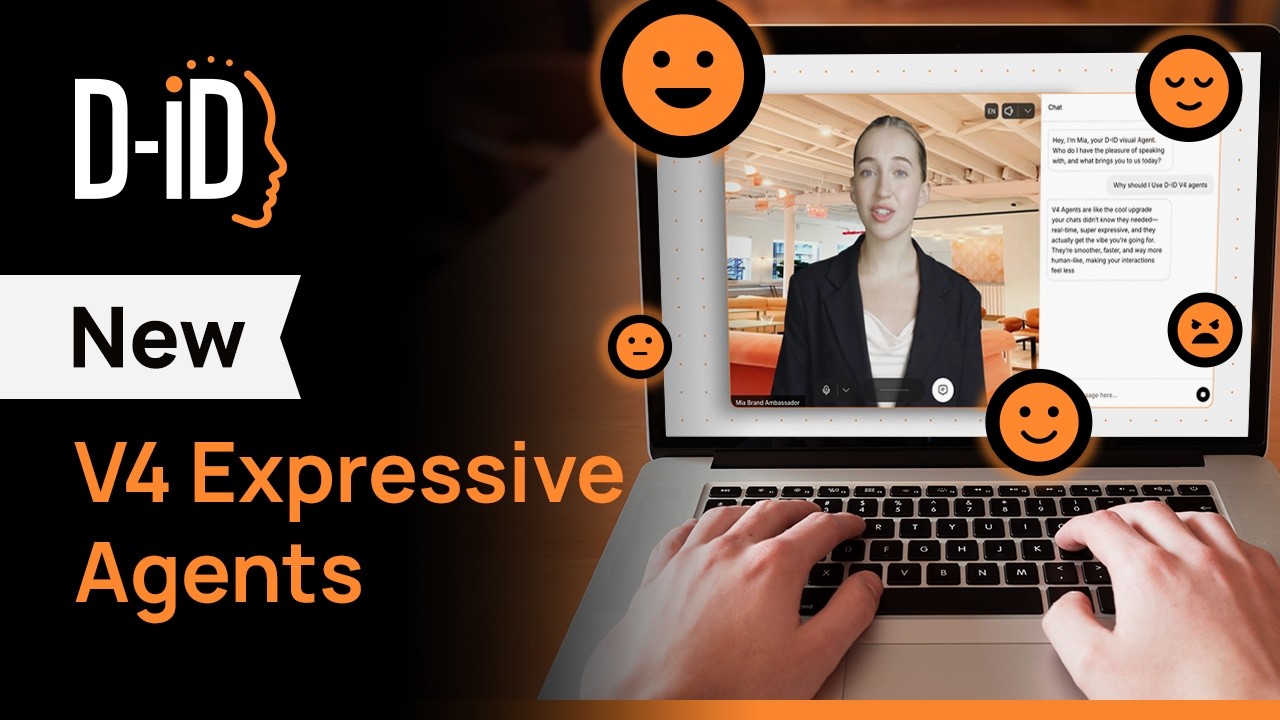
- Key strengths: Optional VPC and on-prem deployment, the longest list of security certifications here, V4 Expressive Visual Agents, and Agentic Videos for adding an agent to existing video.
- Limitations: Higher per-minute pricing (~$0.50–$0.56/min), knowledge-base limits of 5 documents per agent, and live-avatar performance figures that come from D-ID's own testing.
What it does
D-ID offers two related products:
- Agentic Videos embed a conversational agent in a video. Viewers can ask questions by voice or chat during playback or after it ends, and answers are grounded in the video's script, with optional extra knowledge sources. Creators get analytics on conversation volume, engagement time, and the topics and sentiment of viewer questions.
- AI Agents are real-time conversational avatars built on V4 Expressive Visual Agents. D-ID describes V4 as a diffusion-based model trained on real actors, with sentiment-driven expressions, sub-0.5 s conversational turns and up to 4K output. As a managed agent, D-ID runs the LLM and voice, with a knowledge base of up to 5 documents (PDF, TXT, PPTX or URLs, up to 500,000 characters each), server and client tools, and memory across conversations. You can embed it on a website with a single script tag.
There are also bring-your-own options: Echo Sessions let the avatar speak audio you stream from your own stack, agents can use a custom LLM, and ElevenLabs-backed agents hand the conversation to ElevenLabs while D-ID renders the avatar. For developers, D-ID also offers a REST API, a LiveKit SDK integration, an MCP server and an Azure Marketplace listing.
D-ID has the longest list of security certifications here: ISO 27001, 27017, 27018, 27799 and 42001, plus SOC 2. It also offers SSO, RBAC, audit logs and optional VPC or on-prem deployment.
Pricing
D-ID prices live agents through its API plans, which include a monthly allowance of streaming minutes. It doesn't publish separate prices for its bring-your-own options, so these are its only published rates for both managed and avatar-only use.
- Build: $18/month includes 32 minutes ($0.563/min).
- Launch: $50, $99 or $149/month includes 90, 180 or 270 minutes ($0.556, $0.550 or $0.552/min).
- Scale: $198, $248 or $297/month includes 400, 500 or 600 minutes ($0.495, $0.496 or $0.495/min).
D-ID doesn't publish a price for additional minutes; you move up a credit tier instead. Agents are charged at 0.5 credit per 15 seconds of video, half the rate of standard video, which is why each plan includes twice as many streaming minutes as video minutes. Annual billing saves up to 30%. A 14-day free trial includes up to 10 minutes of streaming, and Enterprise is custom.
Verdict
D-ID is the best fit for organizations whose security or IT requirements rule out a vendor-hosted service. It's the only platform here that publicly documents VPC and on-prem deployment. For a standard hosted deployment, compare it with Synthesia, Anam or HeyGen on realism, and check how its ~$0.50–$0.56/min API rate compares at your expected volume.
Comparison table
Pricing
All prices are USD, monthly billing. Implied cost per minute is the monthly plan price divided by included minutes, assuming the full allowance is used, rounded to three decimals.
When comparing prices, match avatar-only rates with avatar-only and managed rates with managed. An avatar-only minute covers just the avatar, while a managed minute also covers speech, the language model and streaming.
Kyle Odefey is a London-based filmmaker and Video Producer at Synthesia. His content has reached millions across TikTok, LinkedIn, and YouTube, even inspiring an SNL sketch, and has been featured by CNBC, BBC, Forbes, and MIT Technology Review.
Frequently asked questions
What is the best interactive AI avatar platform in 2026?
Synthesia, for customer-facing enterprise use. It had the highest visual-quality score (0.95 vs. 0.34–0.70) and the highest average on 5 of 6 dimensions in our evaluation of four leading platforms, plus 100 concurrent sessions on paid plans and SOC 2 Type II, ISO 27001, ISO 27701 and ISO 42001 certification. It pairs a no-code widget with a bring-your-own-agent API. The best choice still depends on your use case: Tavus for in-call forms and scheduling, Anam for performance diagnostics, HeyGen LiveAvatar for deployment flexibility, LemonSlice for full-body characters, and D-ID for private-cloud or on-prem deployment.
Which interactive avatar platform is best if I already have an AI agent?
Synthesia's API is the best fit if avatar quality matters most. It had the highest visual quality in our evaluation (0.95), costs $0.10/min, and attaches to your own model and speech stack through LiveKit. If you're not on LiveKit, HeyGen's avatar-only (LITE) mode supports more frameworks (LiveKit, Pipecat/Daily, Agora and VisionAgents) at about $0.08–$0.10/min. Tavus avatar-only and Anam's custom LLM option also attach an avatar to your existing agent, at the same plan pricing as their managed stacks. LemonSlice works this way too, through LiveKit, Daily/Pipecat and Agora at ~$0.16–$0.20/min, and D-ID can put its avatar on your own audio stream (Echo Sessions), custom LLM or ElevenLabs agent.
Which platforms can create cartoon, mascot or full-body avatars?
LemonSlice is the only option here for full-body avatars: on its Ultra plan, it generates the full body, hands and surrounding scene live, with actions and emotions you can trigger, from a single image of a person, cartoon, animal or mascot. Tavus's latest avatars extend motion through the head, shoulders and torso. Synthesia supports stylized characters and brand mascots as well as photorealistic people, in bust framing. HeyGen LiveAvatar uses chest-up framing.
Which interactive avatar platform has the most built-in agent features?
Tavus. It includes a knowledge base, per-participant memory, objectives and guardrails, perception-triggered tools, post-call actions, MCP connectors, in-call UI (Magic Canvas) and meeting participation.
How much do interactive AI avatars cost?
Avatar-only rates are about $0.08–$0.10/min for Synthesia's API and HeyGen LITE. Full-stack rates, where the vendor runs the model and speech too, are $0.20/min for Synthesia's widget, ~$0.16–$0.19/min for HeyGen FULL mode, ~$0.24–$0.37/min for Tavus and ~$0.12–$0.24/min for Anam, depending on plan. LemonSlice costs ~$0.16–$0.20/min avatar-only and ~$0.25–$0.29/min with its hosted stack. D-ID's API plans work out to ~$0.50–$0.56/min for live agents. Compare like with like, avatar-only vs. full stack, and include your model and speech costs.

.webp)

.webp)