



How to Create SOP Training Videos

Create engaging video SOPs in 160+ languages.
Nothing kills trust in L&D like out-of-date training.
I get it. I would also be frustrated if I sought out a training that demonstrates how to do something, only to find out the steps were just wrong. Not only would I feel like I've wasted my time, but I certainly wouldn't finish the training.
That's the challenge we face when it comes to SOP training. Any time the SOP changes, whether insignificantly or substantively, the training needs to be revised. Quickly.
Unfortunately, our ability to turn around updates to training depends on factors like our tech stack and SME availability. While I can't help you with the latter (believe me, I wish I could), I can help you with the former.
If you're looking for ways to design engaging training for your SOPs using video, you're in the right place.
Video SOPs vs. SOP training videos
Before I dive in, I want to clarify something: a video SOP and a training video about SOPs are two different things.
I've seen a lot of discussion conflating the two, so if you're also confused, you're not alone.
To be clear, a Standard Operating Procedure (SOP) is a document that instructs someone how to complete a task. Typically, it includes things like step-by-step processes and any quality checks or risks, to ensure safety and consistency.
In many regulated industries, like manufacturing, pharmaceuticals, or government agencies, SOPs serve an important role. They're a paper trail or a system of record. Therefore, they need to be clearly labeled and versioned, and regularly maintained.
A video SOP is exactly what it sounds like: a video version of that document. Yet somehow, it has become shorthand for training videos about SOPs (more on why that's a problem in a bit).
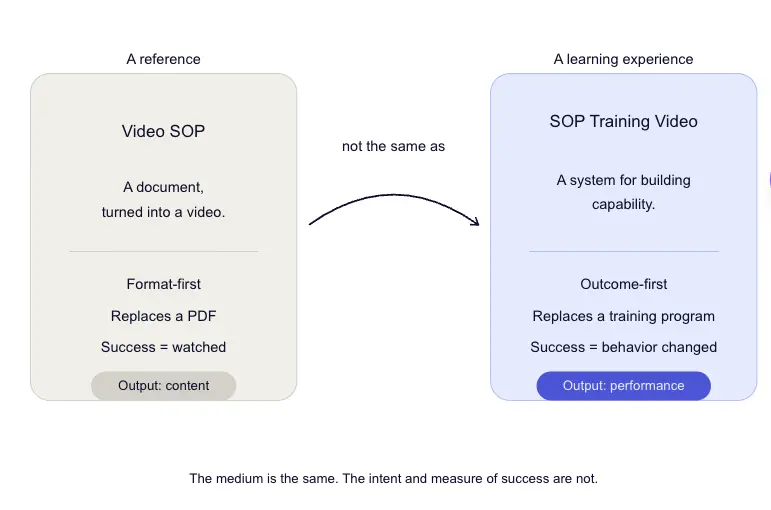
While you could use video SOPs if you're in a non-regulated industry, like hospitality or retail, if you're in an industry that submits SOPs to a regulatory body for compliance auditing, I would not recommend it.
Why the SOP can't be the training
I want you to think about your first day at your current job. Now, I want you to imagine someone handed you a 50-page document and told you to read it cover to cover because it's all the training you need as a new employee.
How engaged would you be in that training?
SOPs are great repositories of information. Thanks to AI integrations, employees can often surface them in the flow of work. But an SOP is not a substitute for structured training.
Decades of learning science show that we can only retain so much information before we overwhelm our working memory. A 30-page document will do that to you.
When to use video for SOP training
If the training objective is for someone to follow a process and perform it, video is often the right choice.
Video-based learning is effective because it combines visuals with narration. People can pause and replay at their own pace until they feel confident enough to perform the process.
But video isn't always the right choice for training on SOPs. Here are several scenarios to help you decide when video training is the right format.
How to create an SOP training video
Once you've identified that video is the right medium for your SOP training, there are five steps you want to follow every time to create an effective training.
If you want to follow along, download this fictional SOP I've created to demo for you.
Step 1: Define your learning objective
I recommend using a structured approach every time to determine who the video is for, what they need to be able to do after watching, and how you'll know if the training was effective. Here's an example of that:
This video is for [role] who need to [perform specific process]. After watching, they should be able to [complete the task or follow the procedure] without [common error, point of failure, or escalation].
Using my fictional SOP, the learning objective would be something like this:
This video is for IT helpdesk analysts who need to process software access requests for new employees. After watching, they should be able to verify, provision, and log access correctly without granting permissions outside the approved RBAC template or missing a required audit entry.
Step 2: Write your script
If you're taking a 30-page SOP and transforming it into a 3-minute video, I recommend using an LLM or scripting tool to get started. You can upload the SOP, along with a prompt like the one below. (Please be sure to treat the output as a first draft that you revise, okay?)
You can always do this by hand, if you prefer, just know that it is going to take some time and several rounds of iterating to write.
Step 3: Plan your scenes
With your script in hand, you can plan your video's layout. That could include a screen recording from an SME or footage of the process being demonstrated.
A helpful rule of thumb is one idea per scene. You can combine steps in one scene, but I'd limit it to two at most so someone can easily replay if they get stuck.
If you're working with a production company, you'll likely hand off the project at this point. Be sure to share your finalized script, any screen recordings or footage, and brand assets like logos, colors, and fonts.
A note on localization: plan for it at this stage, whether you're handing off or doing it yourself. Standardize components that are universal, like how a tool works or industry terminology, and identify the parts that vary by region, like local contacts, policy names, or workflow differences. You'll be grateful you did.
Step 4: Create your video
Follow the guidance for whatever tool you're using to build your video, and dedicate time for revisions.
Be ruthless about cutting anything tangential to your learning outcome. Think carefully about how people will engage with the video, only adding interactivity like knowledge checks or branching scenarios if they prompt viewers to apply what they've watched.
If possible, always include a link to the SOP (just make sure it is the right version).
Step 5: Publish your video
Before you release your video broadly, publish it to a small group first. That could be a handful of people who use the SOP, an SME, or both.
If you can, run your pilot one of two ways. The first is a live focus group. Take notes as they go through it and capture what works, what's confusing, and what context is missing. The second is async feedback with a few targeted questions tied to the clarity of each step.
Once you've incorporated feedback, you're ready for a broader release. Plan for where your video will live and how you'll manage revisions going forward. Our Academy team refers to this as the publishing triangle:
- Surface: Where does this live, and how do people find it?
- Security: Who has access, and what happens when it's shared?
- Stability: How do you update content without creating confusion or outdated versions?
Surface and security are largely managed at the time of publication, though you may revisit either based on feedback or emerging needs. Stability requires a system for maintenance that includes:
- Assigning a clear owner for every SOP training video
- Including the SOP ID, version, and last updated date in the description or end card so viewers know which SOP version they're learning about
- Setting a review cadence and updating the video whenever the SOP changes
How to create an SOP training video with AI
If you're interested in using an AI video platform like Synthesia, the workflow I just described becomes more iterative and collaborative, particularly in how you create and revise your video. You'll still start by identifying your learning objective and end with a strong publishing plan.
Generate a first draft
There are a couple of different ways to generate your first draft. You can upload your SOP, a script, or a prompt into our AI video generator.
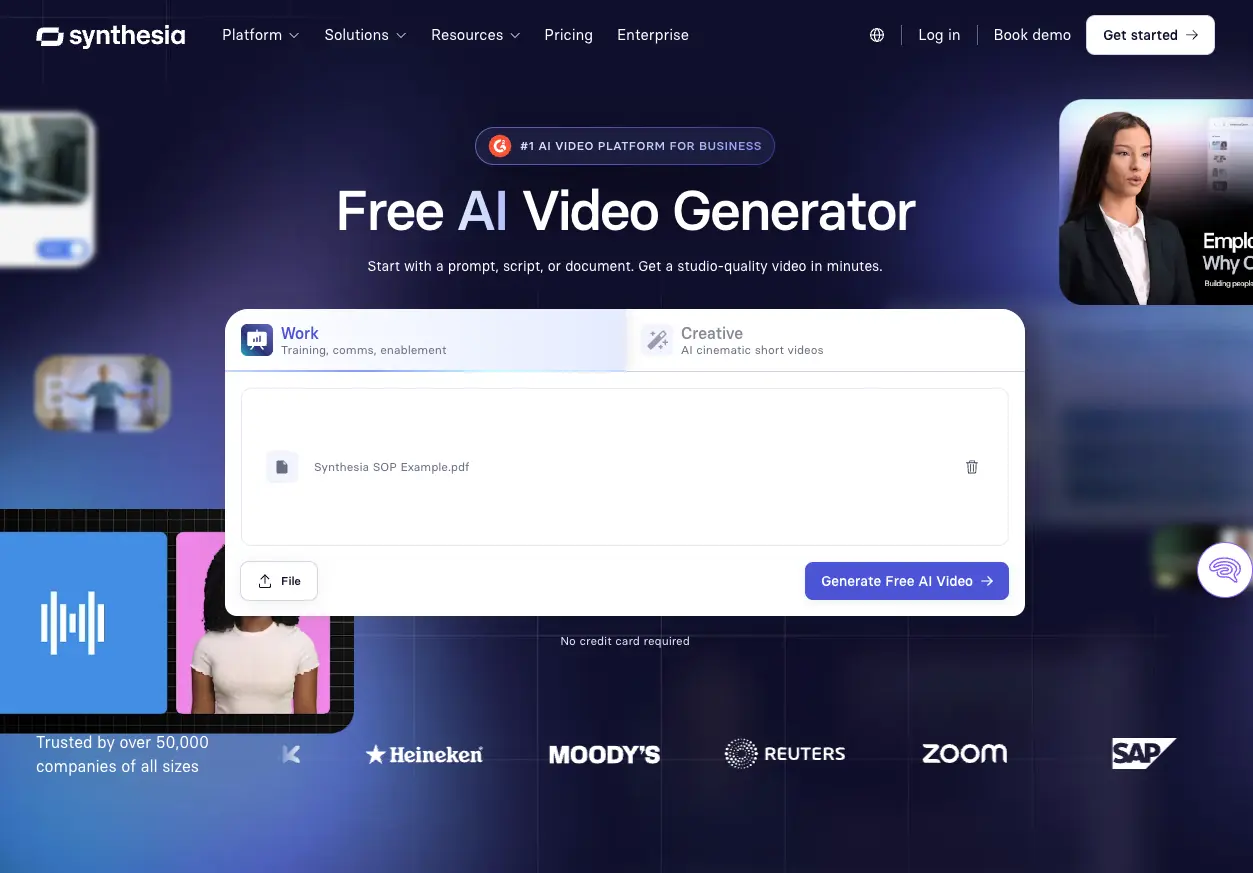
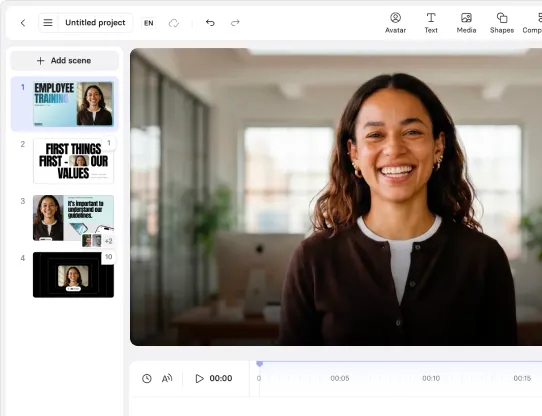
If you're curious, here's the first draft created using the sample script I shared above. The only edit I made was choosing an avatar — everything else that you see was generated by the Assistant.
Another way to generate a first draft is to start with a template. If you're new to designing learning experiences for video, you might find this route easier as you're learning. Our templates are created by instructional designers, so you can focus more on the content and learning objective and less on the production decisions (note: enterprise clients receive customized and branded templates).
If you have a screen recording of a process you want to use, for instance, you could start by uploading that into the template and customizing the script and scenes from there.
Choose your avatar
Once you have a draft, you can choose what to focus on next. Some people like to start by picking their avatar (I think millennials feel at home "picking their fighter"). Just don’t spend too much time picking out their outfits or background (consider uploading a photo of your workplace).
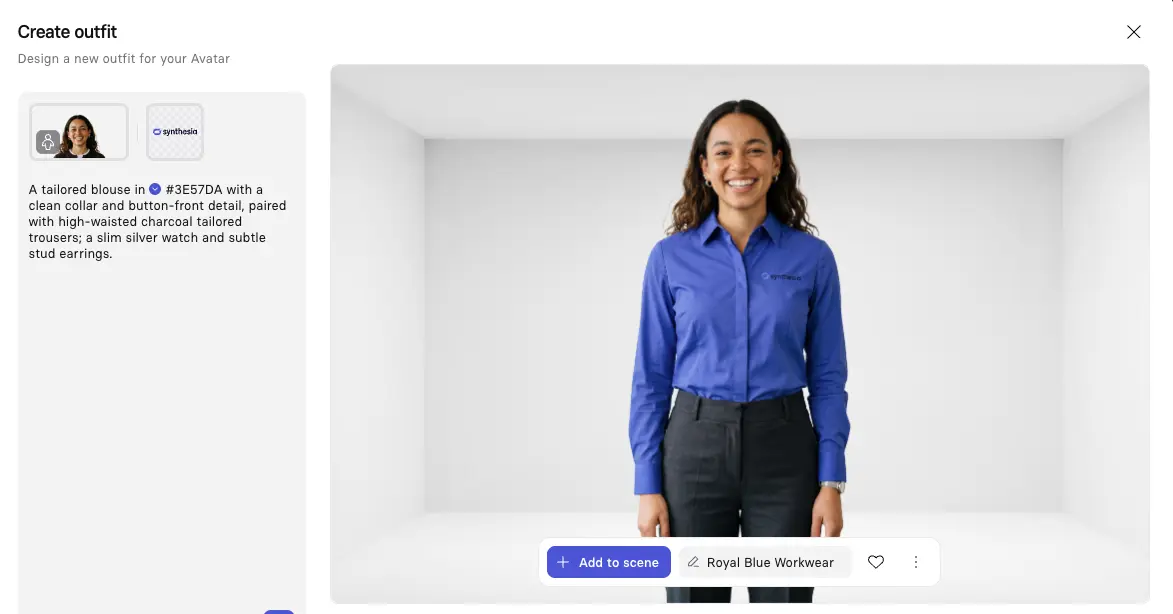
With an avatar selected, you can also make any modifications to the voice. Pay attention to the avatar’s accent and pronunciation as you go along. You can always create a glossary to ensure terms like your company name are consistently pronounced.
Customize your scenes
Whether you want to add motion graphics, b-roll, or interactivity, keep attention focused. Anything you add should help employees understand the process.
Preview your video before generating, and double-check that everything from the pronunciation to the flow makes sense.
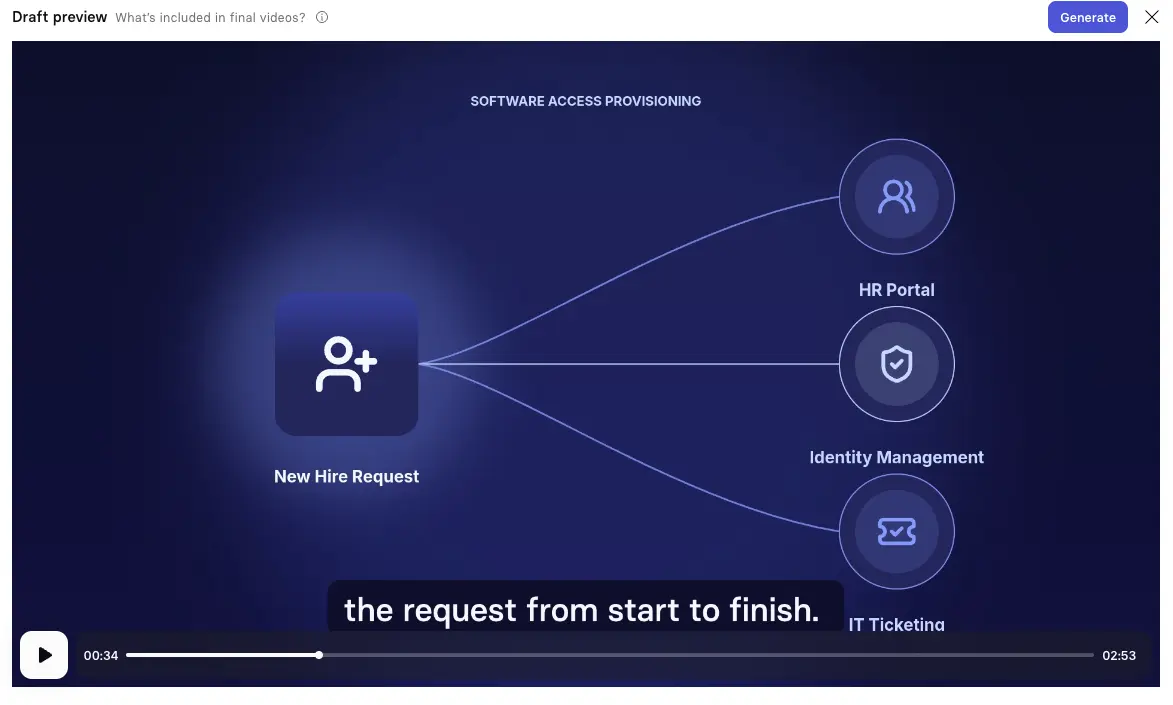
Note: some generated assets may appear as placeholders or low-fidelity previews until you generate the final video.
Localize your video
When you've generated your video, you can localize it into over 160 languages with a few clicks. If you’re localizing videos, be sure to include native speakers when you conduct any pilots.
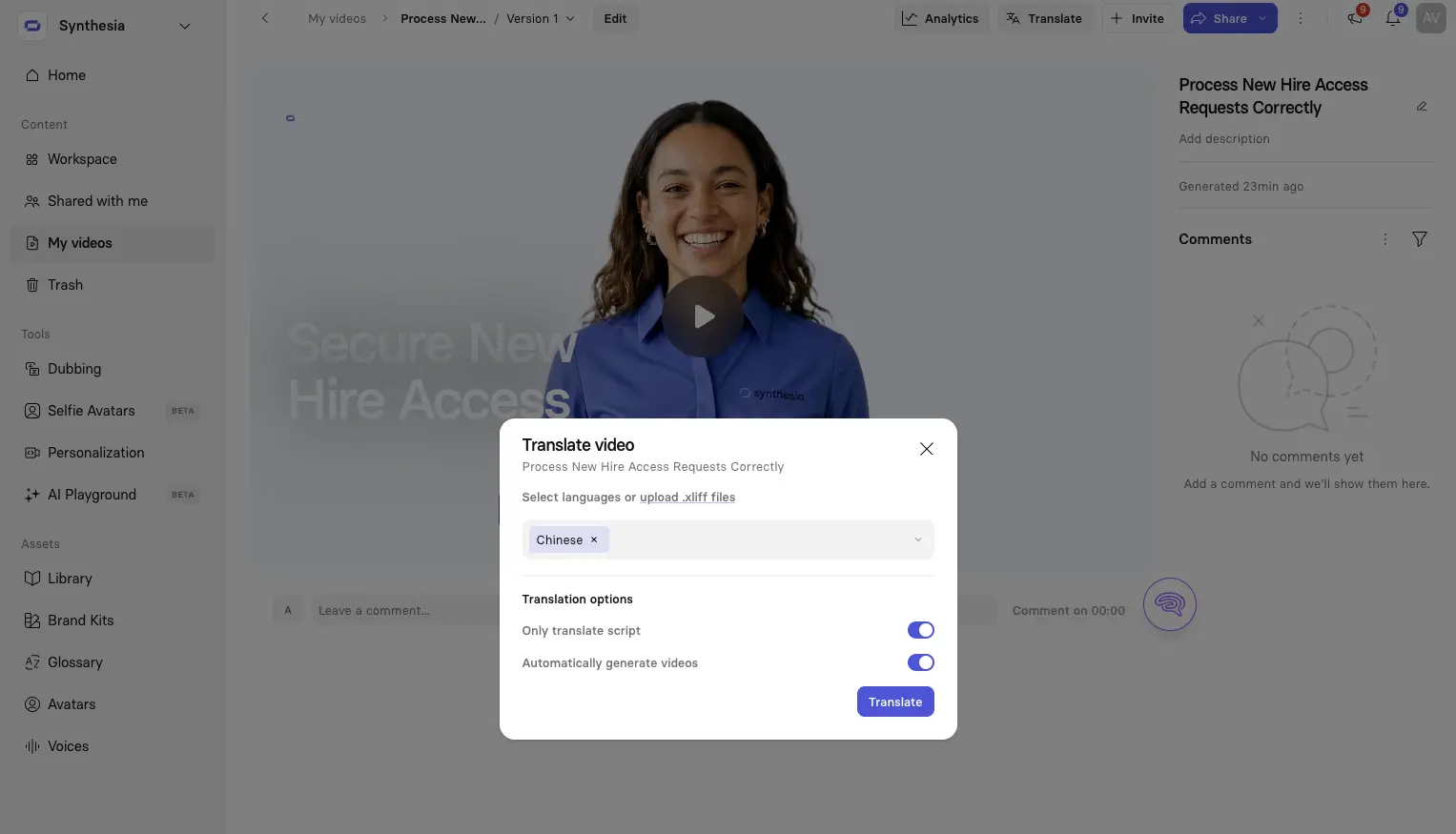
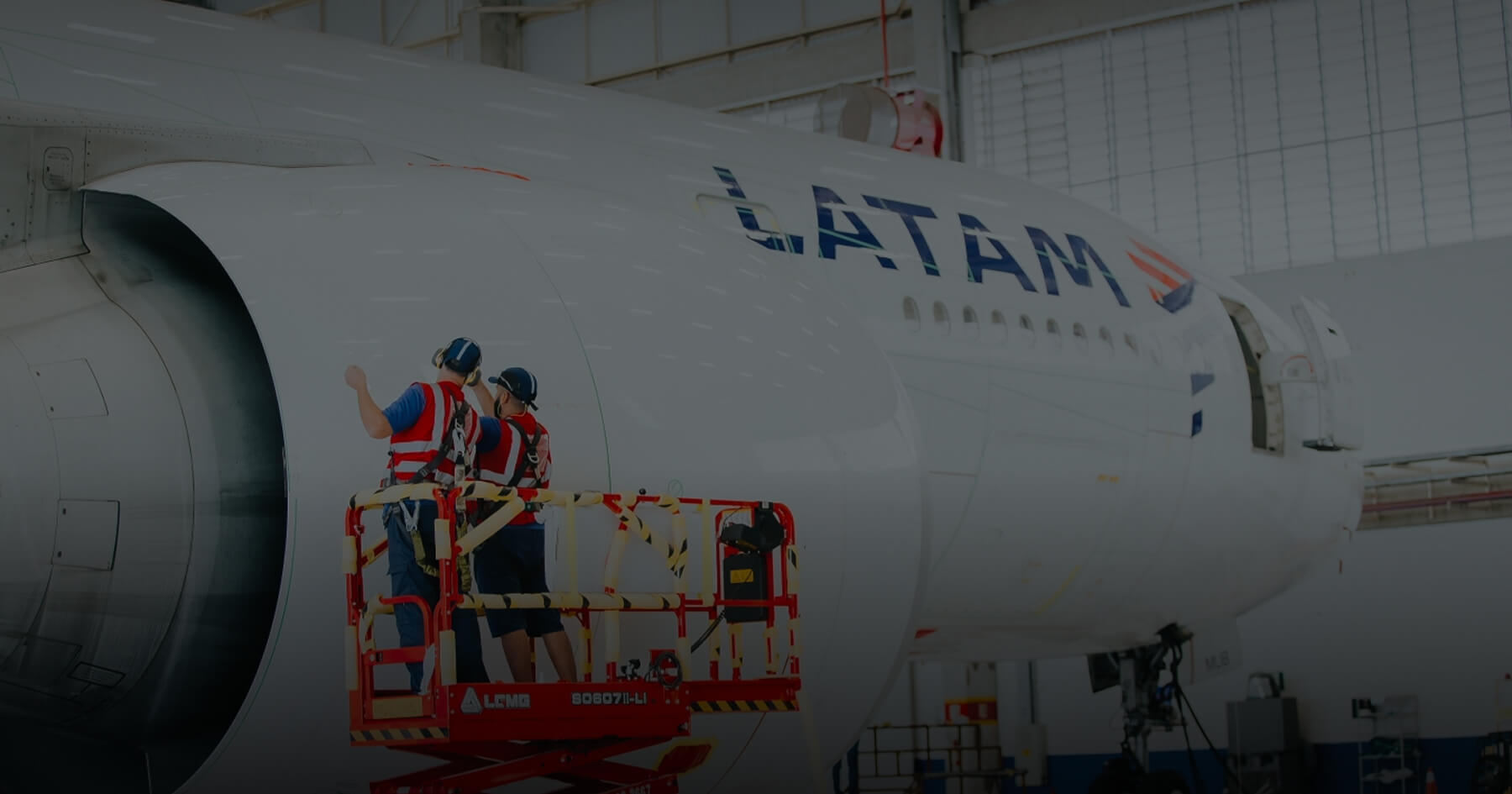
If you want to see how this works within a real organization, read how LATAM Airlines used Synthesia to train their operations and support functions, localizing their videos into Spanish, Portuguese, and English.
Measuring SOP training videos
To know whether your SOP training video worked, go back to the learning objective you wrote in step one. That's your baseline for measurement.
Here's the catch: your publishing plan determines what you can actually measure. If you need to track completion data for regulatory purposes, you'll likely distribute through an LMS, which limits the depth of your assessment and your ability to deliver training in the flow of work. It's worth accounting for that constraint before you publish.
If you want to measure the effectiveness of your training beyond completion rates and knowledge checks (and I really hope you do), figure out what good enough measurement looks like in your organization.
If you're unsure, talk to the SMEs who helped with the SOP. They can likely suggest how people following the SOP can be quantified, whether through fewer errors, fewer support tickets, or something else entirely.
Amy Vidor, PhD, is the Learning and Development Evangelist at Synthesia, where she researches learning trends and helps organizations apply AI at scale. With 15 years of experience, she has advised companies, governments, and universities on skills.