



10 Employee Onboarding Video Examples (+ How to Create One with AI)

Create onboarding videos that scale across teams and roles
Only 12% of employees strongly agree that their company does a great job with onboarding. That's not particularly inspiring for those running onboarding programs.
But I'm also not surprised. Onboarding is tough to get right.
Think about your own experiences going through onboarding. More than likely you're changing companies every four years or so, which means repeatedly relearning the basics: where's the bathroom and how do you request PTO.
Effective onboarding is both universal and specific. It communicates the same message to all new employees about the company and culture, while reflecting the specificity and nuance of someone's previous experience, role, and location.
What is an onboarding video?
An onboarding video is a short, focused video designed to help a new employee achieve one goal. That could be to learn essential information, follow a process, or get energized about the company.
While formats vary, every employee onboarding video should be built around a clear objective.
10 examples of employee onboarding videos
There are plenty of lists of employee onboarding videos out there. I want to give you something more useful: real examples organized by type, based on my own experience running L&D programs and the use cases we see from Synthesia customers.
Finding good examples is harder than it sounds. Most companies don't share their onboarding content publicly (fair enough, it's their secret sauce). So some of the examples you see here may feel a little outdated or generic. That's fine. The goal is for you to be inspired to create something that authentically reflects your organization.
Welcome videos
Welcome videos do just that — they welcome new hires. When I think about welcoming new hires, I often think about personal touch points: greeting people in an office lobby or over a coffee Zoom call. If you're considering making a video the first time an employee hears from the company after the hiring process, you want to convey the same level of enthusiasm and engagement as you would in person.
First impressions matter.
You might think about introducing your team, or having a leader share a bit more about the company and what excites them. Here are some ideas to consider.
1. HubSpot
A welcome video can also be shared with candidates, by the way. Take this video HubSpot made, a genius piece of storytelling featuring photos of their founders and hand-drawn art to give it that human touch. They share their mission and introduce their team, having fun while doing it. By the end of the video, which new hires and candidates could both appreciate, you know their core value "use good judgment" and their benefits policies (hello, unlimited books).
In less than 4 minutes, I can confidently say I could describe their company. Talk about powerful.
2. Missouri State University
Missouri State University offers a more traditional approach to a welcome video, using narration over b-roll and some upbeat music to showcase the university's campuses, academics, and student life. With an audience of faculty and staff, they introduce things that everyone can relate to. Most importantly, their president talks about fulfillment for employees, grounded in the university's educational mission.
At about 6 minutes, this video is comprehensive without feeling too lengthy.
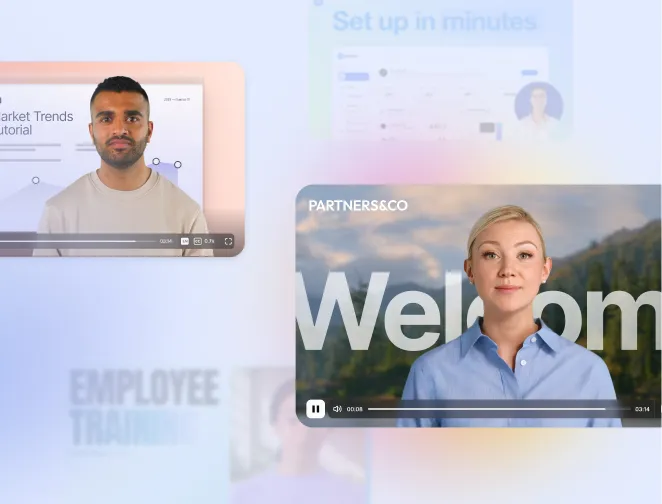
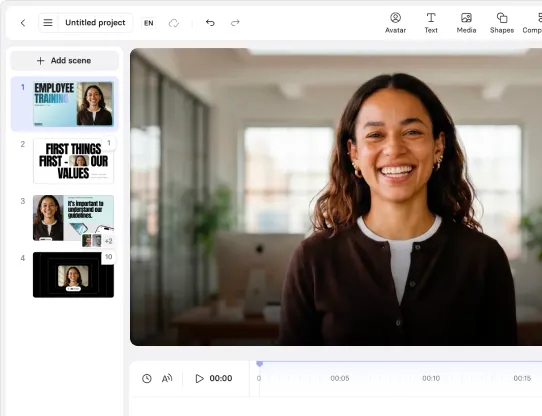
Note: If designing your own welcome video feels like a daunting task, fret not. You can try a structured template like the one below, or chat with our AI Assistant to get started (more on how that works in a bit).
Company culture
You could make the argument that all onboarding videos are culture videos. And you'd be right.
Sometimes a company culture video is explicitly that, covering a mission or values. In other cases, it is about how employees treat each other and build community. These videos are examples of that diversity
3. Atlassian
Culture is a thing that can't be manufactured," Mike Cannon-Brookes, co-founder and co-CEO of Atlassian, says in this video, before passing the baton to other employees to describe in their own unfiltered words. There are some carefully chosen shots of how their culture shows up in collaboration and events like Twilight Cinema. (I was sold with the sleeping puppy.)
While I enjoy the frank tone, it may not work for your organization. Again, authenticity is key here.
4. Microsoft
Microsoft takes a different approach with this video highlighting how women are shaping the future of technology. Note the tone difference, as the video brings together employees to generate genuine dialogue.
Definitely on brand for Microsoft (peep the Microsoft colored-wheel and balloon game).
5. Spotify
The last type of video I want to highlight in this section are office tours. In this Spotify video, the camera glides around the New York office, zooming in on the quirky decor, coffee bar, plant life, and fun seating. There's no narration, but there are lots of textures and sounds.
Within a few minutes, new hires can see everything from how employees dress to how they meet, collaborate, and eat. I don't know about you, but after watching I want to touch all those interactive walls.
For more on how to build a company culture video, check out my guide.
Career development and internal mobility
Onboarding isn't just about welcoming new employees. It's about showing them how you will support their career development and foster internal mobility.
According to LinkedIn's 2025 Workplace Learning Report, "Organizations that prioritize career development outpace others on key indicators of business success."
That's why I encourage you to consider making an onboarding video like the ones below. Show, don't tell, your new hires how you'll invest in them.
6. Patagonia
I'll preface this by saying I'm a long-time Patagonia customer, and this video only reaffirmed my status. In 2022, Patagonia's founder declared that all future profits would be invested in fighting climate change, noting that "Earth is our only shareholder."
This video feels completely on brand. By following one employee's journey from sewing technician to manager, spliced with footage of her surfing and camping, Patagonia shows rather than tells what their culture looks like on a production floor.
The career story and the lifestyle story are inseparable, and that's the whole point. For a new hire, this video answers a question that no handbook can: will this company actually live its values?
7. Adobe
If you're looking for a more corporate example to emulate, watch this one from Adobe highlighting their two-year Sales Academy. That's right, two years. This isn't a lightweight investment, and it shows. Senior leaders and program alumni share their perspectives on the program.
If you invest in a flagship program like this, I highly recommend crafting an onboarding video to celebrate the work. It's the best marketing you'll do in L&D.
Try uploading promotional materials about your flagship program, like a deck or flyer, to our AI video generator to craft a strong first draft.
Role-specific onboarding
Role onboarding is where the universal meets the specific. Every new hire needs to understand the company, but they also need to understand their team, their tools, and what success looks like in their particular role.
Typically, onboarding program managers don't own role-specific content, but you may be responsible for providing guidance on how to build it out, especially when the only onboarding that exists lives in people's heads or questionably-stored documents.
That's where onboarding videos are especially useful. With the right guidance, they can introduce a team, a process, or a set of expectations with minimal annual revisions required.
8. Accenture
One of the best things about these videos is that they require minimal production. This one by Accenture looks like it was shot in one take with a cell phone and then captioned.
This format, asking someone to read and then answer a question, is a great way to document institutional knowledge. And as a bonus, it probably takes less than 10 minutes to make with an auto-captioning tool.
9. Lego
Of course, if you have a production crew at your disposal, you can film well-lit productions like Lego's video. It uses the same principle as Accenture, asking employees questions about their role while filming in the office. Lego rotates through members of their Digital Technology team and captures the essence of their playful workplace with their signature bricks.
Importantly, there is nuance to these interviews, capturing the reality of working at a large enterprise and the competitive talent pool they're recruiting from.
Role-specific onboarding often includes an introduction to people management, covering everything from how to conduct performance reviews to approving PTO according to policy.
It may also be extended to include onboarding for newly promoted managers, with skill specific training, like how to give constructive feedback. If you're looking to design something like that, try out this template to get started.
Compliance and safety training
The least exciting part of onboarding is the one that matters most. Usually that includes everything from filling out paperwork to setting up your computer and completing compliance training. If your workplace includes controlled environments, it may also include safety training.
The stakes are real. Non-compliance can expose your organization to risk and liability, and in safety-critical environments, physical harm. That's why consistency matters: every employee needs to receive the same information, regardless of their role or region.
Video is particularly well-suited for this use case because it allows you to deliver messages consistently and meet regulatory requirements.
10. Synthesia
At Synthesia, we practice what we preach. Our People team uses video to deliver important messages about getting started and compliance training. In this video, there's a brief overview of important systems and information.
The video begins by telling new hires they'll know exactly what to do on Day 1. It's sent before the employee's first day so they know what to expect. (If you're looking to reduce the number of emails your People and HR team fields about what to expect from orientation and onboarding, this is a great solution.)
While this version has been scrubbed, generally speaking you want to be as precise as possible in your compliance videos. That means including system names, precise contact information, and links to internal resources. Use videos to equip employees with the right contextual information so they can start solving their own problems.
These videos will inevitably need to be updated when a policy or tool changes. Using AI video allows you to swap out a single scene without having to reshoot an entire video.
How to create an employee onboarding video with AI
I've already shared one way to make employee onboarding videos: using a structured template. Another way to get started is using our AI Assistant and existing onboarding materials to shape the output.
Let's say you host onboarding every other week. On Monday mornings, part of the program is an IT overview covering how to turn on your computer, set a new password, and log into SSO. You have this all documented in a slide deck. Here's how you transform that into a video using natural language and an AI video generator.
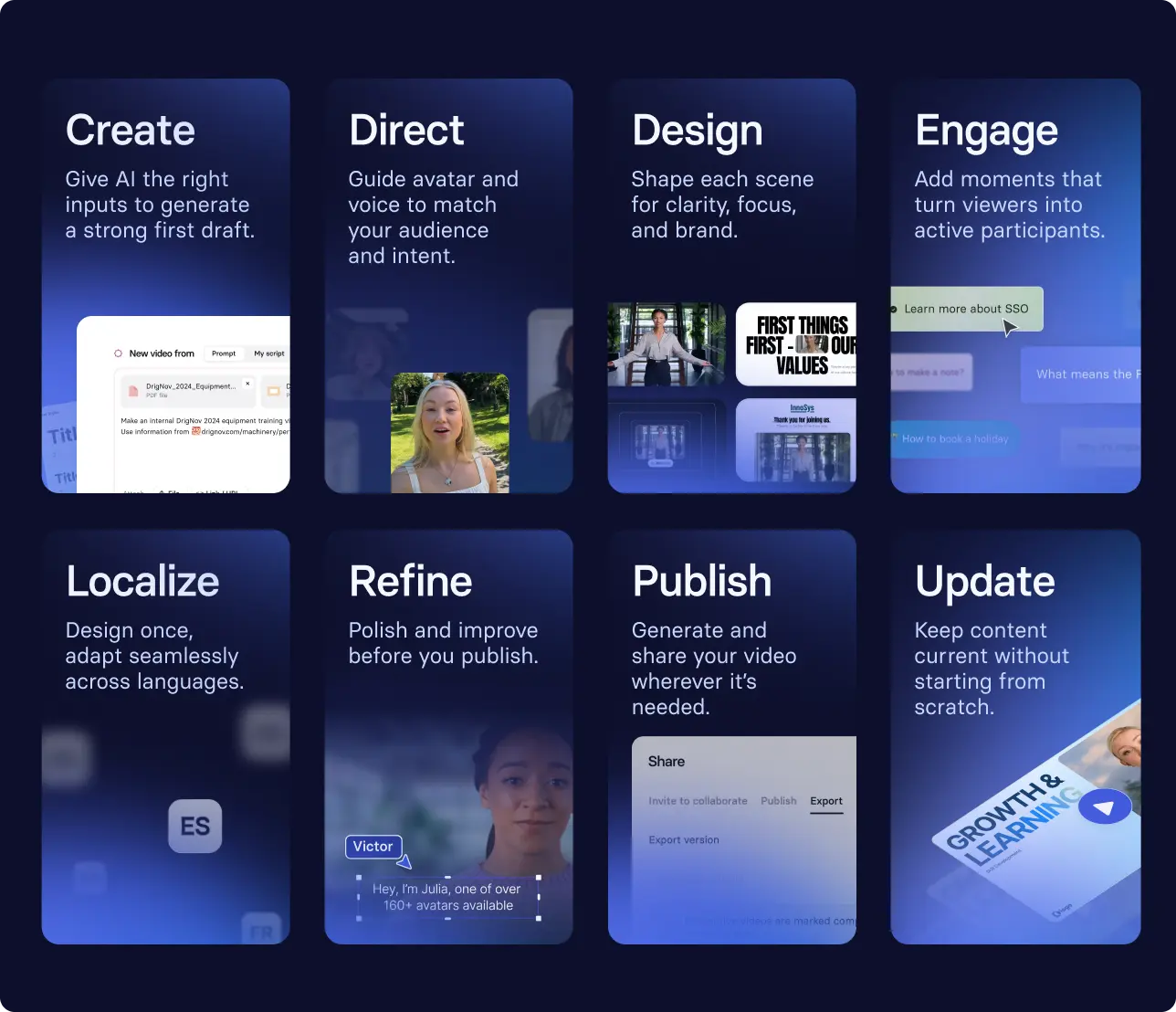
Step 1: Upload your materials and define the outcome.
Upload the PowerPoint file and input the outcome you want. An easy way to frame this is to complete this sentence:
After watching this video, [role] should be able to [complete a specific task] in [context], without [common errors or support].
For example: After watching this video, new hires should be able to log onto their company laptop on wifi and connect to their SSO hub, without needing to reach out to IT support.
If that outcome isn't clear or observable, your video will be difficult to design and even harder to measure.
Step 2: Generate a first draft.
Get up and stretch your legs while you wait (trust me, it boosts your creativity). Then, when your draft is ready, pick an avatar to narrate your video.
Step 3: Review each scene
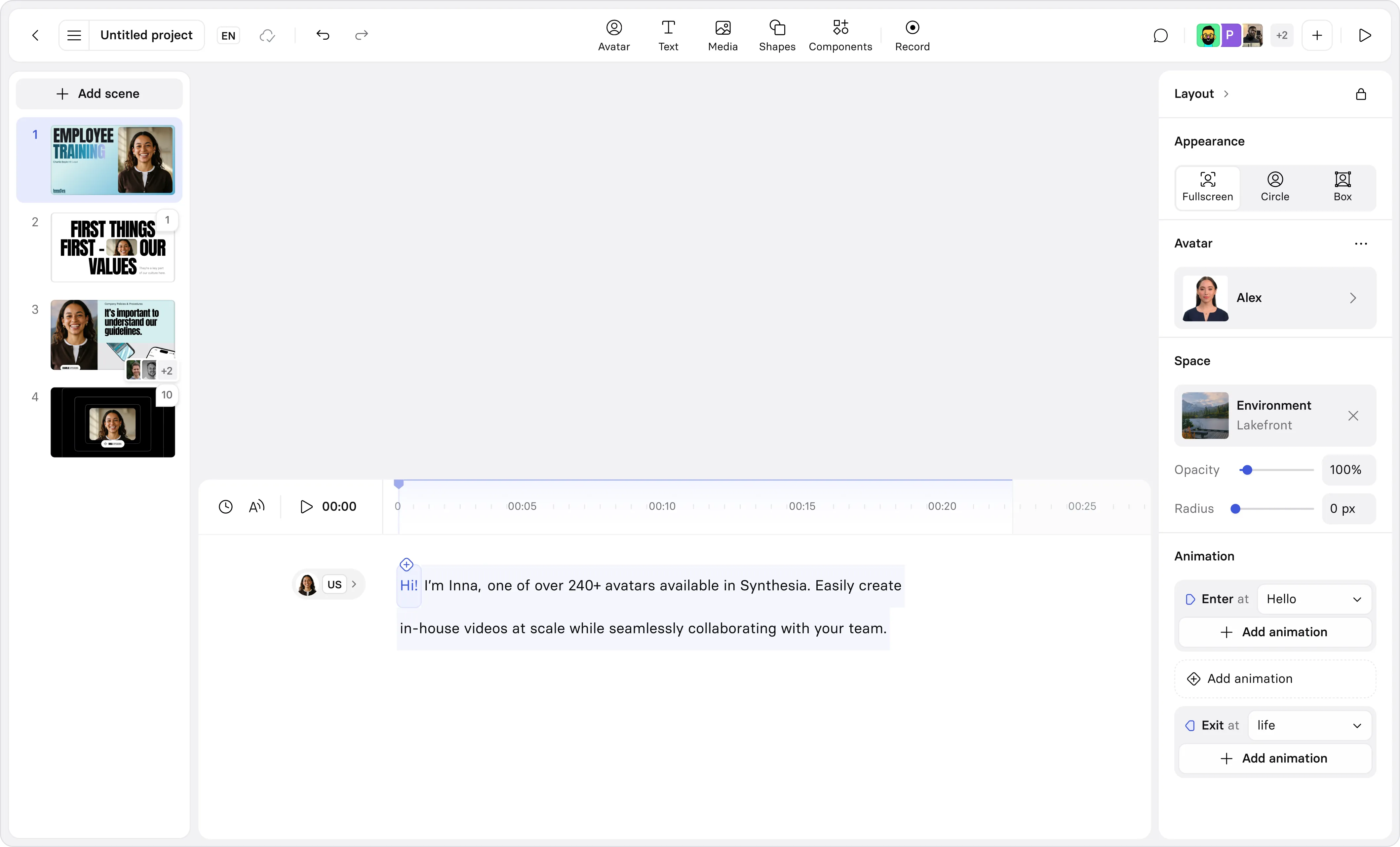
Next, go through each scene. (A scene is like a slide.) Refine for clarity and adjust the tone and visuals to match your audience and outcome. For instance, if relevant, add in a screen recording of someone navigating to the SSO hub.
Step 4: Publish and share.
Consider piloting during an upcoming orientation session to gather real-time feedback. Note where people have questions so you can incorporate that into your next draft. Keep in mind that the video will eventually be distributed in advance, so people can pause and rewatch at their own pace. There's always someone who struggles with wifi and slows down the group.
If the feedback surfaces something that isn't working, our FOCA framework can help you diagnose the problem. Most issues trace back to an unclear outcome, a loose structure, or a CTA that doesn't point anywhere useful.
Step 5: Iterate.
Make any changes based on what you observed. Once you're confident in the video, publish it to a central hub like your LMS, intranet, or help center so new hires can always find the current version. If you're working across regions, prioritize localization early.
Here's an example of a completed orientation video.
Organizations we work with often structure onboarding as a series of videos, interwoven with live touch points. Criteo uses this approach to deliver consistent messages to new hires across teams and locations, helping employees ramp faster while reinforcing a shared understanding of how the company works.
How to measure onboarding video success
Earlier, I recommended completing this sentence before building any video: After watching this video, [role] should be able to [complete a specific task] in [context], without [common errors or support]. That sentence is your measurement baseline. Without it, you're producing content without a way to know if it worked.
For onboarding specifically, early signals often look like reduced IT or HR support tickets, or improvements in survey responses to questions like "I know where to find answers to my questions" or "I know where to go for help."
But those signals only tell you so much. Over time, you want to build a more robust measurement approach that accounts for your full onboarding program, including the investment in AI video tooling and the time and labor saved or spent. Create a baseline before you transition to video, pick a reasonable timeline like three months to assess progress, and make sure your metrics connect to something the business actually cares about.
That last part matters more than people give it credit for. Onboarding isn't just an HR concern. Delays in ramping new hires, poor early experiences, and early attrition all have real costs: slower productivity, additional burden on managers, and turnover after you've already invested in talent acquisition. Measurement is how you make that case and keep improving.
Note: measurement is limited to the capabilities of your file packaging or tracking systems like an LMS. When you create a video in any training video software, it can be distributed as an MP4 file, but you will not get any data from the file itself on completion rates or progress.
That's why a robust measurement approach includes a consideration for where videos are published, how they work in your learning ecosystem, and how you capture feedback.
Amy Vidor, PhD is a Learning & Development Evangelist at Synthesia, where she researches learning trends and helps organizations apply AI at scale. With 15 years of experience, she has advised companies, governments, and universities on skills.
Frequently asked questions
What is an employee onboarding video?
An onboarding video is a short, focused video that helps new employees succeed at the start of their role. It explains what they need to know, demonstrates what to do first, and points to the next step.
Organizations use employee onboarding videos to cover everything from company culture and role expectations to key policies, tools, and compliance requirements.
What should be included in an employee onboarding video?
Every onboarding video should cover what the viewer needs to know, what they need to do next, and where to go for help. The specifics depend on the type video: a welcome video covers culture and first steps, a role onboarding video covers priorities and tools, a compliance video covers required behaviors and consequences.
The most common mistake is trying to cover too much in one video. Remember that each video should cover one objective and one next step.
How long should an onboarding video be?
The video's length matters less than its scope. Remember to keep videos focused on objective and one next step.
That being said, most onboarding videos perform best whey they are between 3 and 7 minutes.
Welcome and culture videos can be shorter, around 2 to 3 minutes. Compliance and role-specific videos can run longer if the content requires it, but anything over 10 minutes should be broken into modules.
How do I create an employee onboarding video without a camera or production studio?
AI video platforms allow you to create an employee onboarding video without a camera or production studio.
You write a script, choose an avatar presenter, and the platform generates a finished video with synchronized voiceover. You can incorporate screen recordings, b-roll, and more to illustrate product demos or process walkthroughs.
Can AI create employee onboarding videos?
Yes. AI video platforms like Synthesia let teams turn a script into a finished video, with an avatar presenter, voiceover, and on-screen text, in minutes.
The same video can be localized into multiple languages from a single source, which makes AI-generated video particularly useful for global onboarding programs.
How do I create onboarding videos in multiple languages?
The most scalable approach is to create the video once in your primary language, then use an AI video platform to generate language variants from the same script. This avoids re-recording and keeps messaging consistent across regions.
Whether you choose to subtitle or dub your video depends on what you want employees to do while watching. Subtitles work well for reference content and review. Dubbing tends to be a better fit when learners need to track actions or follow a process in real time, since it keeps their visual attention on the content.
How often should employee onboarding videos be updated?
Review onboarding videos at least once a year, or whenever there is a significant change to the role, process, policy, or tool being covered. Compliance videos should be reviewed more frequently, particularly when regulations or internal policies change.
The easiest way to stay current is to assign a named owner to each video and set a review date at the time of publication. That way updates happen proactively rather than when someone notices the content is wrong.

You might also like