



The 7 Coaching Leadership Skills Every Leader Needs


Practice critical conversations with Interactive Avatars.
To be an effective leader, you need to be an effective coach, at least that’s what psychologist Daniel Goleman’s research shows.
In 1998, Goleman argued that emotional intelligence is the key attribute distinguishing adequate leaders from outstanding leaders. He breaks emotional intelligence at work into five components, including empathy, which he describes through behaviors like coaching.
He argues that effective coaches are able to “get inside the heads of the people they are helping. They sense how to give effective feedback. They know when to push for better performance and when to hold back.”
But how do you build those capabilities in leaders, and in turn a coaching-based leadership culture? It starts with a specific set of skills.
The 7 coaching skills every leader needs
The International Coaching Federation (ICF), one of the primary bodies governing professional coaching standards, identifies core competencies for coaches. The ICF last updated these competencies in 2025 based on an analysis of over 3,000 coaches.
Because the ICF’s audience is broad, ranging from new coaches to executive coaches, I find it helpful to break down these competencies into skills by audience.
A competency is the knowledge, skills, abilities, and behaviors a person needs to perform effectively in a given role – in this case, a leader who needs to coach.
Here are the 7 coaching skills every leader needs based on the ICF's competencies, using an example of a leader coaching a member of their team who has just been promoted into a role where they're managing managers.
- Setting clear expectations
Agreeing on, and revisiting as appropriate, the overall focus of the coaching relationship (e.g., focusing on delegation instead of individual workload). - Responding without judgment
Acknowledging what the coachee shares without sharing your personal perspective on the situation (e.g., not showing disappointment when they admit to micromanaging their directs). - Sitting with silence
Resisting the urge to fill the space after asking a question (e.g., letting them reflect on why it's difficult to let go of their previous workload). - Listening actively
Giving your full attention to the conversation (e.g., not comparing their experience with yours). - Asking to understand
Asking because you're genuinely curious what they'll say, not because you already know what you want them to conclude (e.g., "What have you tried with your directs that is working?"). - Setting goals
Turning insights from coaching conversations into specific next steps (e.g., agreeing that they will let one of their directs lead the next team meeting). - Giving feedback
Describing what you observed and its impact, without necessarily prescribing a solution, then checking back on whether it changed anything (e.g., noting that they answered a question for a direct instead of asking what they'd already tried, and checking in afterward on whether they noticed doing it again).
Now, this list is not exhaustive. There are plenty of skills that could be added based on the leader’s background.
This list also presupposes several conditions. The leader has a trusted relationship with whomever they are coaching. The coachee has to feel psychologically safe. That includes coaches maintaining confidentiality about all conversations, and being able to separate out coaching conversations from things like performance reviews.
How to build coaching skills
For leaders, building coaching skills often means changing behaviors. That's why the best approach to building coaching skills is what researchers call Behavior Modeling Training: learning how to do something (inform), watching someone do it (demonstrate), and trying it themselves (practice) with real-time feedback and support in the flow of work (reinforcement).
Often, leaders are promoted because they're good at making decisions and getting people aligned behind their vision. They're "do-ers," capable of executing. Coaching challenges those behaviors. Developing the insights of another person requires setting your own ideas and perspectives aside, at least temporarily, so theirs can surface instead.
This isn't unique to leaders. The ICF requires professional coaches to follow the same loop throughout their careers, investing in ongoing learning, supervised practice, and working with a mentor coach. If even trained coaches need this, leaders starting from scratch need it more.
Inform
The first step to building coaching skills is understanding the fundamentals, which are often taught through frameworks. Every coaching training I’ve ever attended or led has included a framework.
Frameworks do two things effectively: they provide a structure for a coaching session, and they have built-in best practices. Most coaching frameworks are intentionally simple, and often mnemonic devices of some kind. The goal is for you to be able to focus on the conversation with the framework serving as the directions so you know where to start and end.
Take GROW, for example, a framework I recommend to new coaches. What I like about GROW is that it gives you a way to practice skills like setting goals and asking to understand. It's also aptly named: the framework's purpose is to help the coachee grow.
Demonstrate
The next step in building skills is watching them be modeled by someone else. Leaders can do this several ways. They can shadow an experienced coach's session, with the coachee's consent. They can also review recorded coaching sessions or watch roleplay scenarios.
A good demonstration shows both what to do and what not to do in specific situations. (I wouldn't recommend the latter in a real coaching session, obviously.)
They should also include explanations of why the model was good or bad, identifying the transferable principles for any of the seven skills above. For instance: this coach effectively used silence to allow the coachee to further reflect on their answer.
Practice
The final step in building skill is practicing it, with real-time feedback. This is where most leaders struggle to build coaching skills.
Getting leaders a structured space to practice, so they're not trying something out for the first time on a direct report, can feel impossible. Their schedules are packed, and finding a peer who is available is unlikely.
There are a few options available for practicing coaching-based leadership: participate in a cohort, like one run by the ICF; partner with a mentor to roleplay; or use an AI tool. But these options are dependent on other people's availability, and aren't scalable.
How Synthesia supports practice
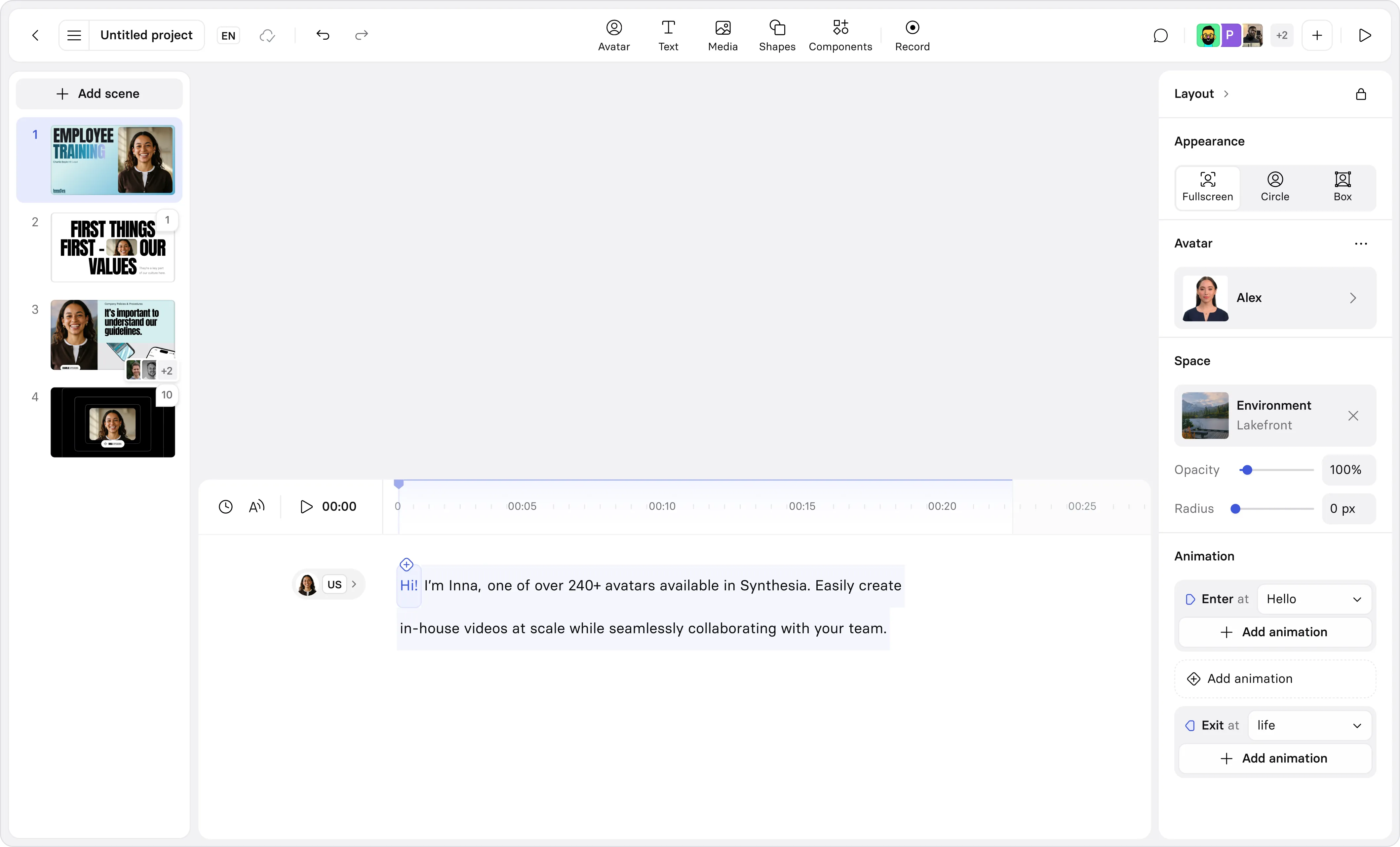
At Synthesia, we've designed Roleplay Sessions to help leaders practice their coaching skills on demand, without waiting on a peer or mentor's availability. That means every leader in your organization can practice.
Hear more from our CEO, Victor Riparbelli.
Try it for yourself. See if you can coach a direct report through a difficult conversation.
Reinforcement
Finally, for coaching skills to build over time, they need to be reinforced through sustained application, feedback, and support.
For a leader building coaching skills, that means being able to track their own progress, whether through the dashboard analytics in Roleplay Sessions, 360 assessments, or another evaluation mechanism.
It also means receiving ongoing training, along with nudges toward the frameworks and tools they can use in their coaching practice.
Amy Vidor, PhD, is the Learning and Development Evangelist at Synthesia, where she researches learning trends and helps organizations apply AI at scale. With 15 years of experience, she has advised companies, governments, and universities on skills.
Frequently asked questions
What are the core coaching skills every leader needs?
The core coaching skills every leader needs are: setting clear expectations, responding without judgment, sitting with silence, listening actively, asking to understand, setting goals, and giving feedback.
Each of these skills is based on the International Coaching Federation’s core competencies.
How do you train managers to have difficult conversations?
Training managers for difficult conversations requires teaching the conversation itself (e.g., a framework, best practices), modeling what good looks like, and giving them an opportunity to practice with structured feedback. This needs to be reinforced before a manager has a difficult conversation for the first time.
How do you measure whether coaching skills are working?
Leaders can measure whether their coaching skills are working by using an AI tool, like Roleplay Sessions, to track their skill uplift, using 360 assessment tools, or partnering with a mentor or experienced coach who can shadow them and provide a formal assessment.
What's the difference between coaching leadership skills and a coaching leadership style?
Coaching leadership skills are specific behaviors that can be developed and refined over time, like active listening.
A coaching leadership style is an approach to management where someone focuses on unlocking the potential of others. It's often listed alongside other leadership styles, such as transformational, participative, and transactional.