



Personalized Coaching at Scale: A Guide for L&D Teams


Practice critical conversations with Interactive Avatars.
Coaching is hard.
Good coaches have honed a skill that most of us struggle with. They ask genuine questions, and then they… stop talking.
According to the International Coaching Federation, the accreditation body behind most corporate coaching certifications, competencies of an effective coach include "Listens Actively" and "Evokes Awareness." A common strategy they recommend to facilitate deeper self-reflection? Silence.
I had a coach once joke that their job was easy: they just needed a few open-ended questions, and the phrase, "And what else?" That's because the person doing the work in a session is the coachee.
Why coaching fails to scale
Coaching fails to scale at most organizations for one of three reasons:
- They make coaching the de facto responsibility of managers, leaving outcomes dependent on whatever skill and time a manager happens to have.
- They don't empower employees to drive coaching. Employees think coaching is something that happens to them, rather than something they drive.
- They outsource coaching, but don't build in follow-through. It's one thing to get someone to sign up for coaching. It's another to keep coaching connected to their day-to-day work once the excitement of the first session wears off.
How to scale coaching
To build a robust coaching culture at any organization, you need to address each of these issues. Here's how to do that, step-by-step, no matter who is doing the coaching (more on that next).
Step 1. Outline why you're investing in coaching
It's easy to overlook this step, but take the time to articulate why coaching is an investment you're making in employees, how it relates to your learning and development strategy, and how you're measuring success.
Step 2. Define roles and responsibilities
Determine who is responsible for what, and write it down. If a manager is expected to be a coach at your organization, that should be explicit. If employees are able to opt into coaching with a third party, note that down too. A clear one-pager for coaches and coachees is essential.
If you're working with a third party, be sure to create an overview to share with their coaches. I recommend including a brief description of your organization, along with the mission, vision, and values (if available). Share guidelines for how you want coaches to interact with employees, and include resources like how performance is managed, career ladders, and skill libraries. The more information coaches have available, kept succinct, the more likely coaching will be aligned with your organization's goals.
Step 3. Enable the coaches and coachees
Whether your managers are expected to coach or just reinforce coaching best practices, provide them with proper training, practice opportunities, and reinforcement. A template doesn't cut it.
Employees similarly need training that outlines expectations of their role as a participant. If you're investing in a third-party solution, that often comes with a significant monetary investment. Explain how this works, give employees support to drive the sessions, and don't be afraid to create boundaries. If someone signs up for coaching but never follows through, they lose out.
Step 4. Evaluate the coaching
If you genuinely want to build a culture where coaching is a valued opportunity, you need to assess what you're offering as you build. This is why you set expectations at the beginning around evaluation.
You'll want snapshot data: things like how many people participated, how many sessions, ratings or feedback collected (from third parties), but also impact data. Did those who participated see benefits in their performance? How are you collecting that information?
How to use AI to scale personalized coaching
AI can support each of the steps I just mentioned. An LLM can help you articulate your coaching strategy, draft roles and responsibilities, and support your enablement. It can also handle administrative tasks, such as scheduling sessions and sharing resources in the flow of work.
But that's not the only thing AI can do to support scaling personalized coaching. AI can also provide the coaching.
Now, a few caveats to that statement. There are a range of AI coaching solutions available on the market today, varying in quality and what they offer. Some coaching solutions are just an AI chatbot that someone types to, while others are interactive avatars that you can have a conversation with.
If you're considering any of these solutions, I encourage you to think about them as a complement to your coaching strategy. AI coaching excels when it is focused on structured coaching sessions, the kind where you're practicing a specific scenario, like doing a discovery call or giving feedback as a manager.
What AI coaches cannot do is replace coaching that requires human judgment. You know, topics like wellbeing in the workplace or career advancement. (There's a reason you don't see executives ditching their seasoned coaches.)
How Synthesia supports your coaching strategy
At Synthesia, we've designed a platform that helps you address a core piece of a coaching strategy: closing the gap between employees knowing how to do something and being able to do it consistently, under pressure.
Our AI video platform has enabled L&D teams to deliver better training, at scale, for over five years. But we know that training videos alone don't drive behavior change. For that to happen, employees need to be able to practice, get coaching, and try again, and again. That's why we've created Roleplay Sessions.
Here's how it works.
- L&D partners with our experts to design coaching scenarios tailored to your organizational needs.
- An employee joins a coaching session with one of our interactive avatars to practice the specific skill, like delivering constructive feedback.
- A coach (also an interactive avatar) asks the employee to assess how the call went before delivering an overall score, plus a breakdown of how they performed across the skills being practiced.
- The employee tries again, immediately, or whenever they want to. Coaching is on-demand.
Try it for yourself below.
Data from every Session is aggregated into dashboards tracking progress and performance outcomes, filterable by manager, department, or any HRIS property you've configured.
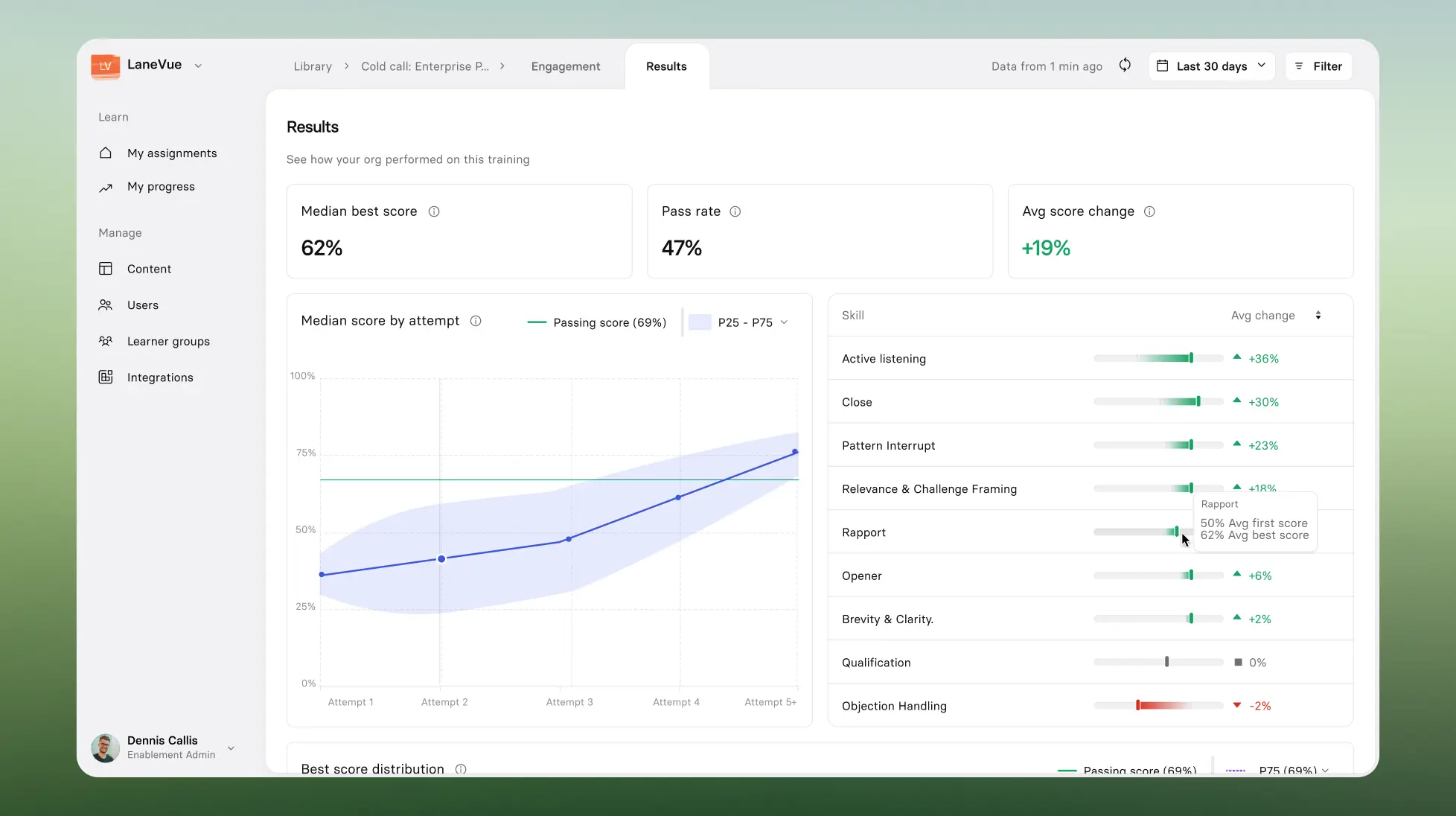
Managers can review call transcripts and coaching feedback for their direct reports, along with metrics like skill uplift (the change from a learner's first completed attempt to their best). This means managers can use their 1:1s to provide additional coaching based on data-driven observations, and you have actionable insights to evaluate the success of the program.
With AI, your ability to give employees tailored coaching is no longer constrained by manager capacity.
If you're interested in learning more about how Synthesia can support your coaching plan, schedule some time with our team.
Amy Vidor, PhD, is the Learning and Development Evangelist at Synthesia, where she researches learning trends and helps organizations apply AI at scale. With 15 years of experience, she has advised companies, governments, and universities on skills.
Frequently asked questions
How do you keep coaching consistent across managers?
The best way to keep coaching consistent across managers is to build a coaching enablement program. That means training on expectations, tools, and best practices, followed by structured practice and feedback, and ongoing reinforcement.
You can't just create a template or tool and hope every manager executes it consistently.
How do you deliver personalized coaching at scale?
There are several ways to deliver personalized coaching at scale, including enabling managers, partnering with a coaching vendor or platform staffed by certified coaches, and using AI for structured practice and reinforcement.
L&D teams often blend these based on employee needs. For example, they might train managers to coach, supplement that with in-the-flow-of-work resources, and use an AI platform to give employees on-demand practice and feedback in a structured setting.
How can AI help with personalized coaching?
AI can provide a spectrum of support for personalized coaching. On one end is lightweight support: scheduling regular sessions, surfacing coaching tips before a call for the manager and coachee, or building an agenda. General AI tools can handle this today. On the other end is more advanced support, where AI leads structured skill-practice sessions directly with an employee.
What AI can't do is replace the coaching relationship itself, where the real value comes from trusted, open-ended dialogue between two people.

.webp)