



Coaching vs. Mentoring: The Difference (And How to Choose)


Practice critical conversations with Interactive Avatars.
A manager once came to me seeking support. They were feeling frustrated, having been passed over for a potential promotion opportunity that went instead to an external candidate. In that moment, I had a choice to make. I could either help them figure out their own solution or I could give them advice.
I was choosing between coaching and mentoring them.
That's the key difference between coaching and mentoring: who is responsible for the solution. Sometimes we want someone to offer us solutions. Other times we would benefit from finding our own.
Here's how to decide between coaching and mentoring:
- Do they need someone to hold them accountable and ask the right questions, so they can work out their own solutions? If yes, they need coaching.
- Or, do they need someone to share their perspective, provide guidance, or make an introduction? If yes, they need mentoring.
In this case, the manager didn't need my perspective on what happened. They needed to work through what they wanted to do next. They needed coaching.
What is coaching?
In the workplace, coaching is a partnership between two people: the coach and the coachee, focused on overcoming challenges or achieving specific goals. The coach asks questions, actively listens, and provides feedback. The coachee does the work. They find their own solutions, with the guidance of the coach.
Coaching is considered non-directive and non-evaluative, meaning the coach does not tell the coachee what to do or how to do it, nor do they judge the performance of the coachee along the way. Their job is to help the coachee build confidence and become more self-aware. They provide accountability, not answers.
A coach can be an employee, like a manager or leader, or it can be a third party. The coachee is always an employee. A typical coaching relationship is recurring and time-bound (e.g., an hour-long session each month for six months).
Often, someone in an organization will recommend coaching for a specific purpose, such as closing a skill gap or preparing for a new role. While coaching can be used to address poor performance, it is more often used as an incentive to retain critical talent.
What is mentoring?
Like coaching, mentoring in the workplace is a partnership between two people: the mentor and the mentee. Unlike coaching, mentoring involves the mentor providing advice, perspective, or even answers.
A mentor can be internal to the organization, like a manager or senior colleague, or external. Mentors are often assumed to be more senior, but they don't have to be. A peer can mentor just as effectively as someone higher in the hierarchy. The mentee is always an employee. The mentee typically drives the relationship, requesting meetings and determining the agenda based on their needs. Mentoring relationships can vary from one-time meetings to decades-long relationships.
Coaching vs. mentoring comparison
In my experience, the need for coaching and mentoring is greatest in liminal moments, like returning from or going on parental leave, taking on a new role, or starting at a new company. And yet, both coaching and mentoring are limited by the same scarce resource: people's time.
Here's a way to compare the two at a glance.
Types of coaching and mentoring
Employees most often seek out coaching or mentoring when they're navigating one (or more) of three things:
- A new job, a new company, a new role, or a promotion
- A skill to build, or a performance goal to meet
- A life change that's affecting how they show up at work
That's why I like to think about "types" of coaching and mentoring more holistically, rather than by audience (executives, managers, ICs), session format (virtual, in-person), or subject domain (communication coaching, sales mentoring). While those distinctions matter when you're designing a coaching or mentoring program, they don't tell you what the driving force behind the need for support is.
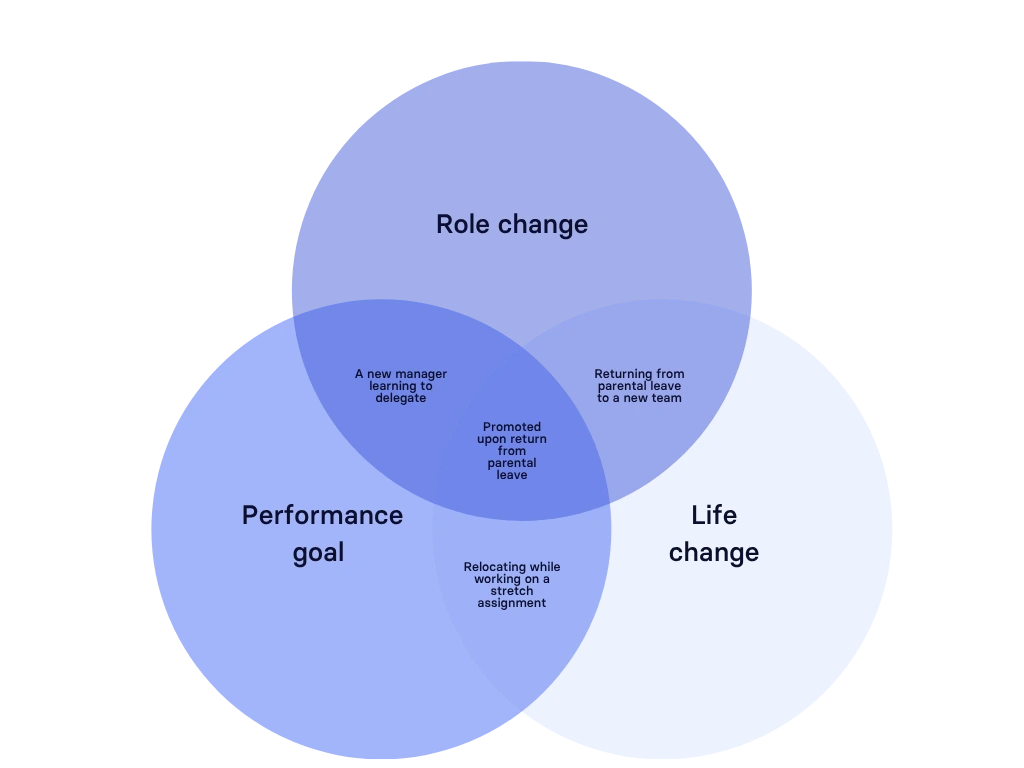
These three things aren't mutually exclusive, and frequently overlap, as illustrated above. Someone returning from parental leave may find out they're on a new team after a re-org or that they've been promoted. It can be impossible to separate the personal from the professional, whether that's a new role, a new skill, or both.
Note: while coaching and mentoring most commonly occur in one-on-one settings, they can also take place in group settings. Group coaching and mentoring is more common in the workplace when it's narrowly focused, for instance, coaching a team working to build the same skill, or mentoring members of an Employee Resource Group.
Common mistakes with coaching and mentoring programs
The research is clear that coaching and mentoring work, but only if they're implemented well. Here are four common mistakes I see that prevent teams from getting there.
1. Not outlining roles and responsibilities
No matter how informal or lightweight your coaching and mentoring program, you need clear roles and responsibilities for participants. I recommend sharing one-pagers that highlight an overview of the program, and why it matters, their role, the time commitment, and what's expected of them. This can also include some do's and don'ts, followed by how to get support if something goes wrong.
2. Not providing any training
Outlining roles and responsibilities isn't enough. You also need to provide training. For an internal coaching program, where the coaches are employees, this should include information on how to coach, common frameworks, best practices, and aligning with organizational priorities. It should also include practice opportunities. After this training, follow up with resources like helpful coaching questions or tools to use in a session.
Don't make your employees guinea pigs. Be sure to provide coachees and mentees with training that demonstrates what's expected of them, especially in how they show up and do the work. This can also include recommended agendas or topics to discuss.
3. Not assessing the program
It's not enough to offer a coaching or mentoring program. You need to evaluate it. For coaching programs, especially programs that involve an external party, evaluate the program the same way you would a training program. Identify metrics you can consistently capture, then decide how you plan to use those metrics to craft a narrative about the program's impact.
For lighter-touch coaching programs, that might be participation and session counts with ratings. For more resource-intensive programs, that might mean 360-assessment data paired with business impact.
Mentoring rarely has the same rigor, but even lightweight tracking, through a platform or otherwise, can show how many people are opting in, how many connections are actually forming, and whether those relationships are lasting.
4. Not considering the hidden costs
Coaching and mentoring programs can have a lot of operational logistics: everything from pairing to scheduling, agenda tracking, and evaluation. This can be done manually, but it's time-intensive. That's often why people turn to third-party solutions, though, importantly, these still require work to set up and maintain.
When designing any coaching or mentoring program, factor in the time and costs associated with running it, like platform costs and the time it takes to source and vet coaches and mentors. Those costs are real even when no one signs a check for them, and skipping that math is how programs end up underfunded within the first year.
Assigning someone a coach or helping them find a mentor isn't the end of your engagement, either. Getting participants to show up and engage, over and over, is much harder than getting them to sign up. Follow up with participants after the pairing, send reminders when engagement drops, and make sure the relationship is actually the right fit.
Coaching, mentoring, and AI
AI can meaningfully reduce the administrative burden of running coaching and mentoring programs, and help you stretch the most limited resource either one depends on: people's time.
I've managed manual coaching and mentoring programs, but also used platform-based solutions. In both cases, the administrative burden was significant. Nothing was truly seamless. There were integrations required with HRIS and SSO, management of credits, and the constant maintenance of programs: adding someone to a program, removing them if they left the company, changing a coach or a mentor, monitoring progress, and annoying people until they completed an evaluation.
AI is changing that. You can automate registrations, follow-ups, and the delivery of resources, like specific agendas, not to mention recommendations for coaches and mentors based on someone's specific needs.
AI is also changing the delivery of coaching and mentoring. For instance, you can deliver personalized coaching and provide consistent information at scale. But I want to be clear here: while there's a proliferation of AI solutions that pitch replacing coaches and mentors, that's not what I'm recommending. There's real value in human connection and collaboration that can't be replaced, and the research validates this.
Instead, I'm recommending an approach that strategically supplements your most precious resource: people's time.
For mentoring: Imagine a senior leader mentoring several employees at once, each navigating something different, one stepping into a new role, another returning from leave. AI can help prepare for each meeting by surfacing what's already been discussed and what's still open before each session, so the limited time a mentor has goes toward guidance.
For coaching: Say you have a sales manager with several sales development reps (SDRs), all early in their career. They need structured support and would benefit from regular coaching, but a manager can't give them much time beyond a weekly one-on-one. That's where AI can help, with the right focus, like giving SDRs a way to practice cold calls as many times as they need, without taking up a manager's limited time.
That's why we built Roleplay Sessions.
If you're interested in learning more about how to bring AI into your coaching programs, book some time.
Amy Vidor, PhD, is the Learning and Development Evangelist at Synthesia, where she researches learning trends and helps organizations apply AI at scale. With 15 years of experience, she has advised companies, governments, and universities on skills.
Frequently asked questions
How do I choose between coaching and mentoring?
To decide whether to offer coaching or mentoring, ask two questions:
- Does the person need someone to hold them accountable and ask the right questions, so they can work through it themselves? If so, they need coaching.
- Does the person need someone to share their perspective, offer advice, or make an introduction? If so, they need mentoring.
Can someone be both a mentor and a coach?
Yes, it just depends on the context. In the workplace, I recommend that individuals who occupy both roles, which is often the case with managers, separate out the role they're playing in a given conversation. Think of it as wearing two hats, and being intentional about which hat is on for a given conversation.
If a colleague comes to a manager seeking advice about their career progression, the manager can wear their mentor hat for that conversation. If the colleague comes to them seeking support as a coach, working through a decision they need to make themselves or a challenge they need to think their own way out of, the manager should put the coach hat on: ask questions and let the person arrive at their own answer, even if the manager personally knows what they'd do in that situation.
What are the four types of coaching?
In the workplace, coaching is often divided into four categories:
- Executive coaching
- Career coaching
- Life coaching
- Performance-based coaching
I don't find these categories to be particularly helpful, as they often overlap. For instance, a senior leader may work with an executive coach to improve their strategic decision-making and prepare for their next role. As part of that coaching, they may need to work on time management, or even getting better sleep to improve their mental clarity. One could easily describe this coaching as career, life, and skill-based coaching, just as easily as executive coaching.
Do coaches and mentors need certifications?
No, coaches and mentors don't need to be certified, but they should be trained.
If your coaches and mentors are employees at your organization, that training should include, at minimum, their roles and responsibilities, best practices, and how to get help or support if a conversation goes somewhere they're not equipped to handle.
If you're hiring external coaches or recommending external mentors, vet their qualifications and experience first. Professional coaches should have formal training, whether through the International Coaching Federation (ICF) or a similarly credentialed governing body. Mentors don't have an equivalent credentialing body, so look for relevant experience and, where possible, a referral that vouches for them.
What is the 70/30 rule in coaching?
The 70/30 "rule" is actually a heuristic (a rule of thumb, not a formal standard). It says that roughly 70% of a coaching session should be the client talking, while 30% should be the coach talking. Interpretations of this rule vary, with some suggesting that it's actually a listening-to-talking ratio for coaches. No matter how you interpret it, it's a helpful reminder for coaches about how they use sessions.


.webp)