



The 6 Best AI Sales Roleplay Tools in 2026 (Tried & Tested)

.webp)
Practice real sales conversations with Interactive Avatars.
Any sales enablement strategy that can drive measurable performance gains typically involves some form of roleplay and coaching.
The problem is that this isn't scalable.
Ideally a sales leader could provide frequent roleplay and coaching to their teams, but given time and resource constraints it isn't possible to deliver it manually.
That's why I think AI sales roleplay tools show so much potential — they directly address the practice gap by giving sales reps access to realistic roleplays with consistent scoring and coaching whenever they want.
Not all AI sales roleplay platforms are built the same. Some focus on speech analytics and call scoring, while others specialize in deal coaching or immersive avatar-led practice.
Below is my review of the best AI sales roleplay tools. I've tried to highlight the best use cases for each tool to help you choose the right one for your team.
The best AI sales roleplay tools
- Synthesia: Realistic avatar-led roleplay and coaching within a video-based training platform.
- SecondNature: Sales conversation practice with detailed feedback but low realism.
- Yoodli: Self-serve sales communication practice.
- Hyperbound: Deal-specific AI roleplay and coaching.
- Exec: Practice for product demos, walkthroughs, and other screen-sharing roleplay calls.
- Outdoo: Realistic sales conversation practice with strong speaker analytics.
How I tested these AI sales roleplay tools
Many of these AI roleplay tools require entering into enterprise-sized contracts to get full access, so I decided that it was unrealistic to test out the paid versions. Instead, I settled on testing only the free versions.
As a result, I had to omit any tool that didn't offer a free demo. Specifically I had to omit three tools that I wanted to test: Quantified, TrainHQ, and FullyRamped. If they add a free version to their offering I'll be sure to add them here.
One more disclaimer: These tools are evolving rapidly, so the feature sets are likely to change at any time. The comparison I provide here is correct at the time of writing.
I tested all six tools with a roleplay based on the same sales motion (a cold call) to facilitate comparison.
In order to make it a useful comparison, I tried to focus on the factors that matter most to a sales or sales enablement leader:

Evaluation criteria
- Realism: Do the roleplay calls feel like a real conversation that your reps might have with a buyer?
- Customization: Does the tool let you create your own roleplay scenarios if you provide info on your products, buyer personas, and sales processes?
- Feedback quality: How good is the feedback and coaching your reps get after their roleplay call? How actionable is it?
- Analytics: How easy is it for managers and team leaders to track the completion rates, skill uplift, and skill gaps across your team as they practice?
- Sales fit: How well does the tool fit the needs of a sales team? Does it let you practice common sales motions like cold calls, discovery calls, and objection handling?
- Ease of use: Does the tool make it easy and fun for your sales rep to practice? Will they actually use it?
- Integrations: What integrations does the tool offer? Does it connect with your CRM or call intelligence tool to enhance the quality of the roleplays?
- Enterprise readiness: These tools will handle sensitive information, so do they meet all the usual security and compliance requirements?
1. Synthesia

Quick summary
- Best for: Teams that want realistic sales roleplay within a video-based training platform.
- Key strengths: Lifelike interactive avatars, multi-turn coaching, and a single platform for informing and practicing.
- Limitations: Doesn't currently offer granular speech analytics, playback, or CRM-based call prep.
My experience
Synthesia's Roleplay Sessions lets you practice real sales conversations using interactive AI avatars in live, multi-turn practice calls.
The AI avatars helped make the experience feel a lot closer to a real call I might have with a buyer — especially when compared to other tools that only offer text-only or voice-only roleplay. The push-back I got from the avatar and the conversational flow felt really realistic.
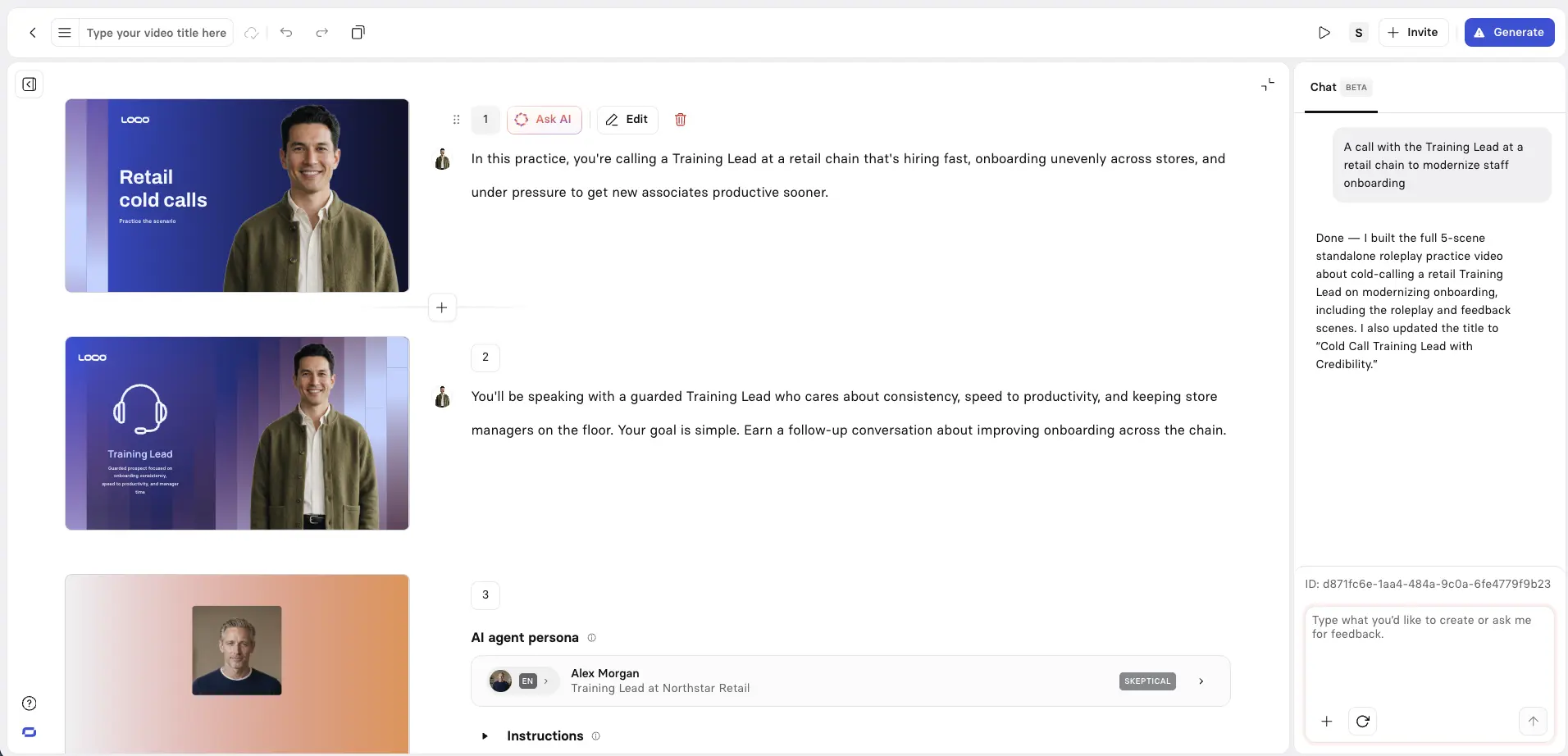
Synthesia allows you to easily create your own roleplays using your products, buyer personas, objections, sales motions, and scoring rubrics with the platform's AI assistant, which lets you build a roleplay from a simple text prompt along with any additional context you want to add (such as scripts, documents, or transcripts).
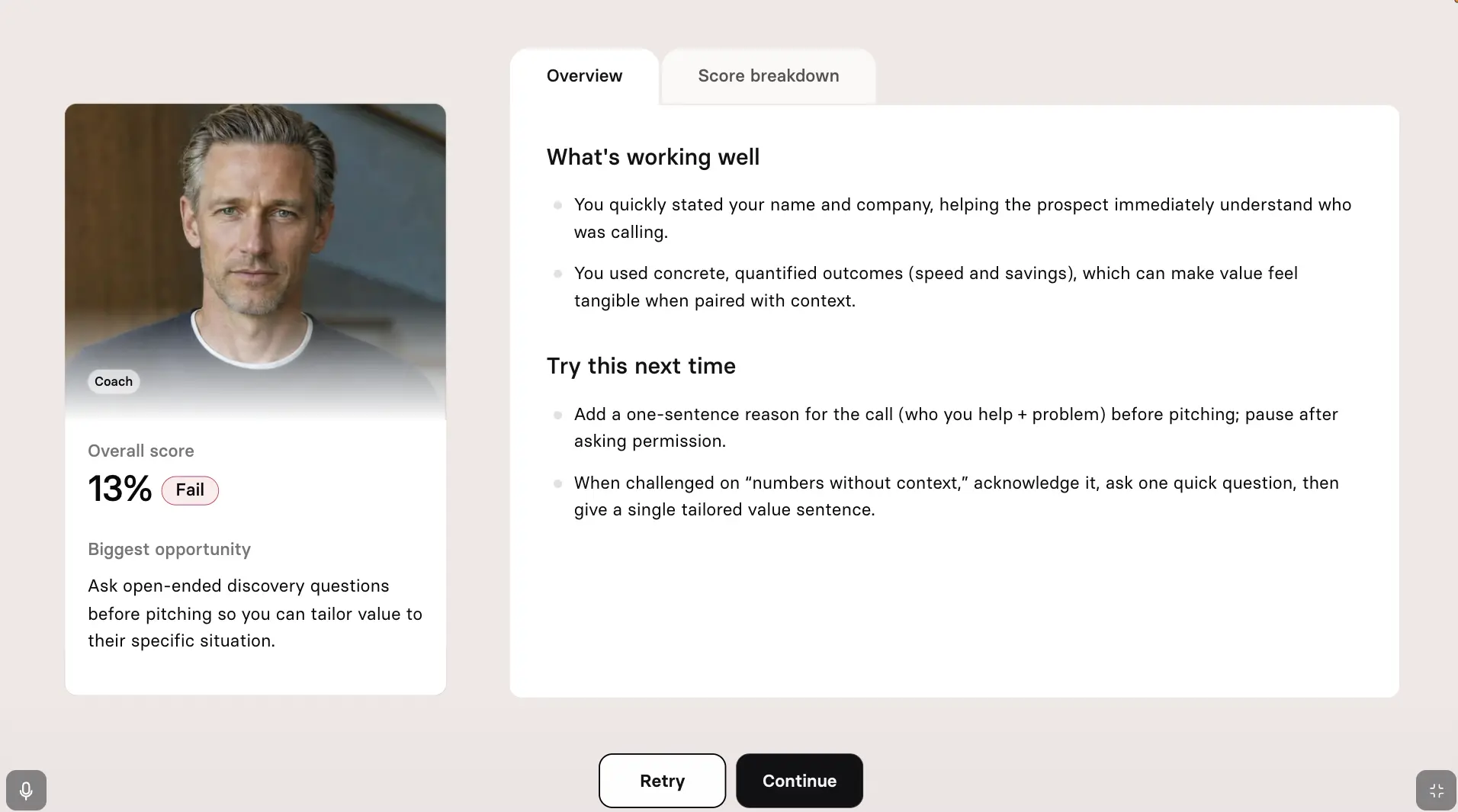
After I had tested my roleplay out, I got detailed feedback and coaching from another AI avatar. This section includes reflection-led feedback, skill scoring, and specific guidance on how I could improve.
I loved the way you can have a back and forth with your coach and dig into the feedback, and I think this would really help a rep to engage with the feedback and understand what to do differently next time.
There are also detailed analytics available for managers to monitor their team's progress. This allows managers to track learner results, attempts, and skill breakdowns all in one place, as well as view team-level performance. It felt like the analytics were built specifically to measure skill lift over time, which I think is what really matters rather than just tracking completion rates.
Synthesia supports a number of core sales training scenarios including cold calls, discovery calls, objection handling, pitch practice, and negotiation-style conversations. Sales is a major use case for the tool, although there are many other potential use cases, including customer support and manager roleplaying.
Overall the platform is very easy to use. The assisted roleplay creation is a great feature, as creating a roleplay from scratch is a bit of a daunting process. You'll typically need to tweak the output a bit but it gives you a great starting point quickly.
On the learner side the platform is very intuitive. The focus on video makes the content naturally engaging and easy to digest, and the roleplay itself is very smooth.
Synthesia is already used by many companies (over 90% of the Fortune 100) for creating learning content like training videos. Being able to combine sales roleplay scenarios with my sales training videos seamlessly in one platform is a pretty big advantage, as it allows my learners to complete all three learning stages (inform, demonstrate, practice) without breaking engagement and without using multiple tools.
Synthesia supports SCORM exports so it's super easy to get my video into my LMS where my learners typically access their modules and where I usually get my learner analytics.
The most obvious weakness of Synthesia's Roleplay Sessions tool is that it's not really a CRM or call-intelligence-native tool, so if you want to be able to generate roleplays directly from live opportunities in your CRM or Gong calls, then it's possible that one of the other tools that do offer such an integration might be a better fit.
My view is that an integration with your CRM or call intelligence tool is useful for deal-specific prep in a specific moment, but if my goal is to build a repeatable sales training program, then I'm more concerned with my team practicing the core motions (cold calls, discovery calls, objection handling, etc.) and the quality of the coaching and analytics available post-roleplay.
You can try a Synthesia Roleplay Session out for yourself in the video below:
My verdict
Synthesia Roleplay Sessions is a platform best suited for teams that want to build a full sales training program instead of just running isolated roleplaying exercises.
Its lifelike interactive avatars and the multi-turn coaching are big advantages that improve the roleplay and coaching experience significantly.
However, Synthesia's most important differentiator is how the wider platform allows your reps to learn what 'good' looks like from engaging, video-based training, and then move seamlessly into roleplay-based practice and coaching that helps them to actually master the topic.
If you compare Synthesia with the pure-play AI roleplay tools like Hyperbound, Yoodli, or Second Nature, then it's fair to say that Synthesia does lack a few features, including deep scenario libraries, granular persona controls, speech analytics, playback, and CRM-based deal prep.
Nevertheless, Synthesia’s ability to connect roleplay to the full learning loop (of inform, demonstrate, and practice) makes it a much better fit for a sales team that wants a scalable training platform rather than another point solution.
2. SecondNature
Quick summary
- Best for: Sales conversation practice with detailed feedback.
- Key strengths: Deep learner feedback with playback, tonality advice, and speaker-performance analysis.
- Limitations: Low roleplay call realism, and more complex roleplay scenarios are difficult to create.
My experience
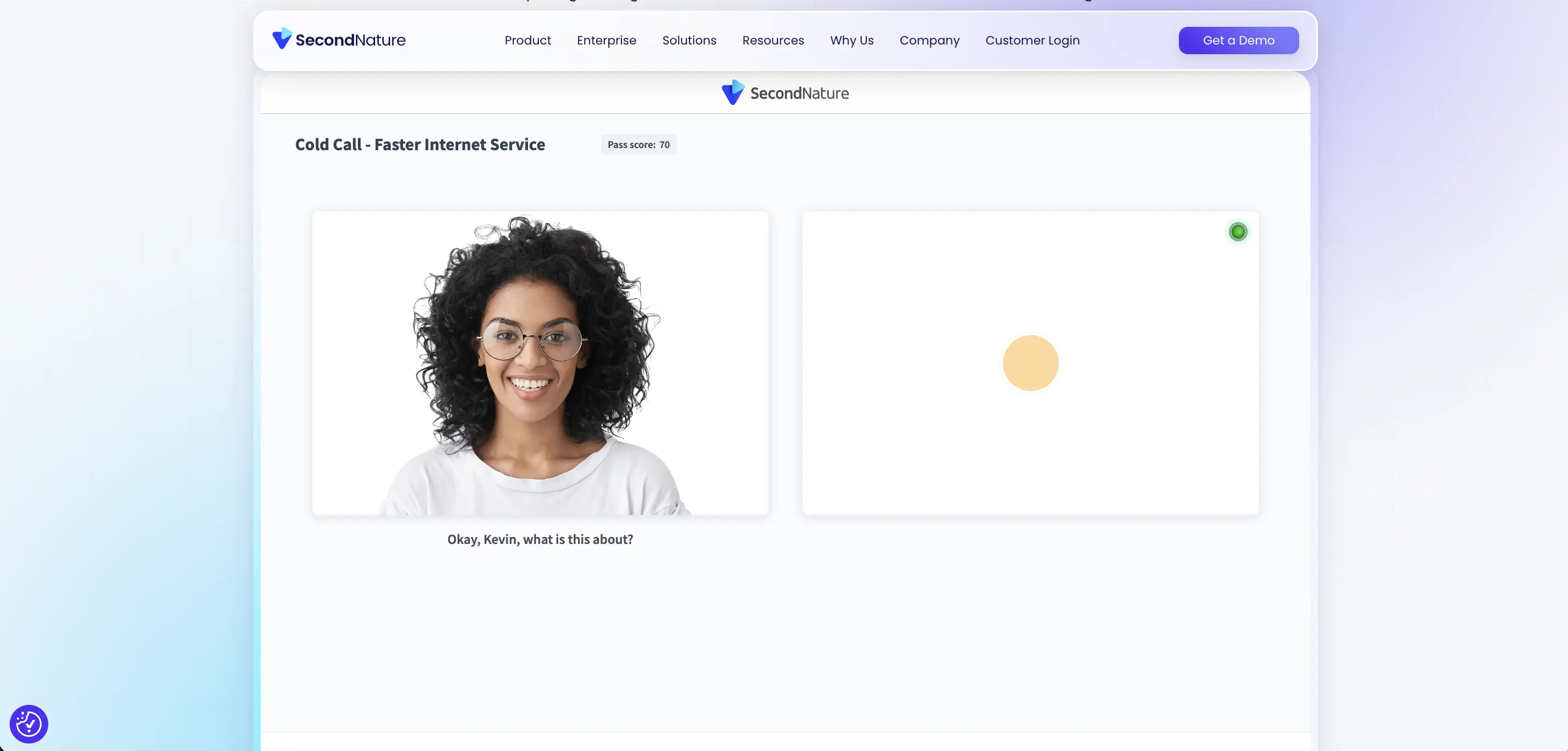
SecondNature is a platform that is purpose-built for conversational sales roleplay, and it does a good job at allowing reps to practice their pitches and objection handling in practice calls.
The calls themselves felt more or less realistic, although the AI doesn't handle interruptions as well as some of the other tools on this list. I also found that the response delay was quite long and the quality of the AI voices wasn't particularly good.
SecondNature is the only other platform (apart from Synthesia) in this list that offers interactive avatars in its roleplays, but the avatar quality is a bit underwhelming — the weak expressiveness and lip-sync detract from the immersion.
If you want to create your own simple roleplay scenarios, the platform's AI assistant works really well. I found it easy to create roleplays by uploading my own practice scripts, call recordings, and product info, which the assistant then uses to create an AI persona.
I did, however, have some trouble creating more complex scenarios. If you're trying to make intricate roleplay paths, you might need the help of SecondNature's customer success team, which will naturally slow you down quite a bit.
The platform's learner feedback is very solid. The tool scores your performance and provides pretty detailed coaching feedback which I think most sales reps would benefit from.
There's also some nice speaker analysis, with metrics that tell you what % of the call time was taken up by the rep speaking vs. the buyer and tonality feedback.
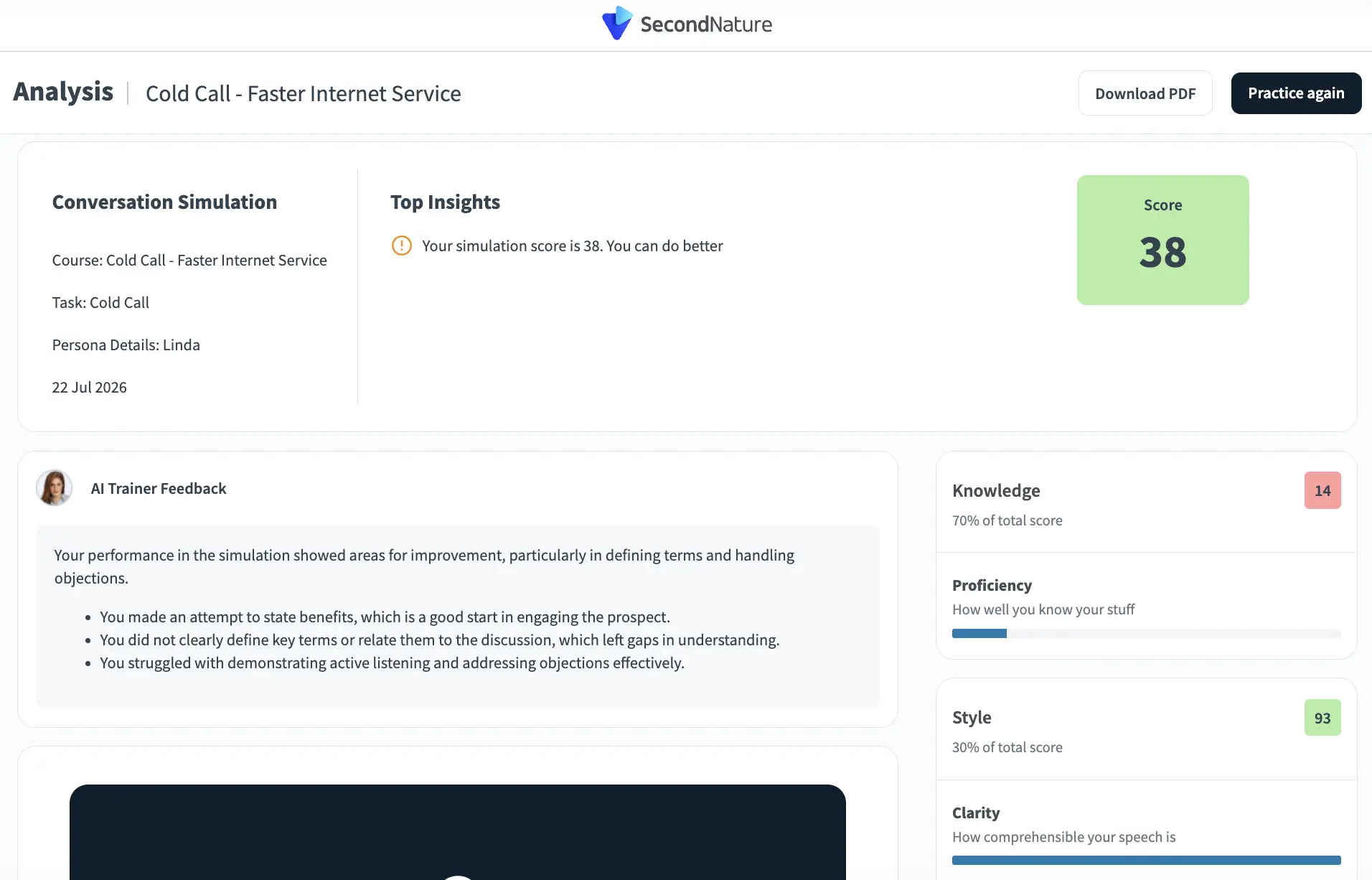
SecondNature's analytics is solid and would definitely allow managers to review their team's performance, track progress, and measure sales-readiness.
SecondNature supports a wide variety of sales-specific roleplays and coaching scenarios, including cold calls, discovery calls, objection handling, negotiation, and others. The platform feels very sales-focused.
In terms of integrations, the platform offers native support for connecting to CRMs like HubSpot and Salesforce, which allow you to sync roleplaying data and trigger roleplays based on metrics like demo success rates, which sounds like a great way to integrate these roleplays into a sales workflow.
My verdict
SecondNature's biggest strength is that it provides very detailed post-roleplay feedback and rich post-session performance reviews. It gives real feedback on how your reps performed, which is much more useful than just telling them if they hit the right talking points.
My biggest issue with SecondNature is the call realism. The conversation doesn't flow anywhere near as well as some of the other tools on this list, and it damages the immersion of the roleplay. The platform doesn't get the use of interactive avatars right either.
One of the biggest benefits of using AI roleplay tools is that they are fun and addictive to use, which means your learners want to keep practicing. Poor call realism lessens that effect, so it's an essential element to get right.
The platform also seems to struggle a bit when you need deep/complex roleplay scenario creation, although their assisted creation tool works well for simple scenarios.
SecondNature is a very strong fit for sales coaching delivery, but it's definitely less suited for teams that want top-level realism.
3. Yoodli
Quick summary
- Best for: Self-serve sales communication practice.
- Key strengths: Easy setup, body language analysis, strong speech analytics, filler-word tracking, and lots of templates.
- Limitations: More of a communication practice tool, with no interactive avatars and manager analytics that feels limited for sales team use.
My experience
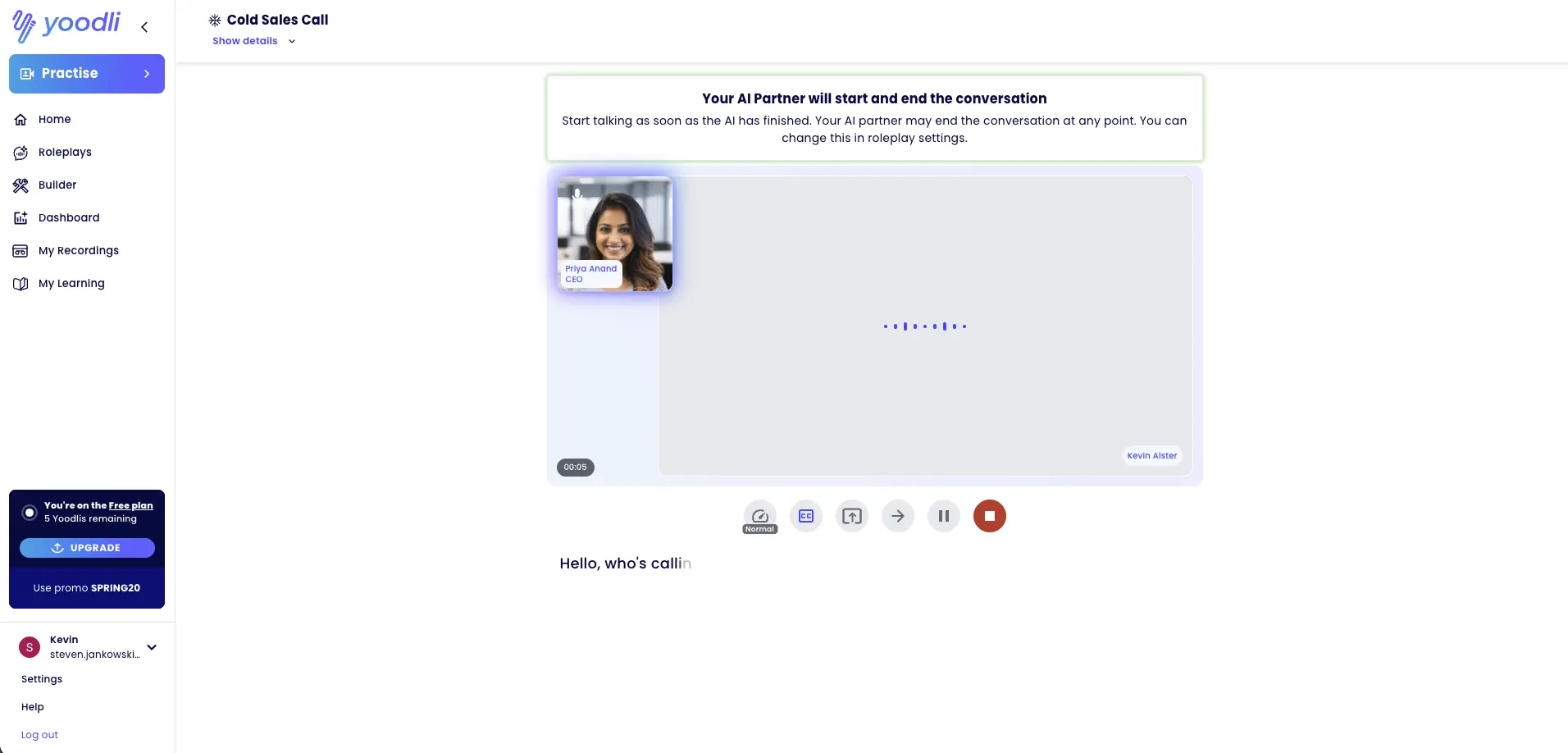
Yoodli is primarily a communication coaching platform that you can use to simulate a wide variety of practice conversations.
It's not a video-based tool, so don't expect any interactive avatars, although it does have an interesting feature where you can share your camera and get post-roleplay feedback on your body language and centering, which isn't something I saw in any other tool aside from Yoodli and SecondNature.
The roleplay realism is very solid. I tested a variety of roleplay types and they all felt very realistic in terms of pacing, natural interruptions, and push-back.
Yoodli also offers the ability to create roleplay scenarios using a text prompt and a range of templates that make it easy to get started.
Yoodli's feedback quality is one of its main strengths. The coaching tab gives the learner useful tips for how to improve, and the analytics tab includes useful metrics on filler words, pacing, clarity, and message adherence.
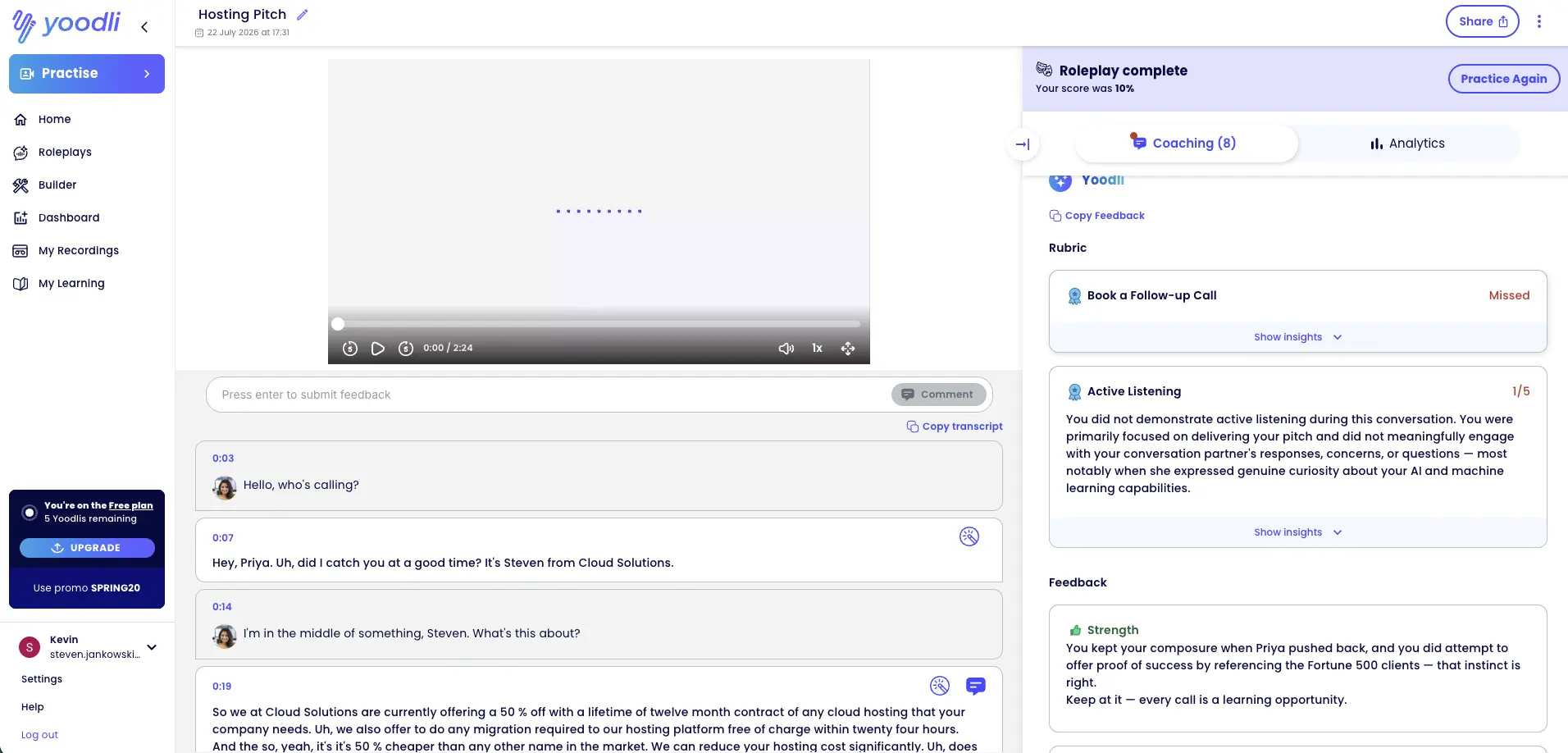
Yoodli's manager-side analytics offering did feel a bit limited in that I couldn't see any way for managers to track skill gaps at a team level, nor did I see any general sales-readiness reporting. These are the kind of analytics that a sales team leader actually needs, so this felt like a gap. Managers are definitely able to track individual performance though.
The platform largely covers the full range of sales motions I'm looking for. There are templates for a range of sales training scenarios including cold calls, inbound and outbound customer discovery, objection handling, and sales pitches.
Yoodli is very easy to use on both the manager and roleplay creation side and on the learner side. I see it as a tool that would be easy to adopt and get learners using without needing much setup time.
It seems to be more of a standalone, specialist coaching tool rather than a training platform or a tool that has deep integrations with CRMs or call-intelligence tools. I can see it fitting into a number of sales enablement and L&D workflows.
My verdict
Yoodli is a really great option if you want to get started quickly with a self-serve communication practice platform.
Its main differentiator is its usability — it's super lightweight and easy to get set up, so I can see it being a good choice if you want a tool that your team can adopt quickly.
The platform also offers a bunch of templates, deep speech analytics, and body language analysis, which are all big positives.
Its main weakness is on the analytics side. As a sales leader I want to be able to track the skill gaps at a team level and I need to know the sales-readiness of my team. I don't think Yoodli does a good job on this.
I think that Yoodli is probably a good fit if you're trying to quickly improve your reps' communication skills, but it's less ideal if your priority is building detailed, company-specific sales training programs.
4. Hyperbound
Quick summary
- Best for: CRM-based, deal-focused AI roleplay.
- Key strengths: Realistic roleplay calls, LinkedIn Chrome extension, deal-based simulations, and strong coaching analytics.
- Limitations: No interactive avatars and scenario creation wasn't as intuitive as with the other tools.
My experience
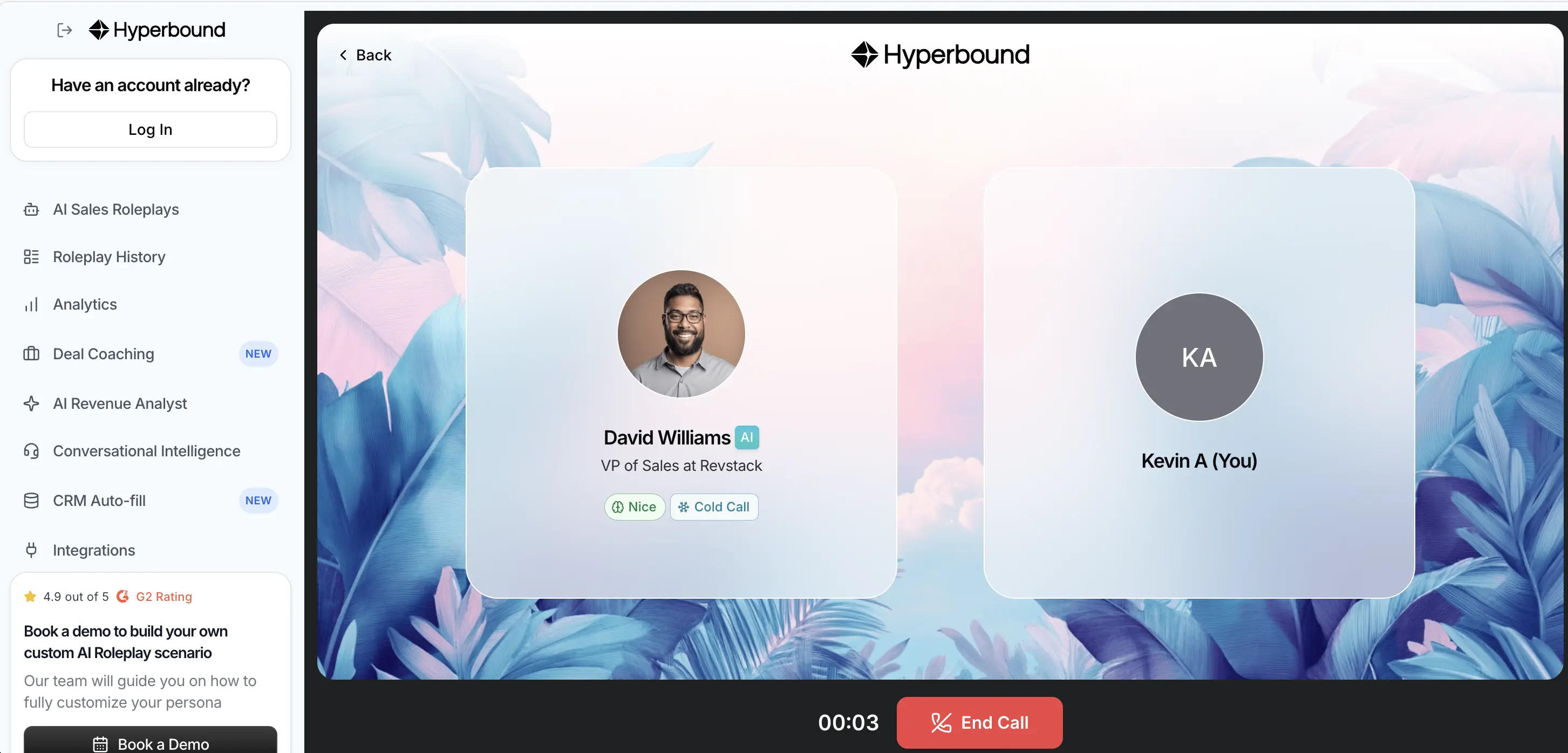
Hyperbound is one of the most realistic tools on this list.
It's voice-only, so there are no interactive video avatars which means less immersion, but the fluidity of the conversation, the interruption handling, and the objections I got during testing felt really spot-on.
The platform allows you to create your own custom roleplays using Hyperbound's bot builder, which lets you add specific objections, personality settings, and urgency levels to help you replicate common scenarios your team has to face.
Hyperbound also offers an interesting LinkedIn Chrome extension that can analyze any LinkedIn profile and use it to generate a buyer persona that you can then use in a roleplay. I thought this was a unique feature that could be particularly useful for cold calling practice when you are dealing with prospects for whom you don't have any data in your CRM yet.
However, the lack of an AI assistant like the one you find in Synthesia, Yoodli, or SecondNature is an obvious downside. I'm confident that most sales leaders benefit from being able to upload product info, practice scripts, and other context in order to generate roleplays, so I see that as a must-have feature that Hyperbound lacks.
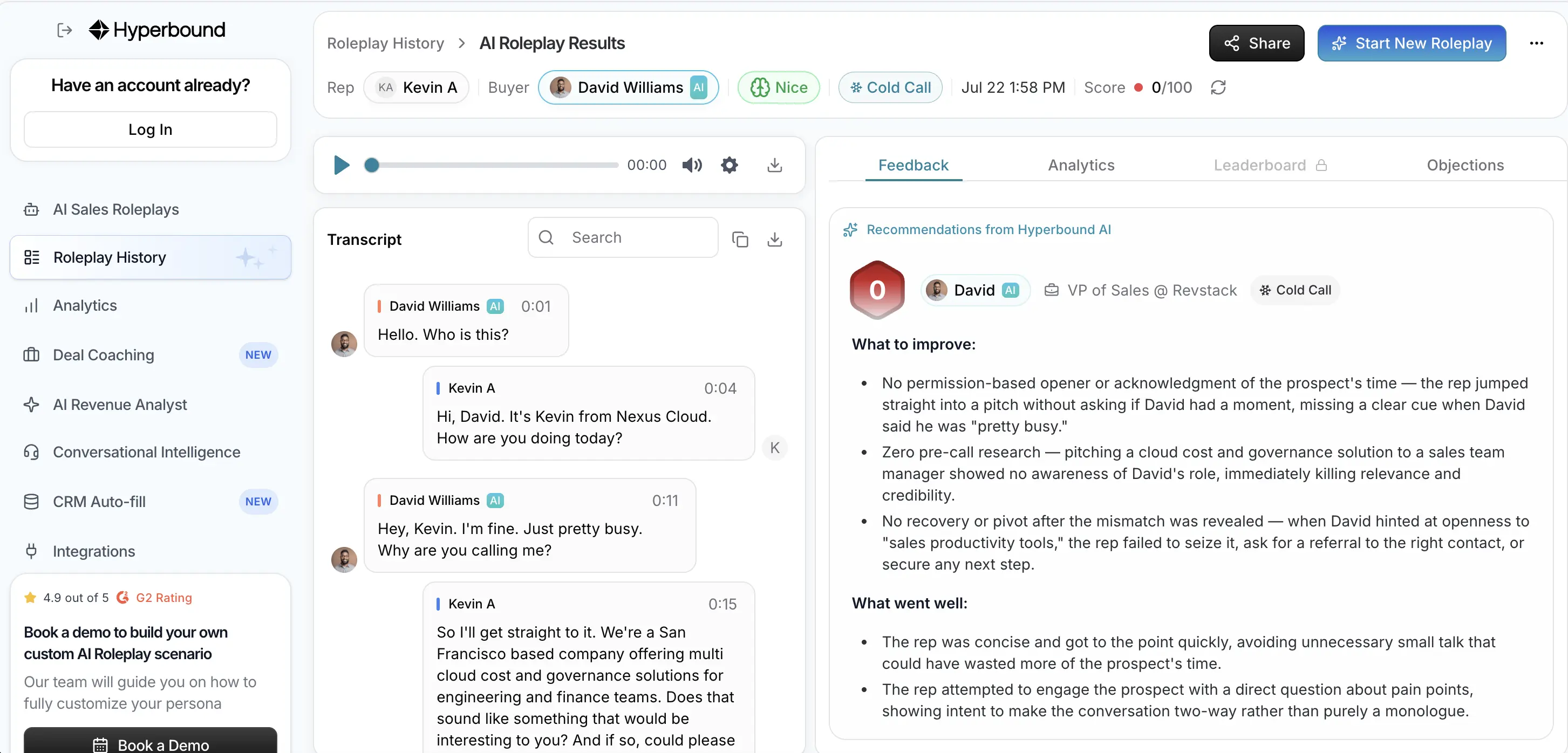
The platform's learner feedback is quite detailed. I was able to listen back to my call and read a transcript, and there were 4 tabs with specific feedback on what went well and where I could improve, detailed analytics, a leaderboard (for gamification purposes), and an analysis of how I handled the AI persona's objections.
Hyperbound is very sales-focused, and the platform comes with a very good range of templates covering common sales motions including cold calls, warm calls, discovery calls, demos, renewals, upsells, and pricing negotiations. It's a pretty exhaustive list.
The platform is very easy to use, and it has a nice intuitive interface which learners will get straight away.
It offers native integrations with the most popular CRMs including Salesforce, HubSpot, and Pipedrive, which allow you to pull live lead profiles for use in your AI roleplay scenarios.
My verdict
Hyperbound is one of the strongest options if you want a roleplay and coaching tool that is grounded in real deals from your CRM which will help your reps prepare for specific deals. The platform's main strengths are its deal-based scenarios, sales-tool integrations, and strong sales-focused analytics.
I also really liked the realism of the calls, although it could have been better if the platform had interactive avatars.
The ability to generate personas from LinkedIn with the Chrome extension is a unique and useful feature that would be particularly handy if you are a new sales team that hasn't built out your CRM data yet.
However, it feels like Hyperbound is overly geared toward deal-specific roleplay and coaching. If your goal is to build a repeatable sales training program that can raise the capability of your entire sales organization, then you'll likely need better scenario creation capabilities, and Hyperbound probably isn't the best fit.
5. Exec
Quick summary
- Best for: Practicing product demos, walkthroughs, and other screen-sharing roleplay calls.
- Key strengths: Screenshare analysis, transcript annotation, persistent memory, and example-based feedback.
- Limitations: No roleplay templates, limited integration options, and no interactive avatars.
My experience
Exec's roleplay realism is pretty strong, and the tool offers a screenshare analysis feature which is pretty unique among the tools in this list (Yoodli and SecondNature technically offer it as well, but I couldn't find it anywhere in their products). Exec's roleplays are otherwise voice-based, so there are no interactive avatars, which limits the engagement depth somewhat.
The screenshare feature makes a lot of sense since a lot of sales reps will often show their screens to prospects in order to present slides or demo the product. The interactive AI audience will then engage with the screenshare like a real audience would, and after the roleplay you can get feedback on what and how you presented it. It works pretty well and gave me useful feedback when I tried the feature out.
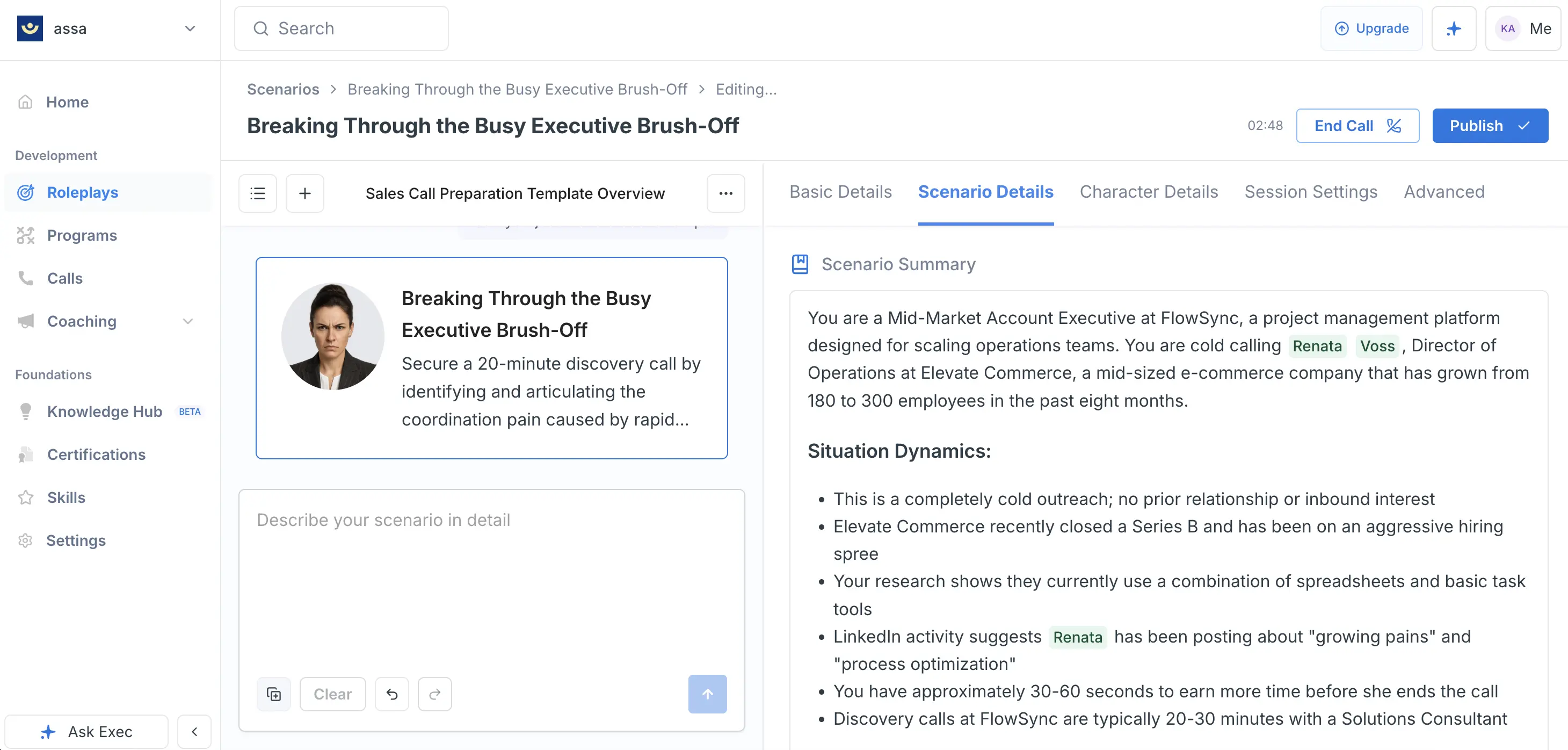
Exec has solid assisted creation functionality with the ability to upload context from files, websites, and knowledge hubs to help build out your own custom roleplays.
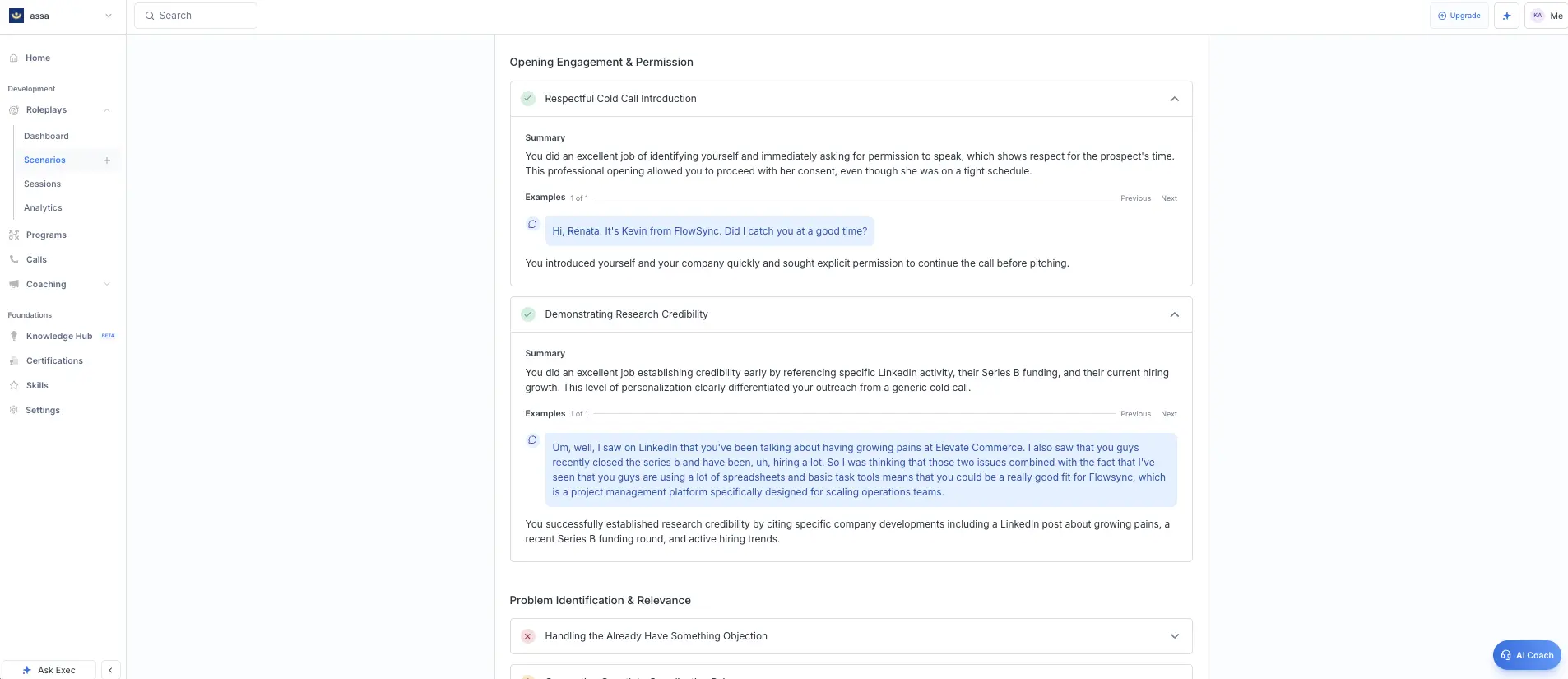
I really liked the way the post-roleplay feedback pulled specific examples from my call transcript (see screenshot below). It's a really effective way of linking the advice on what worked and what didn't work to the specific decisions I made during the call.
Exec offers detailed analytics that allows managers to track completion, identify skill gaps, and measure improvement across their teams.
While Exec has an obvious strength in roleplaying product demos and walkthroughs, it also supports a range of other types of sales conversations. I specifically tested cold calling and objection handling and both of them worked really well.
One nitpick I have with Exec is the lack of templates. The roleplay creation flow is easy to use and lets you customize your scenario, but in some cases I like to be able to jump straight into some pre-made roleplay calls and that doesn't appear to be available.
The platform offers integrations with call-intelligence tools like Gong (but only for call scoring), as well as with platforms like Notion, Google Drive, and Guru to feed a knowledge hub which your roleplay creation can then draw upon.
My verdict
Exec has an obvious fit with teams that 100% need to practice screen-sharing roleplay scenarios like product demos and walkthroughs.
The screenshare analysis feature works much better than I expected, but aside from that I also really liked Exec's example-based feedback. These two features are Exec's key differentiators.
The combination of no templates and the lack of any ability to generate roleplay scenarios grounded in data from integrations with your CRM or call intelligence tools means that it takes a while to get started with the tool. Luckily the assisted roleplay creation workflow is well designed and helps ameliorate this issue somewhat.
If screen-sharing demo execution is your main coaching problem, and you can get past the lack of interactive avatars, then Exec might be a good fit.
6. Outdoo
Quick summary
- Best for: Realistic sales conversation practice with strong speaker analytics.
- Key strengths: Deep speaker analytics and detailed team-level sales-readiness analytics.
- Limitations: Has no interactive avatars and a narrower feature set than the other, broader sales-roleplay platforms available.
My experience
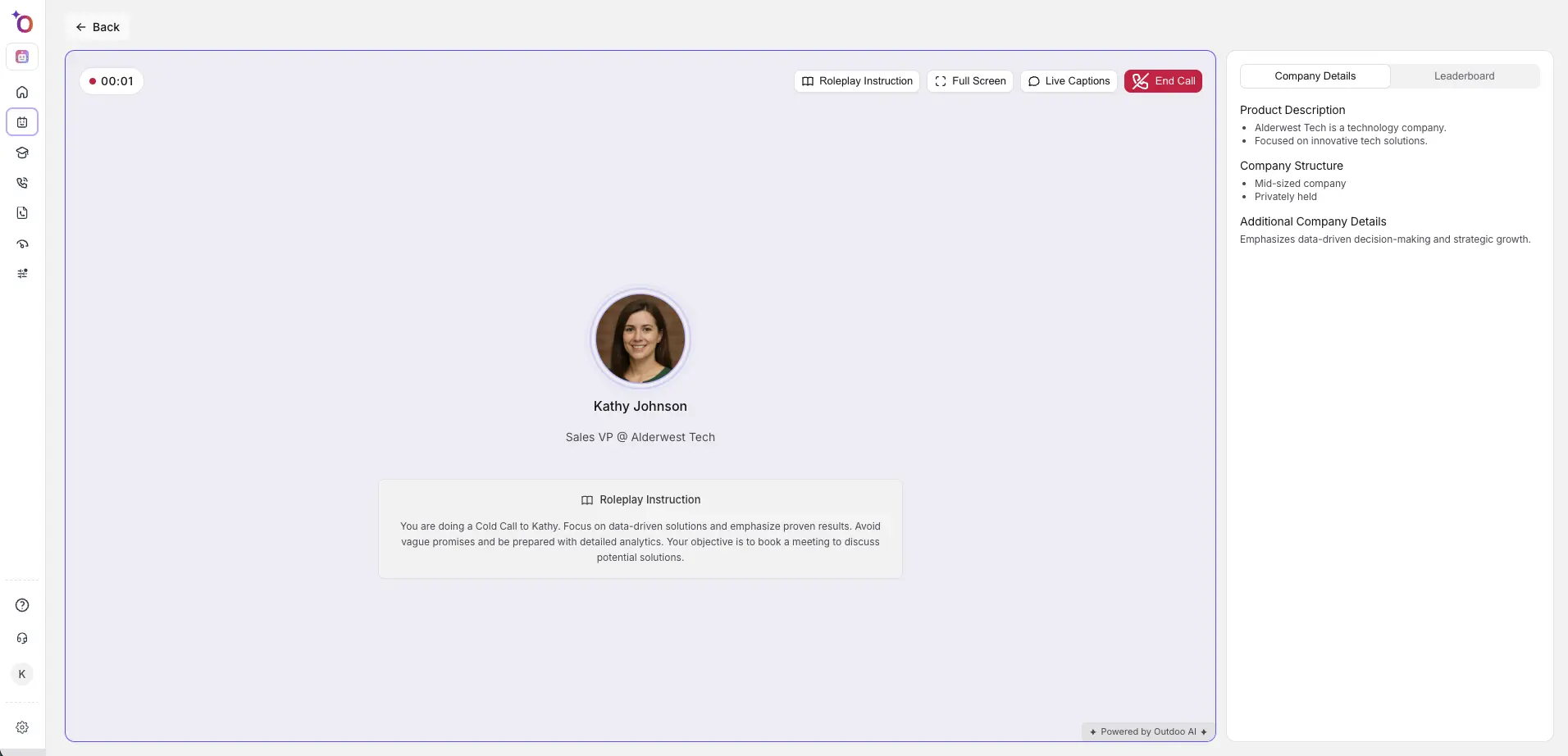
Outdoo's roleplays are among the more realistic on this list. The conversation flowed naturally and the tool handles objections and interruptions in a really realistic way. Unfortunately, the roleplays are voice-only, which limits the level of learner engagement a bit.
Outdoo is another platform that offers assisted roleplay scenario creation from a text prompt with the option to add context by uploading documents, scripts, and call recordings. I tried using it to create the scenario that you see in the below screenshots and it was a very straightforward process that lets you customize your roleplay with specific buyers, objections, products, and sales processes.
The feedback provided by the platform was fairly solid, and is split across a number of tabs, although the really useful stuff is largely found in the Scorecard and Stats tabs.
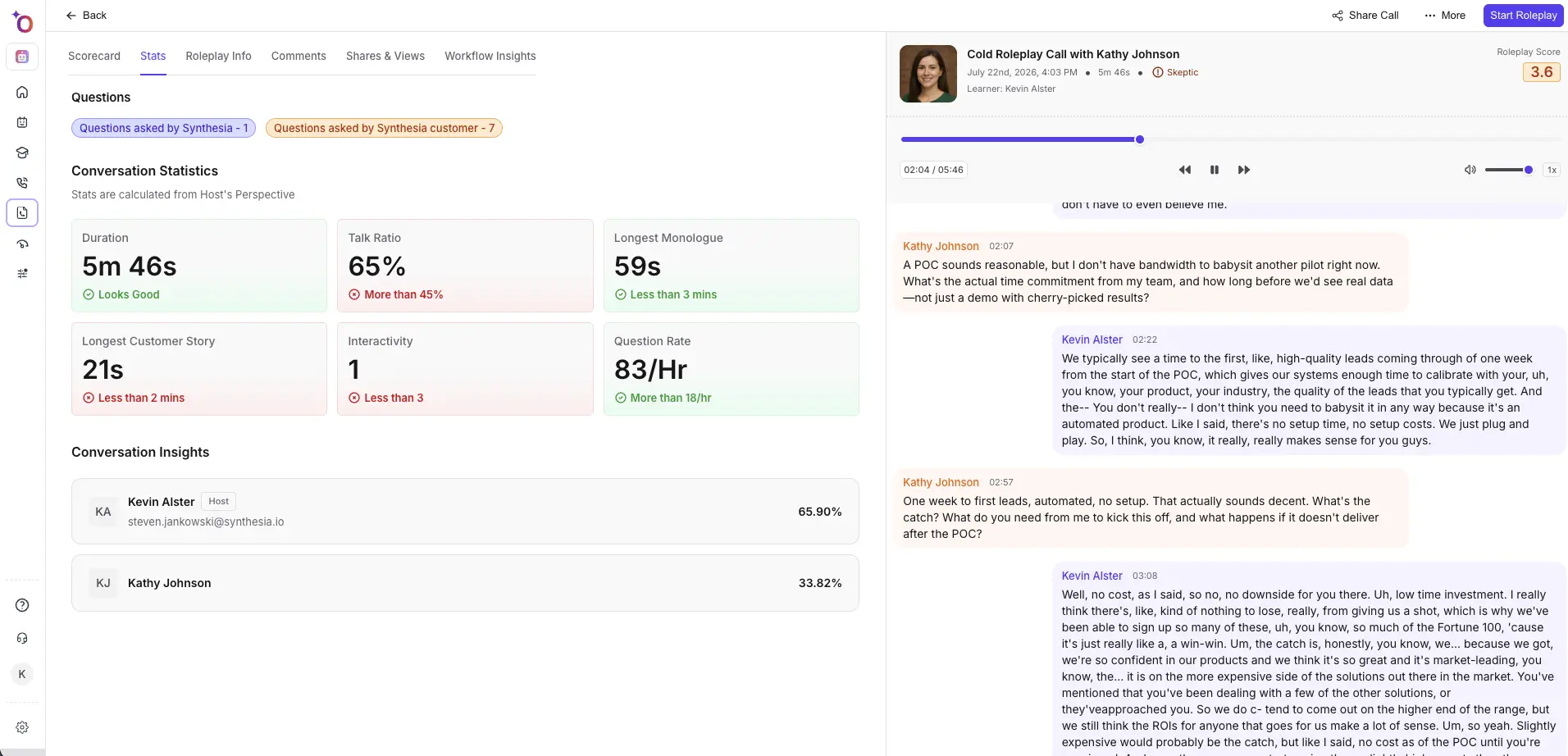
The Scorecard highlights key positives and negatives, and gives you a summary of what you did and then a recommendation of what you might improve. I did, however, find it a bit lacking in depth compared to some of the feedback you get from the other platforms on this list.
The Stats tab gives you some quite detailed speaker analytics which include some nice metrics like longest monologue, longest customer story, and question rate. While speaker analytics isn't the most important type of feedback provided by AI sales roleplay tools, I do think these metrics could be useful for identifying and correcting bad habits.
My takeaway was that Outdoo seems to be quite heavily focused on improving communication skills and speaker performance, and less focused on the sales coaching side.
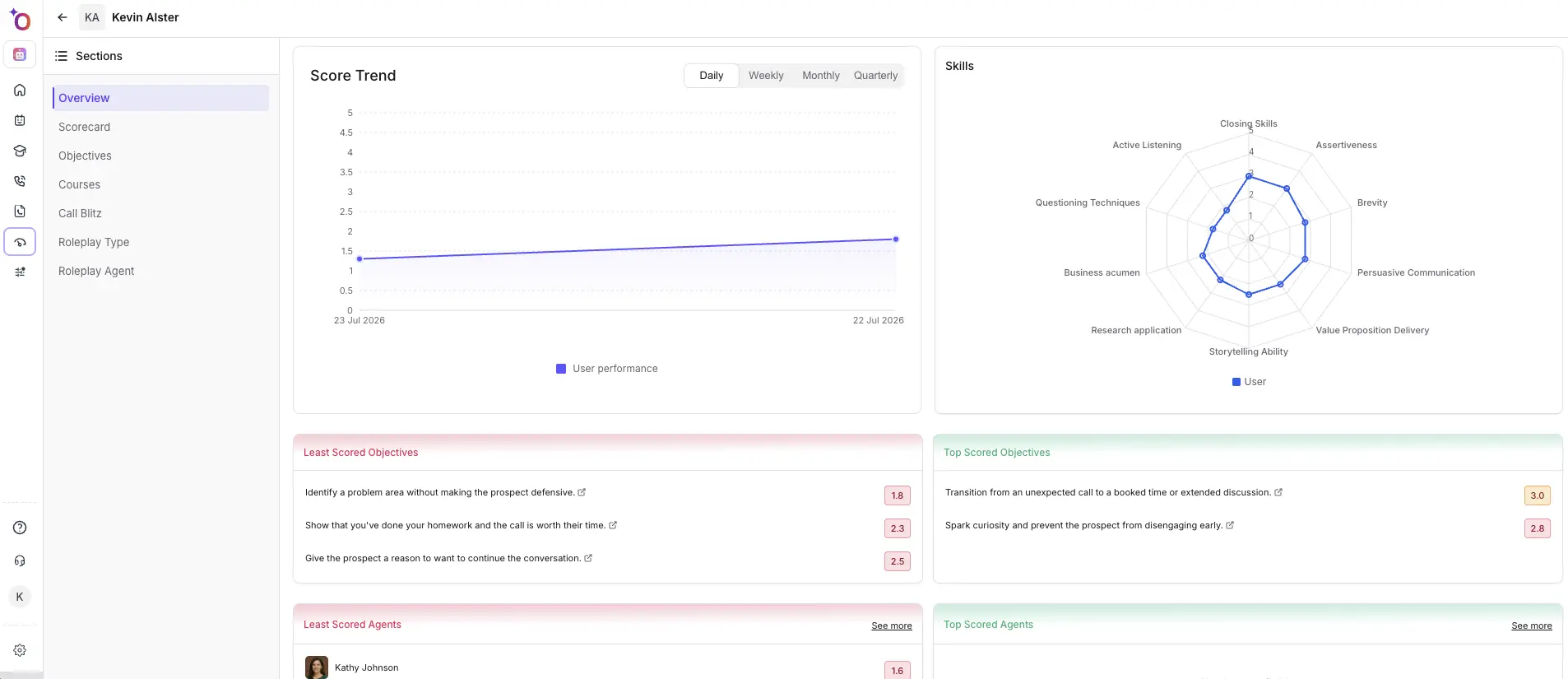
Outdoo's analytics is pretty comprehensive (see screenshot below), and makes it easy for managers to monitor their team's practice activity, scorecards, score trends, and skill gaps.
Outdoo is a platform that's specifically built for sales-readiness, and comes with support for roleplay scenarios that mimic a variety of sales motions, including cold calls, discovery calls, closing and negotiation, and objection handling.
Its also particularly strong with integrations. The platform can connect with a variety of CRMs (HubSpot, Salesforce, Pipedrive, etc.) to provide real-life context for your roleplay scenarios, and call intelligence tools which allows you to convert real call recordings into AI roleplay practice.
My verdict
Outdoo is best suited for teams that want a platform that gives them simple, gamified sales conversation practice which is largely focused on speaking behavior.
The platform has solid team-level analytics for managers which make it a really useful tool for sales leaders looking to level up their team's communication skills.
Outdoo is a good fit if you're looking for lightweight behavior improvement for your sales team, and least suited for complex enterprise sales training programs.
Comparison table
Kevin Alster is a Strategic Advisor at Synthesia, helping enterprises apply generative AI to learning, communication, and performance. With over a decade in education and media, he’s built programs for General Assembly, NYT School, and Sotheby’s.
Frequently asked questions
Which AI sales roleplay tool is best for combining training and practice in one platform?
Synthesia Roleplay Sessions is a platform best suited for teams that want to build a full sales training program instead of just running isolated roleplaying exercises.
Synthesia's lifelike interactive avatars and the multi-turn coaching are big positives that improve the roleplay and coaching experience significantly.
However, Synthesia's most important differentiator is how the wider platform allows your reps to learn what 'good' looks like from engaging, video-based training, and then move seamlessly into roleplay-based practice and coaching that helps them to actually master the topic.
Is there a way to try Synthesia Roleplay Sessions for free?
Yes! Head to this page to try out a Synthesia Roleplay Session for free.
What's the best AI roleplay tool for communication practice?
Yoodli is a really great option if you want to get started quickly with a self-serve communication practice platform.
Yoodli's main differentiator is its usability — it's super lightweight and easy to get set up, so I can see it being a good choice if you want a tool that your team can adopt quickly.
What's the best AI sales roleplay tool for practicing product demos and screen-sharing calls?
Exec has an obvious fit with teams that 100% need to practice screen-sharing roleplay scenarios like product demos and walkthroughs.
The screenshare analysis feature works much better than I expected, but aside from that I also really liked Exec's example-based feedback. These two features are Exec's key differentiators.
Which AI sales roleplay tool is best for practicing real deals from your CRM?
Hyperbound is one of the strongest options if you want a roleplay and coaching tool that is grounded in real deals from your CRM which will help your reps prepare for specific deals. The platform's main strengths are its deal-based scenarios, sales-tool integrations, and strong sales-focused analytics.



.webp)