



The 5 Best Elai Alternatives In 2026 (Tried & Tested)

Create AI videos with 240+ avatars in 140+ languages.
What are the best alternatives to Elai?
- Synthesia: Best for interactive training and enablement
- Colossyan: L&D-focused avatar video platform
- HeyGen: Expressive avatars with fast rendering
- Camtasia: Screen recording platform with basic avatars
- Vyond: Animation-first video platform with basic avatars
Elai is an AI video platform that aims to help L&D (learning and development) teams create video-led training. It comes with a variety of L&D-focused features including SCORM exports, LMS integrations, learner analytics, branching scenarios, quizzes for knowledge checks, and a screen recording tool.
The most common complaint with Elai is that the quality of the AI avatars isn't good enough for L&D use. I think the avatars lack expressiveness (they feel a bit rigid and emotionless), and the quality of the AI voices isn't particularly good either.
As a result of these drawbacks, it might be worth exploring alternatives.
Here are the best Elai alternatives; I've tried to flag each alternative's strengths and weaknesses while also highlighting the use case they are best suited for.
How I tested these Elai alternatives
I tested each of these AI avatar platforms using exactly the same script in both English and Spanish in order to ensure a fair and consistent comparison of avatar quality.
I've evaluated each of these alternatives on their strengths and weaknesses and then I've provided a direct comparison with Elai. Since Elai is an L&D-focused tool, I think it's a fair assumption that creating training videos is most common use case, so I've focused on that in my evaluation.
When you're using AI avatars in an L&D context I think there are a few specific criteria to look out for:
- Avatar realism
- Lip sync accuracy
- Interactivity
- SCORM compatibility and analytics
- Localization quality
- Enterprise readiness
- Collaboration features
- Overall stability
- How nice the platform is to use
I've focused on these criteria in my evaluation. On average I spent about 1 hour testing each tool.
1. Synthesia
URL: https://www.synthesia.io/
Quick summary
- Avatar realism: High realism
- Lip-sync accuracy: High accuracy
- Voice quality: High
- Best use case: Training, enablement, and enterprise comms
- Biggest limitation: Slower rendering
My experience
Pros
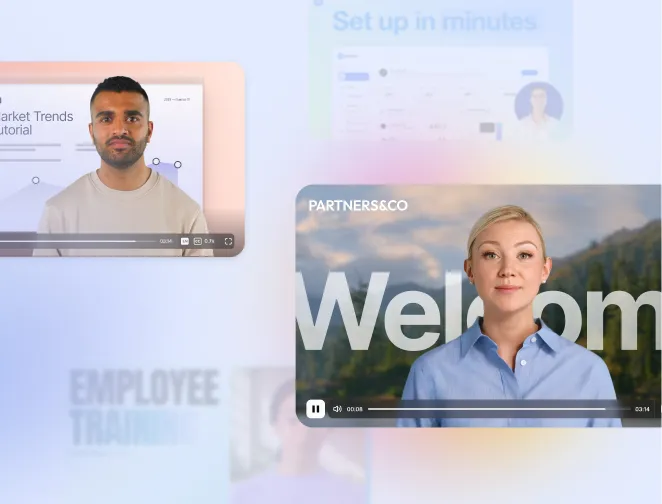
As you can see in my test video above, Synthesia's AI avatars have a very high level of realism. The combination of natural facial expressions, subtle head and hand movements, and even interesting micro-expressions all result in a convincing avatar performance.
I think the lip sync looks very accurate and seemed to be stable across multiple video generations and even when I tested out sentences that were on the longer side.
The Synthesia avatar library has more than 240 stock avatars to choose from, many of which you can customize (i.e. change their clothes or the background).
In terms of custom avatars, the platform offers the ability to generate synthetic avatars based on a prompt, or you can make an avatar that looks like you or someone else (with their permission via a recorded consent video) using an image, a webcam recording, or by booking a studio session.
There is an option to do a one-click translation of any video made within Synthesia. For translation of existing videos (made outside of Synthesia) the platform also offers AI dubbing.
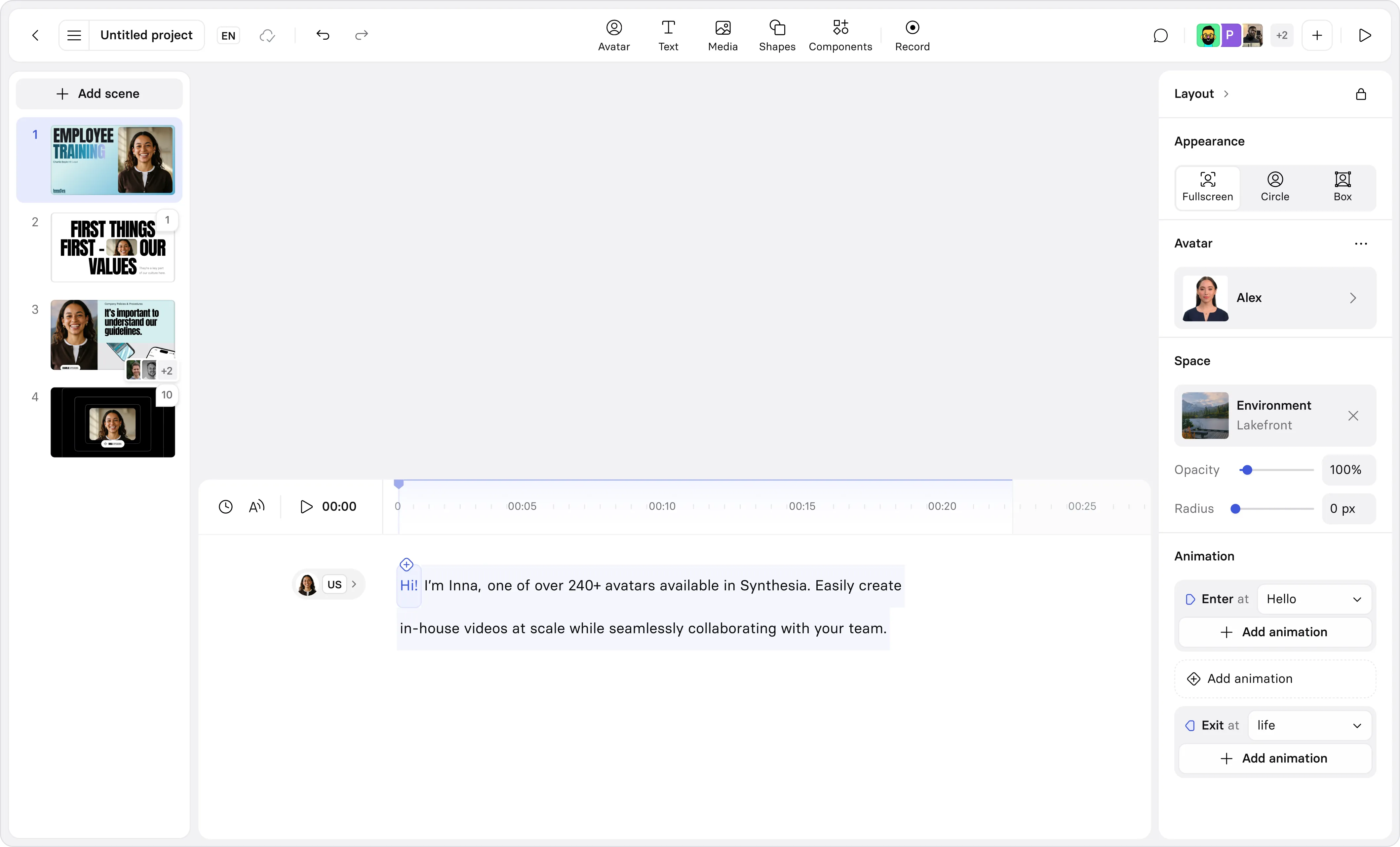
Synthesia offers two main routes for creating a video. You can upload a document, paste a URL, type a script, or input a prompt to create a video via the Assistant feature, which allows you to get a quick start and then iterate on your video via a chatbot.
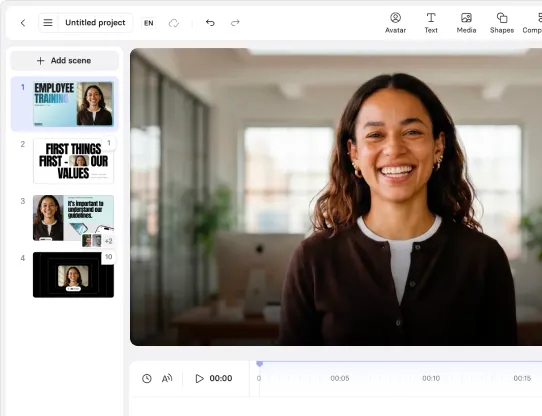
The other option is to use Synthesia's video editor, which feels a lot like PowerPoint since it uses a similar slide-based layout.
While the editor is script-based, there's also a timeline view. Regardless of which route you choose, you'll probably end up using one of the many video templates which help give your video structure and a nice design that you can easily adjust to match any brand kit.
It's worth also mentioning Synthesia's AI Playground, which gives you free access to AI video generation models like Veo 3 and Sora 2. You can then download these assets or use them as B-roll in your avatar-driven videos.
One really cool feature is the ability to 'direct' your avatar to take actions in scenes that you prompt, which really helps to widen the range of videos that you can make with AI avatars.
It moves the whole format beyond 'talking head' videos and towards something more dynamic. The platform also lets you make really beautiful motion graphics that help make your videos look really professional.
Synthesia supports interactivity with options to add knowledge checks, clickable buttons, and branching scenarios to your video. It also lets you export videos as SCORM packages so you can upload them to an LMS and track learner completion.
Cons
One downside with Synthesia is that it only supports Chrome and Microsoft Edge - so there is no Safari support. I use Safari as my default browser on my Mac, so this was a bit of a pain.
Lastly, I'd flag Synthesia's video rendering times as being slightly longer than most of the other options on this list. During my test it took me 6 minutes to render the English version and close to 10 mins to render the Spanish one.
The rendering times have improved a lot since my test though.
How does Synthesia compare to Elai?
The biggest difference between Elai and Synthesia is the avatar quality. Synthesia's avatars are much more realistic, have more accurate lip-sync, and can express a much wider range of emotions. Synthesia's voice quality is also much better.
I think avatar quality is particularly important when using avatars in an L&D setting because low-quality avatars can easily distract your learners and reduce the effectiveness of your training videos.
Another difference is that Synthesia's avatars can be directed to take actions (like pointing, interacting with objects, and more), which I think really opens up the possibilities for what you can create beyond simple talking-head videos.
Synthesia's motion graphics tool is really powerful and can help you make really engaging and professional-looking videos. I didn't see any similar feature in Elai's platform.
Elai is probably the cheaper of the two platforms overall in terms of enterprise pricing, so I could understand why some L&D teams might go for Elai if budget is the primary consideration and they are looking for a 'good enough' solution.
I think the level of interactivity you can add to your videos is relatively similar across both Elai and Synthesia, and they both offer an integrated screen recording tool and SCORM exports.
2. Colossyan
URL: https://www.colossyan.com/
Quick summary
- Avatar realism: Low realism
- Lip-sync accuracy: Medium accuracy
- Voice quality: High
- Best use case: Corporate training
- Biggest limitation: Weak avatar expressiveness
My experience
Pros
Colossyan, like Elai, targets enterprise avatar use cases, with a particular focus on L&D and training.
There's lots of support for interactivity - you can add quizzes and branching scenarios to your avatar videos, there are more advanced features like completion analytics and LMS integrations, and you can also export your videos to your LMS via SCORM.
The Colossyan platform uses a slide-based editor that is similar to PowerPoint with a clean and easy-to-use interface. It lets you do limited exports in 4K quality on their free plan, which is very generous.
The AI voices in Colossyan in general are of a high standard.
Cons
While Colossyan's avatar quality has improved a lot recently, it's still not good enough in my opinion. Looking at my test video above I think that the avatar's body movement is rigid and the gestures are often very unnatural and don't align with the tone of my script.
During my testing I had some issues with rendering. Both the English and Spanish versions of my video got stuck at 79% during the rendering process, so there seems to be an issue with reliability there.
I also noticed some minor audio artifacts and a slightly more robotic tone in the Spanish version when compared to the English, so it feels like you might need to prepare for a reduction in quality if you plan on using Colossyan for multilingual videos.
Lastly, I found the supporting media assets and B-roll options to be a lot more limited in Colossyan. There are no integrated AI video generation models for generating B-roll, and the music library is pretty limited too.
My verdict
Colossyan is very geared towards training and L&D teams, but I feel like the avatar realism is poor enough that it would be a distraction for me if I was a learner trying to complete a Colossyan-made learning module, so I don't think I can recommend it for that use case.
How does Colossyan compare to Elai?
Elai and Colossyan are very similar on paper, since both are AI avatar platforms that target the L&D use case. Both offer the core functionalities that you need to create training videos like interactive video elements (quizzes and branching-style flows), SCORM export, and multi-language support.
They also both suffer from low-realism AI avatars, which makes me think that if you want to create engaging avatar-driven training videos it's better to use a different platform on this list.
3. HeyGen
Quick summary
- Avatar realism: High realism
- Lip-sync accuracy: High accuracy
- Voice quality: High
- Best use case: Marketing videos
- Biggest limitation: Not specialized for L&D
My experience
Pros
I think HeyGen is in the top three of avatar platforms (along with Synthesia and Creatify) in terms of avatar realism. HeyGen's avatars are very expressive, with natural facial movements and body language.
I think the realism is also significantly enhanced by little touches like posture shifts, blinking, and other micro-gestures. I'd also call out the handling of hand and hair movement as being particularly good. These are often areas where AI avatars have issues.
In general, I found HeyGen's lip sync to be highly accurate. In my test video above you can see how the avatar's mouth movements are precisely aligned with the timing of the speech.
HeyGen's avatar creation process is fast and easy. I was able to generate a full avatar in around 15 seconds, which is on the lower end compared to the tools I've tested here, and the platform was also pretty quick to render my video.
I found the platform itself to be easy to use with a clean and easy-to-navigate UI, even with some of the advanced features the platform offers.
Cons
HeyGen is a popular tool among individual creators and marketing teams, so it's easy to see why the platform has placed less emphasis on learning design features and assessments.
I think the voice in my test video above is slightly robotic. The intonation in some parts of the script sounds off, such as the opening "Hello," which is a shame as visually I think my test came out pretty well.
I experienced failed video render issues during my testing. I was wondering if this is just me, but based on the complaints I've seen on Reddit, this appears to be a common issue with the platform. I was obviously able to get my video rendered, but aside from wasting my time, these failed renders also cost me credits.
During my testing I also spotted a few subtle lip texture artifacts (I had to look closely), which somewhat reduced overall avatar realism.
How does HeyGen compare to Elai?
HeyGen's avatars are much higher quality than Elai's, so if you're prioritizing avatars that feel expressive and realistic, it's a fairly straightforward choice.
If avatar realism is slightly less important and you want more support for common L&D workflows, then Elai might still be the better option.
An example of this would be that Elai supports editable PowerPoint imports (i.e. you can easily convert a PowerPoint into a video and edit the elements). HeyGen doesn't.
HeyGen does however offer some L&D-friendly functionality including basic interactivity, SCORM exports, and a screen recording tool.
4. Camtasia
URL: https://www.techsmith.com/camtasia/
Quick summary
- Avatar realism: Medium realism
- Lip-sync accuracy: Medium accuracy
- Voice quality: High
- Best use case: Screen recording videos
- Biggest limitation: Weak avatar expressiveness and no branching scenarios
My experience
Pros
Camtasia is known for providing high-quality screen recording software, but now they offer avatars too. The avatar functionality relies on a script-based editor which is easy to use.
Looking at my test avatar video above, I think the output looks very clean and professional.
I think the voice quality is pretty good too. It looks like they use ElevenLabs voices, which explains why. The intonation sounds natural and the overall delivery is high quality.
Camtasia has some limited support for adding interactivity to your videos. It allows you to add quizzes, clickable hotspots, and interactive navigation features.
Camtasia supports SCORM exports.
Cons
Camtasia’s avatars almost completely lack expressiveness compared to the other, avatar-first platforms in this list. I’d compare it to Colossyan in that the avatars look almost lifeless. There are no visible hand gestures or full-body movement, and I think the lack of this really harms the realism.
The avatar library is quite small and offers a limited variety, and there’s no camera, pose control, or variation options, which are pretty much standard on avatar-first platforms.
Camtasia is probably not a good option if you’re looking to make avatar videos in multiple languages. The avatar functionality only supports 7 languages, and there’s also no support for different dialects or accent variations.
You’ll also need to pay for the higher-tier Camtasia plans (Camtasia Pro) to get access to the full AI avatar functionality.
Camtasia's support for interactivity doesn't extend to adding branching scenarios to your videos.
How does Camtasia compare to Elai?
I think that both Camtasia's and Elai's avatars suffer from a lack of expressiveness and realism, and I think both could be distracting to learners in the context of an avatar-led training video.
Both Elai and Camtasia have issues with their avatar quality in terms of realism and expressiveness. I think these avatars could be problematic in a training video as there is definitely an uncanny valley feeling to them and I can imagine learners getting distracted.
Camtasia is primarily a tool for capturing screen recordings and then editing them. Camtasia's avatar offering is available on the Camtasia Pro/Audiate package.
I think that if you're creating training videos that need screen recordings (e.g. software walkthroughs, SOPs, or product tutorials) and you want maximum editing polish, Camtasia is the better fit.
Elai is the better choice if you want an L&D-first and avatar-focused platform. It has its own screen recording tool (although it's not as advanced as Camtasia's), it also supports more than 100 languages, and it lets you add branching scenarios to your videos (as well as quizzes and clickable buttons).
5. Vyond
Quick summary
- Avatar realism: Low realism
- Lip-sync accuracy: Low accuracy
- Voice quality: Low
- Best use case: Animated training videos
- Biggest limitation: Low avatar realism and no interactivity
My experience
Pros
I wasn’t very impressed with Vyond’s avatars, but one positive I can highlight is that Vyond offers a large library of avatars with over 1,100 to choose from and there's support for more than 70 languages.
I think Vyond's AI avatar functionality is best thought of as an add-on that lets L&D teams create simple talking presenter segments in their videos.
Vyond is best-known for being a platform that helps you to create engaging animated videos without any animation chops. I think that animated training video content can be a really good fit for some training video formats, such as microlearning and scenario-based content.
The platform works as a drag-and-drop editor, and makes it easy to start assembling your animated video and creating character-driven scenarios. That’s where I see Vyond’s biggest strength - it’s a tool that was made for storytelling.
The structured templates and flexible scene editing made my module look really good without being a Vyond expert.
Vyond supports SCORM exports to your LMS.
Cons
I think Vyond’s avatars are the least realistic of all of the tools I mention in this list. To me the uncanny valley effect is pretty noticeable, and the avatar’s gestures and movements look super artificial. The facial expressions lack any emotional depth.
The lip sync isn’t great either. It seemed to get noticeably less precise when I tested longer sentences.
I don’t think the voice quality is very good. There are a number of unnatural pauses, and in general the voice sounds super robotic.
Aside from the avatars, I’d point out that animation might not always be the best option for your training video project. Despite the animated video quality itself being great, I think it could look slightly unprofessional in certain scenarios.
My problem with Vyond's animated videos is the production speed. It typically takes me more than 90 minutes to get to a usable first draft. All of the staging is manual (i.e. you have to build and arrange each scene yourself, rather than being able to rely on any form of automation).
There's also no support for brand kits, so getting your video to match your company's brand colors also takes quite a long time.
How does Vyond compare to Elai?
I'm not a fan of Vyond's or Elai's AI avatars. I think they both lack realism and will distract learners. If avatar realism is important to you, then you should try a different platform.
If you don't use Vyond's avatars and stick with their animated style then Vyond can absolutely make sense in some scenarios. I think Vyond can be a great fit when you want to create narrative-driven animated training.
I would not recommend Vyond when you need fast production, rapid updates, or if you are covering topics where animation doesn’t work, such as technical training, or other more serious topics.
Vyond doesn't support creating interactive videos - you'd need to export your Vyond video to an authoring tool like Articulate Storyline or Adobe Captivate and add the interactivity there. If adding interactivity is important to you then Elai is a much better option than Vyond.
Elai alternatives compared
| Tool | Best Use Case | Key Features | Language Support | Cheapest Plan (Monthly) |
|---|---|---|---|---|
| Synthesia | Interactive training, enablement, and enterprise comms | 240+ AI avatars, SCORM export, interactivity, AI Playground, one-click translation | 140+ languages | $19 / mo — Starter |
| Colossyan | Corporate training | SCORM export, slide-based editor, branching quizzes | 100+ languages | $27 / mo — Starter |
| HeyGen | Avatar-driven marketing videos | Expressive avatars, fast rendering, SCORM export | 70+ languages, 175+ dialects | $29 / mo — Creator |
| Camtasia | Screen recording videos | Screen recording suite, AI avatar via Audiate, multitrack editor, SCORM export, quizzes | Avatars support 7 languages | $179.88 / yr — Essentials |
| Vyond | Animated training videos | Animation builder, 1,100+ avatars, drag-and-drop editor, SCORM export, character scenes | 70+ languages | $99 / mo — Starter |
Kyle Odefey is a London-based filmmaker and Video Producer at Synthesia. His content has reached millions across TikTok, LinkedIn, and YouTube, even inspiring an SNL sketch, and has been featured by CNBC, BBC, Forbes, and MIT Technology Review.
Frequently asked questions
What is the best Elai alternative for avatar realism?
Synthesia is a great alternative to Elai as it offers all of the same L&D-friendly features that Elai does (interactivity, SCORM exports, multilingual support) while its AI avatars are much more realistic. You can pick an avatar from the stock library or create your own custom avatar in your likeness. Synthesia also lets you direct your avatars to take actions and supports AI-generated B-roll and motion graphics.
What is the best Elai alternative for training videos and L&D teams?
Synthesia is the best alternative for L&D use cases. It's used by over 90% of the Fortune 100 and offers realistic avatars, robust interactivity and translation features, as well as SCORM exports, LMS integrations, completion analytics, and branching quizzes. Colossyan is also worth considering, but is let down by its weak avatar realism.
What is the best Elai alternative for screen-recorded training content?
All of the options on this list (Synthesia, HeyGen, Vyond, Colossyan) provide screen recording tools, but Camtasia is probably the go-to screen recording tool for L&D use cases like software training walkthroughs, SOPs, and product tutorials. If screen recording quality matters more than avatar realism and expressiveness, then Camtasia is a good option. If you want realistic avatars then Camtasia won't be a good fit.
What is the best Elai alternative for animated training videos?
If you want animated training videos instead of avatar-led training videos, then Vyond is worth a try. Animated videos can work well with narrative-driven or scenario-based training content. I wouldn't recommend using Vyond's AI avatars.
What is the best free Elai alternative?
All of the tools on this list offer a free plan or free trial. You can find out about Synthesia's free plan on our pricing page.

.jpg)
.jpg)
.webp)