



12 Sales Training Programs to Consider in 2026 (+ How to Build Your Own)

Practice real sales conversations with Interactive Avatars.
Sales training programs often fail because they’re treated as one-off events. Reps attend a half-day workshop and then go back to work. There’s no practice (except on prospects), let alone reinforcement of what they learned.
No matter who designs and delivers your training program, it needs to tie into your enablement plan. Otherwise you're wasting money on something that sounds promising, but doesn’t change behavior.
How to pick the right sales training path
Before you can pick the right approach to your sales training program, you need to have a clear idea of the behavioral change and measurable outcome for the program.
I recommend writing down something like this:
"This training program is for [audience] who currently [skill or knowledge gap]. After participating in this sales training program, they should be able to [demonstrate skill or knowledge] so that [business outcome]."
This statement will also allow you to determine how you will measure the training program (more on that later). Once you have it, you can decide a path forward:
- Designing a training program in-house
- Using an off-the-shelf solution, such as a pre-built content library or an established sales methodology
- Getting a customized solution from a third party
That decision comes down to three factors: your enablement team's capacity, your available budget, and your internal expertise. Here’s how those factors impact your decision.
Budget may be your deciding factor, but if you're anxious about compromising the quality and relevance of training, you can reduce training costs without sacrificing fit by designing a blended training solution.
That could look like offering an internal eLearning course to complement a workshop facilitated by a third-party expert. Or it could be using an off-the-shelf series for new hires during Week 1 of onboarding to teach a specific methodology or skill and then supplementing them with internal workshops as they ramp up.
12 sales training programs worth considering
If you’ve decided on an off-the shelf, customized, or even blended solution, here are twelve sales training providers worth considering.
1. 30MPC (30 Minutes to President's Club)
- In their words: "Sales tactics that'll actually get you to President's Club. Throw your academic sales training from 1972 in the trash. Learn exactly what to do, say, and write from the top 1% sales trainers and practitioners in the game."
- What they offer: Courses on topics ranging from "Selling to the C-Suite" to "Cold Calls to President's Club," plus a separate track on team training.
- What the reviews say: Sellers often cite it as "actually useful" training in B2B sales communities because the content is delivered by peers, though not everyone loves the podcast-style delivery.
- Best for: Individual reps or small teams looking for practical advice they can apply today.
2. The Challenger Sale
- In their words: "The Challenger framework helps sales teams teach for differentiation, tailor for relevance, and take control of the sale — driving higher win rates, faster cycles, and stronger customer relationships."
- What they offer: The Challenger Sale framework and traditional methodologies that teach reps how to lead conversations with how buyers can save or make money.
- What the reviews say: Sales leaders point to it as one of the most research-backed methodologies on this list, but note it's complex to coach and reinforce.
- Best for: Complex B2B sales where reps benefit from reframing how customers think about their problems.
3. Force Management
- In their words: "We don't just enable sales, we operationalize growth. Skills matter—but systems scale. We help you architect a GTM engine that aligns reps, process, and AI for predictable outcomes."
- What they offer: An operating system that includes playbooks, pipeline qualifications, and more, built around a tailored "Value Messaging Framework."
- What the reviews say: Teams credit this system with transforming how they work. The training is embedded into their operations, so everything is connected. The recurring complaint is the high cost (which you would expect given the scope).
- Best for: Enterprise B2B teams looking to overhaul how they work with bespoke training and implementation support.
4. Gap Selling
- In their words: "Sales are won by uncovering what's broken, what it's costing, and why it needs to be fixed now. Gap Selling gives your team the skills to find that information and use it to move deals forward."
- What they offer: A core curriculum on Gap Selling within A Salesgrowth Company's B2B sales training program. The problem-centric method involves mapping the current approach, defining the future state, and selling to that gap.
- What the reviews say: Reps praise the methodology for changing their approach to discovery, but note that the instruction can be polarizing. Some call it a "take no prisoners" delivery style, which isn't for everyone.
- Best for: Leaders: CROs and VPs of Sales who are looking for an alternative sales method for their teams.
5. Korn Ferry (Miller Heiman)
- In their words: "We help organizations around the world to transform their sales culture and revolutionize selling behavior. We have developed a proven, reliable way of understanding the development needs of sales professionals and their managers."
- What they offer: A catalog of on-demand courses, plus certifications, delivered through their LMS and in-person events. They also offer tailored training solutions.
- What the reviews say: Large enterprises (like DXC and Hilton) use their catalog regularly, but report mixed experiences. Some call the content dated for faster sales cycles and note the price is quite high.
- Best for: Establishing strong baseline training or designing custom account-driven training programs.
6. MEDDIC/MEDDPICC Academy
- In their words: "MEDDIC is particularly well-suited for complex sales processes requiring engagement with multiple stakeholders and a defined buying process. This is where MEDDIC thrives."
- What they offer: Online and blended learning on their proprietary framework (MEDDPICC), offered through individual and team memberships and bespoke solutions.
- What the reviews say: Practitioners often regard it as the best qualification-specific training, but some note it's a diagnostic framework that may not lead to behavioral change.
- Best for: Enterprise teams running long, multi-stakeholder deals who need a shared qualification language.
7. RAIN Group
- In their words: "At RAIN Group, we partner with organizations like yours to deliver world-class sales training courses. Discover sales training programs designed to be customizable, goal-oriented, and built for adult learners."
- What they offer: 85 modular training blocks that allow them to create a custom curriculum across the sales cycle.
- What the reviews say: Participants appreciate the interactive delivery style and the real-world examples, but struggle with the long training days with too much content.
- Best for: Teams wanting a research-backed, globally delivered consultative selling program.
8. Sandler Training
- In their words: "Designed to work together or on their own, you get a connected ecosystem that drives consistent, high-impact results without building from scratch."
- What they offer: A five-step system delivered through a network of licensed franchises, with recurring reinforcement sessions.
- What the reviews say: Sellers note the reinforcement is a differentiator, but say the content itself feels more "old school." Training quality can also vary based on the facilitator delivering it.
- Best for: Teams looking to establish an ongoing training and coaching program.
9. SPIN Selling (Huthwaite International)
- In their words: "SPIN Selling is the world's most researched sales methodology, born from observing 35,000+ real sales calls for the behaviours most aligned with success."
- What they offer: In-person, virtual, and digital training, positioned as a behavioral model that works across in-person, phone, and video selling.
- What the reviews say: Sales teams call it one of the most research-backed methodologies (35,000+ calls studied across 20+ countries), but note the research dates back to 1976-1986. As with other providers, quality also varies depending on the local facilitator.
- Best for: Mid-market, consultative selling teams wanting a research-backed questioning framework.
10. ValueSelling Associates
- In their words: "The ValueSelling Framework® methodology, training and toolset align your revenue engine with a common language that enables sales professionals to compete on value, not price, and saves time in all selling scenarios."
- What they offer: Customized sales training with eLearning, instructor-led sessions, and monthly coaching.
- What the reviews say: Gartner ranks it in its Magic Quadrant for Sales Training Service Providers, but sales reps themselves offer less public feedback on how they actually perceive the training.
- Best for: Teams wanting value-based selling with built-in reinforcement.
11. Wilson Learning
- In their words: "Wilson Learning's sales training programs have shaped the sales culture of thousands of organizations over the past many decades, driving undeniable results including increased productivity and win rates, heightened sales effectiveness, improved customer relationships, and significant top-line revenue impact."
- What they offer: Trademarked portfolio of programs, including the Versatile Salesperson, the Consultative Process, Negotiating to Yes, and more.
- What the reviews say: Clients note Wilson's infrastructure supports global teams well, with consultants working in 50 countries and 30 languages. The methodologies, though, feel older compared to some of the newer SaaS frameworks on this list.
- Best for: Large, multinational organizations wanting one consistent training partner across many regions.
12. Winning by Design
- In their words: "Winning by Design helps GTM executives at recurring revenue businesses diagnose revenue inefficiency, design scalable go-to-market systems, and build the operating cadences that deliver compound growth."
- What they offer: Courses and bespoke training focused on a shared model, SPICED (Situation, Pain, Impact, Critical Event, Decision) and revenue architecture to use across sales, marketing, and customer success.
- What the reviews say: Reps praise it for giving SaaS teams a shared language, but note inconsistency in application. They often fail to populate SPICED fields in their CRMs, and some say it can feel one-size-fits-all and miss nuance.
- Best for: SaaS/recurring-revenue teams wanting one shared framework across sales, marketing, and CS.
Note: This list primarily features US and UK-based providers who are able to support enterprise sales teams. Keep that in mind when you’re evaluating possible solutions. In my experience, the best training providers are able to offer training that supports your team’s needs, which includes having knowledge of the local market and your industry. The quality of global providers may vary region to region.
How to evaluate sales training programs
No matter which path you ultimately choose, don't forget to evaluate the sales training program against the outcome statement you identified at the beginning of this process. In that statement you have two signals: a behavioral signal and a business-related signal (ideally a KPI). These are how you'll ultimately determine whether the training was successful.
How you build that evaluation in depends on the path:
- In-house: Incorporate evaluation into your program design from the start.
- Off-the-shelf: You may need to stitch together your own measurement approach. This may look like importing the content into your LMS via SCORM so you have better snapshot metrics.
- Customized: Include evaluation in the scope of work, with roles and responsibilities outlined up front. For example, the vendor tracks behavioral change while your team tracks the business KPI.
The goal is what I call good enough measurement: evidence that the program is an investment worth continuing (or not) that you can confidently report to stakeholders.
If your evaluation shows the program is struggling to change behavior or improve discovery-to-next-stage conversion rate, the most common culprit is a lack of reinforcement.
How Synthesia supports reinforcement
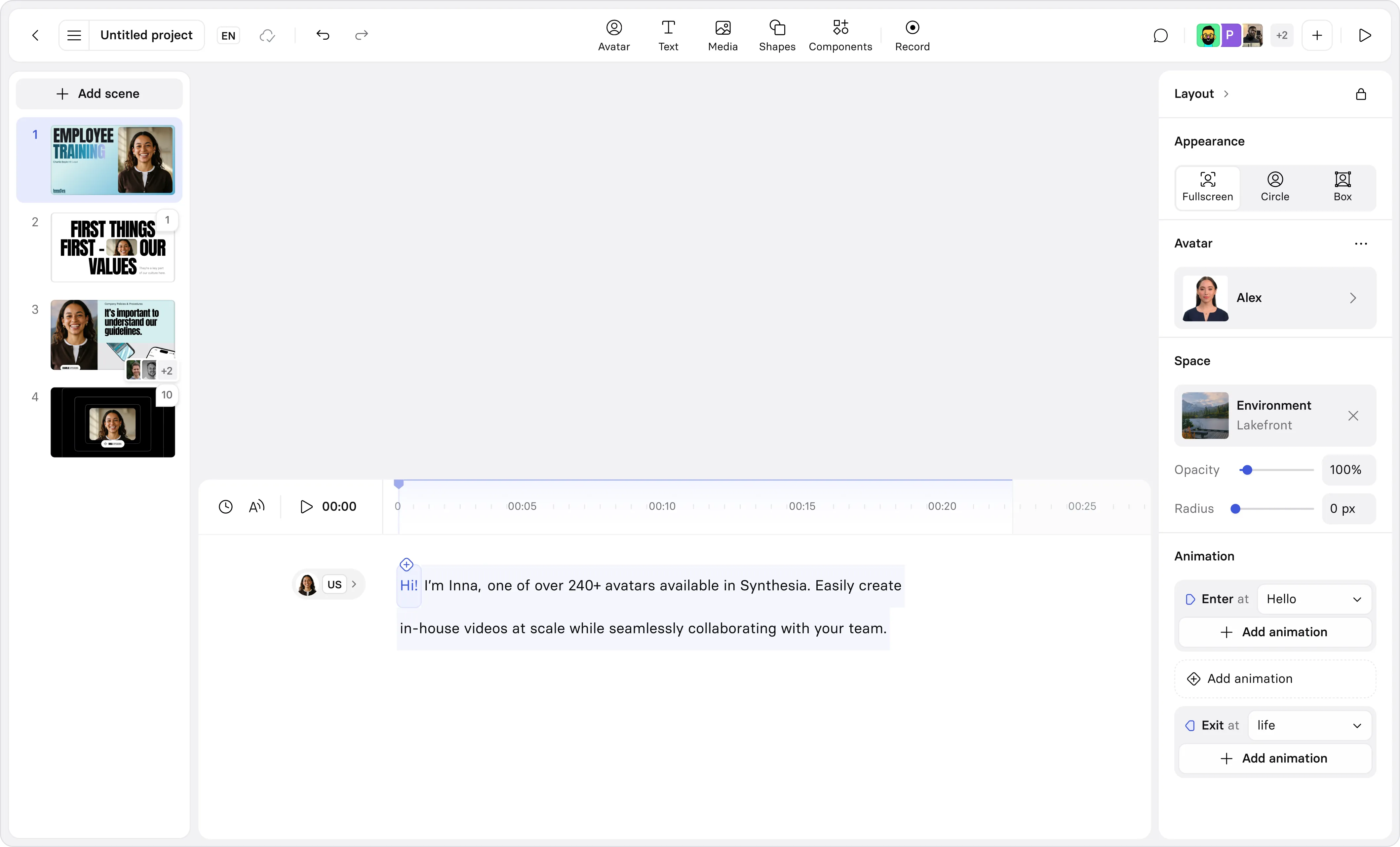
At Synthesia, we've spent years helping sales teams design, scale, and localize training programs with our AI video platform. But we know that training videos alone don't drive behavior change. For that to happen, reps need to be able to practice, get coaching, and try again, and again.
That's why we've created Roleplay Sessions to close the gap between reps learning how to do something in a training program and being able to do it consistently, under pressure.
Synthesia's platform allows you to build a complete sales training program, where reps can learn a new skill, see it demonstrated, and then practice and get feedback, again and again. It can also support an off-the-shelf or customized solution, making sure the investment you're making in that training doesn't disappear the moment the workshop or course ends.
If you're interested in learning more about how Synthesia can support your sales training program, schedule some time with our team.
Amy Vidor, PhD, is the Learning and Development Evangelist at Synthesia, where she researches learning trends and helps organizations apply AI at scale. With 15 years of experience, she has advised companies, governments, and universities on skills.
Frequently asked questions
What is a sales training program?
A sales training program teaches reps specific skills or knowledge. It's time-bound: whether one session or a series, it has a start and an end.
How do you measure the ROI or effectiveness of sales training?
Measure sales training against the behavior it was meant to change and a related business metric, like win rate or stage conversion rate. How rigorously you measure should scale with the program's cost and visibility. See my guide to measuring training ROI for more.
Can AI be used for sales training?
AI shows up in sales training a few ways: practicing real conversations with an AI counterpart and getting scored feedback, using AI to analyze real sales calls for coaching insights, and using AI to keep training content current as products, pricing, or messaging change.
Synthesia's Roleplay Sessions is one example, giving reps a place to practice difficult conversations with AI before a real call.
What's the difference between sales training and sales enablement?
Training and enablement are often confused. Training is time-bound: a session or series with a clear start and end. Enablement is ongoing. It's how you prioritize and sequence the coaching, feedback, and reinforcement that make sure training changes behavior.