



The ADDIE Model, Explained

Create engaging training videos in 140+ languages.
What do ADDIE and SCORM have in common?
They were both commissioned by the US Department of Defense, albeit nearly 30 years apart. Not what you were expecting, is it? (Although it certainly explains a lot.)
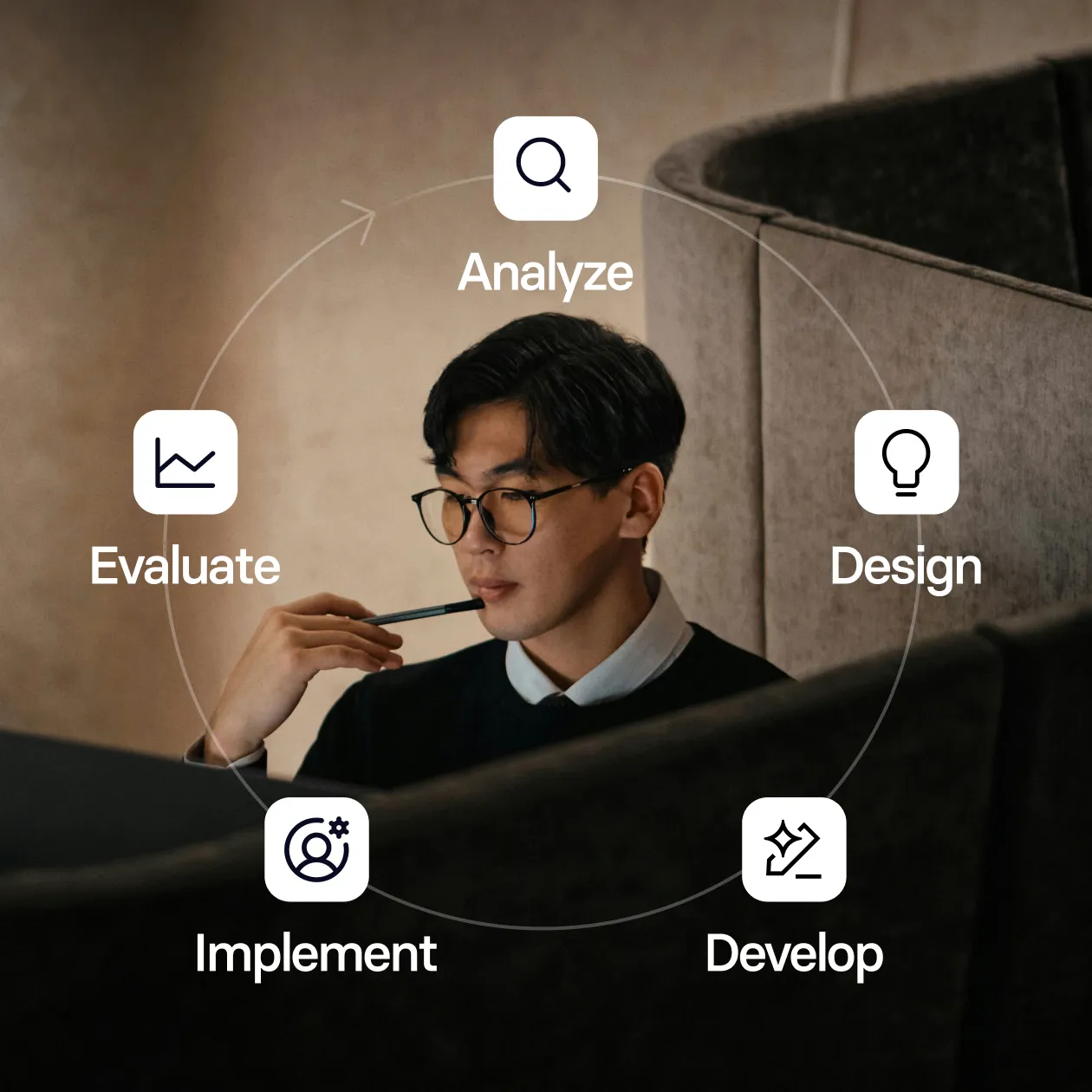
ADDIE, which stands for Analyze, Design, Develop, Implement, Evaluate, is a five-phase framework for creating learning experiences.
Like SCORM, ADDIE entered mainstream learning and development after being designed for a specific military need. In the 1970s, the US Armed Services needed new recruits to be able to operate sophisticated equipment.
The problem? The recruits had varying educational backgrounds, and their ad hoc training approach wasn’t effective. To address this widening capability gap, they partnered with Florida State University to develop a standardized training approach. The result was the Interservice Procedures for Instructional Systems Development, which had 19 steps grouped under 5 phases: Analyze, Design, Develop, Implementation, and Control.
Turns out, they were on to something. By the 1980s, instructional designers in the private sector, and eventually education, had adopted ADDIE. They ditched the unnecessarily complex steps, and adapted the five phases with one change. They decided to swap out Control for Evaluate (same meaning, just a little less, well, regimented).
Given ADDIE's age, and origins, you might be wondering if it's still relevant. The answer isn't as simple as you might think. I'll explain why, but first, let's dive into the five phases.
Analyze
The first phase of ADDIE is conducting a needs assessment.
Here's why that's so important. Let's say you've been asked by IT to redesign an orientation session. IT insists they need 45 more minutes with every new hire to cover how to use your company's tech stack. (Just what every new hire wants in their first week.)
In this phase, your job is to ask IT where they're seeing gaps in desired behavior, and what evidence supports that, such as:
- Are they fielding too many questions in a new hire messaging channel?
- Are new hires unable to request the tools needed for their roles?
- Are new hires responsible for an uptick in cybersecurity incidents?
In this phase, you're validating whether or not a training problem exists. If you skip this step, you risk creating something based on assumptions, which means you may struggle to demonstrate its value.
Design
Let's say IT comes back to you with data supporting their claims. New hire messages to IT support about the HRIS have increased 30% since last quarter, concentrated on two tasks: enrolling in benefits and setting up payroll direct deposit. After some investigating, you find out the HRIS's UI substantially changed since the IT orientation training was originally designed.
Your next task is to translate this into learning objectives that are specific, observable, and measurable. (This is also known as the ABCD method, Audience, Behavior, Condition, Degree, developed by Robert Mager in 1962.) For instance, you might write two objectives:
- After participating in the IT orientation session, new hires will be able to navigate the HRIS platform to elect their benefits within the first 30 days of employment, without IT support.
- After participating in the IT orientation session, new hires will be able to navigate the HRIS platform to set up their direct deposit by the end of their first week, without IT support.
Taken together, these objectives also identify two types of measurement data: an org-wide baseline (the volume of IT tickets, measured now and compared against after the training rolls out), and individual completion data (tracked by HR and Payroll teams).
In this phase of ADDIE, you’ll also identify the instructional strategy (how the training will be delivered) and content structure (how the content gets sequenced). In this case, you might decide to create an IT orientation eLearning course, with a brief training video showing how to navigate the HRIS.
Develop
Now it's time to build the training based on the blueprint you've designed, which is easier said than done.
In my experience, this phase is where scope creep becomes an issue. While you've technically outlined everything you're going to do, things will inevitably change. A stakeholder will ask for one more thing to be included. An SME will have feedback about your instructional design approach. A budget or staffing resource shifts.
To successfully develop any learning experience, you need to remain focused on the original capability gap you identified. Continuously ask yourself throughout this phase, "are we building the right training?"
In the case of this IT orientation, developing a five-minute training that shows two common workflows should be relatively straightforward. You'd need to work with SMEs to get updated screen recordings, and fact-check the final version. But this task could easily balloon with last-minute asks about other HRIS workflows that should be included, or tangential IT tasks for new hires related to onboarding.
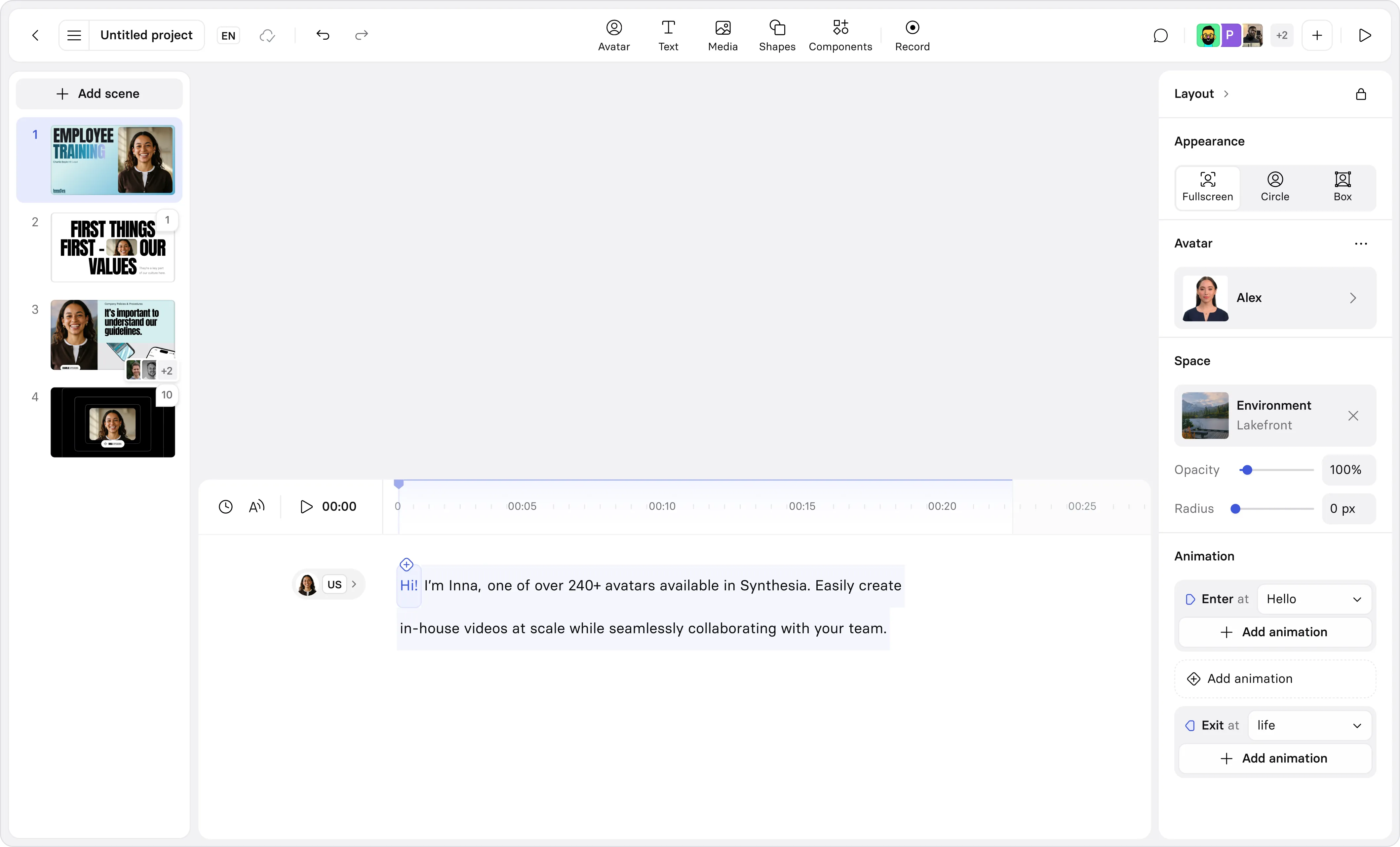
At Synthesia, it's our mission to help people work better. L&D practitioners often come to us because they’re looking for ways to develop content more effectively and efficiently. Learn more about how one of our customers, Criteo, used AI video to improve their onboarding training development.
Implement
The IT orientation training video is published and ready to embed in your eLearning course. In this phase, you need to make sure the implementation of the new video is sequenced as originally designed. (If you were designing a live training, this phase is also where you'd make sure your facilitators are ready.)
This is your time to be a marketer and bring awareness to the training. After all, you went to all this effort, you want to make sure it's actually watched.
That includes deciding where to host the video and how to announce it: an enrollment email with reminders from your LMS, pinning the video in an onboarding hub, or even a calendar invite that blocks time for new hires with a link included. It also means figuring out the optimal timing. For this training, that might mean two nudges: a notification after new hires attend a benefits session from HR, and a reminder before their benefits enrollment deadline.
A successful implementation ensures you'll have sufficient data to evaluate the quality of the training. There's nothing worse than designing an objectively great training that no one actually watches or completes.
Evaluate
The final phase of ADDIE is also the one that gets skipped, or compromised the most. (I’m also guilty of this.) There’s so much pressure for L&D practitioners to consistently churn out content that evaluation is often a lower priority, contributing to what I call the readiness debt.
The good news is that if you use ADDIE as a framework, you've already built the foundations for evaluating your training. For simple trainings, like this one, you can use the Kirkpatrick model for evaluation.
To do so, you start by determining a reasonable time frame, a month or even a quarter, after releasing the new training video. Then, you're going to collect the data from IT, HR, and Payroll.
You can complement this with feedback from new hires collected in onboarding surveys, that's your Level 1. Level 2 is whether new hires could actually enroll in benefits or set up direct deposit without escalating to IT, the same completion data you defined back in Design.
A drop in IT tickets overall is Level 3, evidence new hires are applying that skill unprompted, beyond just the two tasks you measured directly. To get to Level 4, translate that into what it's actually worth: fewer support tickets means fewer hours IT spends on password resets and walkthroughs, time and cost you can put a number on.
Measuring more complex training may require another measurement approach, like the Phillips ROI method.
How relevant is ADDIE?
ADDIE is still relevant, but whether it's relevant to you depends on how you like to work.
In the age of AI, there's a tendency to write off anything built for another era of workplace learning. I get it. But some things stick around despite their age (I'm looking at you, SCORM) because they still solve the problem they were built for. That's true of ADDIE too.
Critiques of ADDIE say that it is too rigid and too time-consuming. (It's even why Allen Interactions created the Successive Approximation Model, as a more agile alternative to creating learning experiences.)
If you're someone who likes the structure of a step-by-step procedure, then you might find ADDIE particularly beneficial. If, however, you're someone who prefers to work in a more iterative way, then you might find ADDIE unhelpful to you.
There are plenty of people who want to convince you either way: yes, you should use ADDIE, or no, ADDIE is irrelevant. They cite factors like complexity and timing to convince you. I say decide for yourself by asking: does it align with how you and your team approach learning design?
ADDIE and AI
While you mull over your approach to learning design, and how ADDIE does or doesn't fit into it, I'd recommend considering one other thing: the role of AI in learning design. (I know, I work at an AI company, I can't help it.)
In our 2026 AI in Learning & Development report, which was based on responses from over 400 L&D practitioners, we found that teams are primarily using AI to support the early phases of ADDIE.
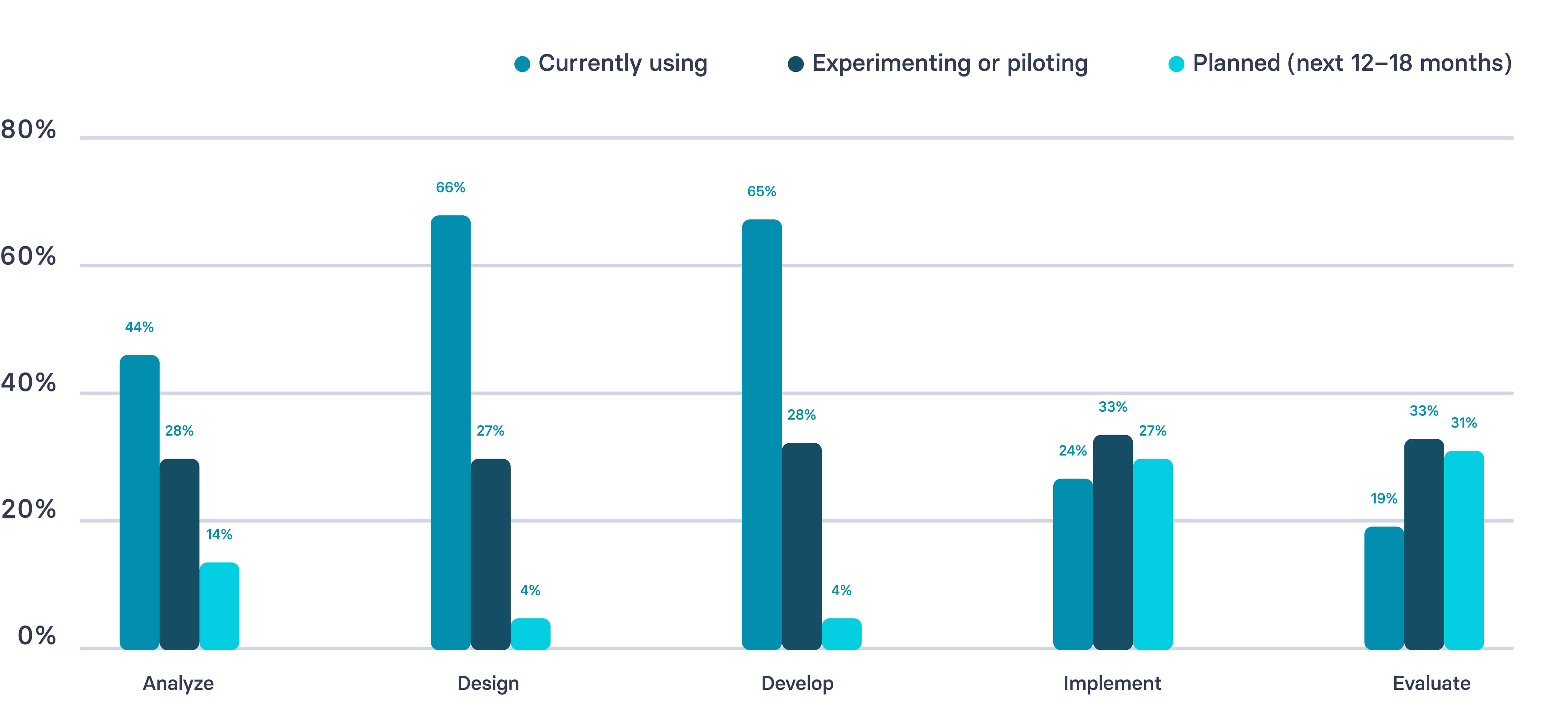
What that signals to me is a few things. First, because L&D practitioners spend most of their time in the Analyze, Design, and Develop phases of content creation, there's the greatest opportunity for AI to make these more efficient. Second, L&D generally isn't sure how to, or isn't comfortable, delegating more complex and strategic work, like measurement, to AI tools.
Whether or not you decide to use ADDIE, consider this something to reflect on. It may be a way for you to think through how you integrate AI into your tech stack and workflows, and why.
If you’re interested in learning more about how practitioners are (or aren’t) using ADDIE, consider joining our free community. You’ll find great conversation.
Amy Vidor, PhD, is the Learning and Development Evangelist at Synthesia, where she researches learning trends and helps organizations apply AI at scale. With 15 years of experience, she has advised companies, governments, and universities on skills.
Frequently asked questions
What does ADDIE stand for?
ADDIE is an acronym that stands for Analyze, Design, Develop, Implement, Evaluate. It is a five-phase framework for creating learning experiences. While originally conceived as a linear process, many practitioners now approach the phases of ADDIE iteratively.
Who developed the ADDIE model?
The US Army commissioned Florida State University's Center for Educational Technology to address a widening capability gap in service members by developing a standardized approach to training development.
The original model, Interservice Procedures for Instructional Systems Development, had 19 steps grouped under five phases. By the 1980s, practitioners had simplified the model to what we now know as ADDIE.
What are the advantages and disadvantages of the ADDIE model?
The truth is, the advantages and disadvantages are subjective. They depend on how literally someone adheres to ADDIE as originally designed, meaning a linear step-by-step process (designed for people who, let's face it, like to strictly follow instructions).
The real advantage of ADDIE is that it's a mnemonic device, meaning it's easy to remember. If someone comes to me with an idea or request about a learning experience, I can walk them through the scope of work quickly with ADDIE's framing. It's also a great way to remind stakeholders about the importance of evaluation, which is often skipped.
The disadvantage of using a framework like ADDIE, when followed linearly, is that it can be too slow. That's true, especially in corporate environments. Research has also supported this.
My recommendation: think of ADDIE as a tool in your L&D toolkit. It's not the only one, and it can serve a specific function.
ADDIE vs. SAM: what's the difference?
SAM, which stands for Successive Approximation Model, is another instructional design approach created by Allen Interactions. SAM is designed for agile e-learning development, and is inspired by agile software development. In SAM, there's a preparation phase followed by two successive iterative phases: design and development.
ADDIE emphasizes more analysis and design before creating anything. SAM recommends rapidly prototyping (again, much like software development) to gather feedback and continuously improve.
Neither is inherently better. My recommendation is to choose a framework that works with how your organization operates and/or your approach to learning design.